

Nigeria’s New Tax Regime: What You Need to Know (Finance Act 2025)
At Akinyele Oluwale & Co., we are committed to keeping our clients informed about the latest regulatory changes affecting businesses and individuals in Nigeria.
The Finance Act 2025 represents one of the most significant tax reforms in Nigeria in recent years. Signed into law to simplify the tax system, reduce multiple taxation, and improve ease of doing business, the Act introduces several key changes:
Major Highlights:
Company Income Tax (CIT) reduced to 25% for large companies (from 30%).
Tertiary Education Tax significantly reduced from 2% to 0.5%.
- Strengthened rules against multiple taxation across federal, state, and local governments.
- Expanded scope of Value Added Tax (VAT) on digital services and luxury goods.
- Higher exemption thresholds for Capital Gains Tax and Personal Income Tax.
- Mandatory digital compliance through the new Rev360 platform.
New Tax Portal – Rev360
The Federal Inland Revenue Service (FIRS) has launched Rev360 (www.rev360.gov.ng), a unified digital platform for all federal tax filings and payments. This new system makes tax compliance easier, faster, and more transparent.
Our Advisory
These reforms present both opportunities and compliance requirements for businesses. Early adaptation will help you avoid penalties and optimize your tax position.
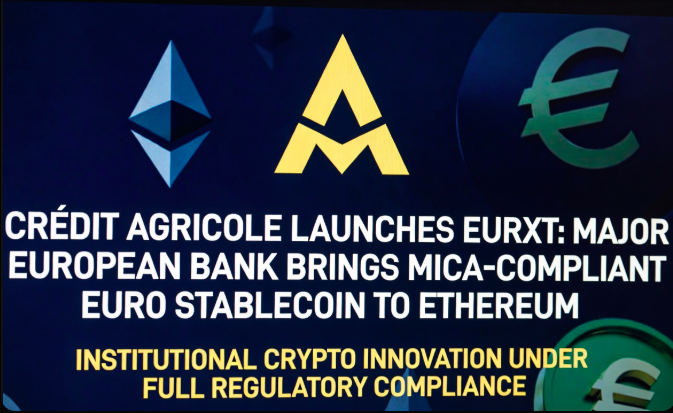
The launch of EURXT by Crédit Agricole marks a pivotal moment in the convergence of traditional European finance and blockchain technology. As the EU’s comprehensive MiCA framework took full effect, this development signals strong institutional confidence in regulated crypto innovation and sets a new benchmark for compliant stablecoins in Europe.
The Markets in Crypto-Assets (MiCA) regulation represents the world’s most ambitious attempt to create a unified regulatory framework for digital assets in a major economic bloc. One of its core pillars is the strict authorization and supervision of stablecoins (classified as Electronic Money Tokens EMTs or Asset-Referenced Tokens ARTs).
For a euro stablecoin to operate legally across the EU/EEA, the issuer must:
Circle’s USDC was among the first to secure full compliance. Now, traditional European banking giants like Crédit Agricole are entering the space with EURXT, bringing centuries of institutional credibility to the blockchain.
EURXT is a euro-pegged stablecoin issued on the Ethereum blockchain. Key features include:
Initial supply stands at approximately 20 million EURXT, with plans for expansion based on market demand.
For the Banking Sector Crédit Agricole’s move demonstrates that major European banks are not resisting crypto but actively embracing it within regulatory boundaries. By launching their own stablecoin, they can:
For the Crypto Ecosystem
For European Businesses and Citizens
While Tether (USDT) remains the most widely used stablecoin globally, it faces ongoing regulatory scrutiny in Europe. USDC has strong compliance credentials, but EURXT brings the weight of a major European banking institution and direct euro backing, potentially appealing to risk-averse European users and institutions.
The launch of EURXT is more than a single product release it represents the institutionalization of stablecoins in Europe. As more traditional financial players enter the space, we can expect:
For Nigeria and other emerging markets, this development is also relevant. European stablecoin innovation can improve remittance channels, trade finance, and access to euro liquidity for African businesses.
Conclusion Crédit Agricole’s EURXT launch on Ethereum under MiCA is a historic step that validates the maturation of the crypto industry. It bridges the gap between regulated finance and decentralized technology, promising greater stability, transparency, and innovation for the European (and global) financial system.