

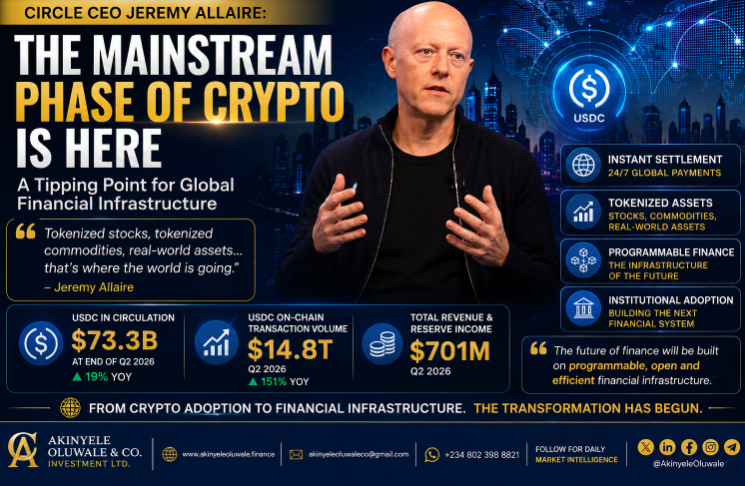
Crypto’s Mainstream Phase Is Here: Circle Says Finance Is Reaching a Tipping Point
Circle CEO Jeremy Allaire believes crypto is moving beyond its speculative phase and into the infrastructure of mainstream finance. With USDC transaction volumes accelerating, tokenized stocks and commodities gaining traction, and traditional institutions building on blockchain rails, the bigger story is no longer simply crypto adoption it is the gradual rewiring of financial markets.
Published: 24 August 2026
Category: Stablecoins • Tokenization • Financial Infrastructure • Market Intelligence
By: Akinyele Oluwale & Co. Investment Ltd.
Executive Summary
Circle has made a bold call:
The mainstream phase of crypto is here.
Jeremy Allaire argues that the market is crossing a tipping point where blockchain infrastructure is increasingly being used for traditional financial assets not merely cryptocurrency speculation.
There is data behind the argument.
Circle reported $73.3 billion of USDC in circulation at the end of Q2 2026, up 19% year-on-year. More strikingly, quarterly USDC on-chain transaction volume reached $14.8 trillion, up 151%. Circle's total revenue and reserve income reached $701 million. (Circle)
The transformation underway is increasingly about what moves through blockchain rather than the price of blockchain tokens themselves.
What Happened?
Allaire highlighted a remarkable change in digital markets: tokenized real-world assets including stocks and commodities have begun accounting for significant trading activity on crypto native platforms.
He cited Hyperliquid as an example, saying real-world assets recently represented close to 75% of perpetual-futures volume on the platform. (TBPN Digest)
Meanwhile, tokenized equities are expanding elsewhere. Platforms are increasingly offering blockchain-based exposure to traditional shares, while major financial institutions are developing their own tokenization infrastructure. (Investor's Business Daily)
That is an important change.
Crypto rails are beginning to carry traditional finance.
Background
For most of crypto's history, blockchain activity revolved around crypto itself:
Bitcoin → Altcoins → DeFi → NFTs → Speculation
The emerging model looks different:
Stablecoins → Payments → Tokenized Stocks → Bonds → Commodities → Collateral → Settlement
Stablecoins sit at the centre because markets need a digital unit of account and settlement asset.
USDC increasingly plays that role.
And Circle isn't stopping at stablecoins. Its Arc blockchain is scheduled for public mainnet launch on September 16, with more than 100 ecosystem and institutional builders already involved. Circle says Arc will support programmable finance, tokenized real-world assets and agent-based applications. (Circle)
Why It Matters
The biggest crypto breakthrough may eventually be that users stop thinking about “using crypto.”
Think about the internet.
People don't say they're “using TCP/IP” when sending an email.
Likewise, tomorrow's investor may buy a tokenized stock, receive a dividend, borrow against an asset or make an international payment without caring that blockchain infrastructure sits underneath the transaction.
That is what mainstream adoption looks like: the technology becomes infrastructure rather than the product.
Winners & Losers / Key Stakeholders
Stablecoin issuers, blockchain infrastructure providers, custodians, tokenization platforms and regulated exchanges could benefit enormously.
Traditional financial institutions also stand to gain if blockchain reduces settlement times, expands trading hours and improves collateral mobility.
But some existing intermediaries could face pressure if technology removes unnecessary layers from transactions.
The winners won't necessarily be the companies shouting “crypto” the loudest.
They may be those quietly making financial markets work better.
Short-Term Impact
Investors should avoid assuming mainstream blockchain adoption means every crypto asset rises.
Circle itself illustrates the distinction: Q2 revenue grew 7%, but still missed market expectations, while lower reserve yields created another consideration for its economics. (Reuters)
Technology adoption and investment returns are not the same thing.
That distinction remains essential.
Long-Term Impact
The endgame could be a global market where stocks, bonds, funds, commodities, currencies and private assets increasingly operate on programmable financial infrastructure.
That could enable:
24/7 Markets + Fractional Ownership + Faster Settlement + Global Distribution + Programmable Assets
And eventually, AI agents may transact across those same rails automatically.
At that point, blockchain becomes less of an alternative financial system and more of an upgrade to the existing one.
Editorial Perspective
The phrase “mainstream crypto” can be misleading.
The future may not involve everyone owning dozens of cryptocurrencies.
Instead, it may involve billions of people using financial products powered by blockchain without thinking about the underlying technology.
That is a far more significant proposition.
What to Watch Next
Watch USDC circulation and transaction volume, tokenized securities activity, Arc's September launch, institutional participation and regulatory treatment of tokenized assets.
Most importantly, watch whether real economic activity continues replacing speculation as blockchain's dominant growth engine.
Investing Lesson
Don't confuse adoption of the technology with guaranteed appreciation of the token.
Identify where value is actually captured.
Infrastructure can transform an industry while investment returns accrue very unevenly.
Key Takeaways
The transition is becoming clearer:
Crypto Speculation → Stablecoins → Tokenization → Financial Infrastructure → Mainstream Adoption
Crypto's next trillion-dollar opportunity may not come from creating more speculative assets.
It may come from putting existing global assets onto better rails.
Editorial Bottom Line
The real tipping point arrives when blockchain stops being the headline.
When people trade stocks, move dollars, settle assets and deploy capital on-chain without thinking about “crypto,” mainstream adoption will have truly arrived.
And judging by the infrastructure now being built, that transition is no longer theoretical.
Notes
Primary references include Circle's Q2 2026 results and SEC filings, Jeremy Allaire's recent comments on tokenized markets, and current reporting on institutional tokenization. (Circle)
Akinyele Oluwale & Co. Investment Ltd.
Where Global Finance Meets Tomorrow's Technology.