

Weekly Crypto & Digital Finance Intelligence | Week Ended Saturday, 14 November 2026
Published: Sunday, 15 November 2026
Reporting period: 8–14 November 2026
Category: Weekly Crypto Recap
By: Akinyele Oluwale & Co. Investment Ltd.
The cryptocurrency market delivered a striking contradiction during the week ended 14 November 2026. While Bitcoin and other major digital assets experienced substantial price declines, some of the world's most established financial institutions continued expanding their involvement in blockchain infrastructure, stablecoin payments and tokenized securities. Bitcoin fell below $70,000, exchange-traded funds experienced significant withdrawals, and investors became increasingly concerned about inflation, interest rates and financial-market valuations.
Yet the same week produced important announcements from DTCC, Visa, PNC Bank, Coinbase, Deutsche Bank and Ant Digital Technologies.The contrast deserves careful attention Cryptocurrency prices were weakening at the same time that institutional digital-finance infrastructure was advancing. That is the defining story of the week. For investors, financial institutions and policymakers, the question is whether these developments represent conflicting signals or simply different stages of a broader financial transformation. Our assessment is that the two trends can coexist. A technology can become more useful while financial markets reduce the prices they are willing to pay for assets associated with it. Understanding that distinction is essential to interpreting the current digital-finance landscape.
Executive Summary
A Week of Market Stress and Institutional Progress
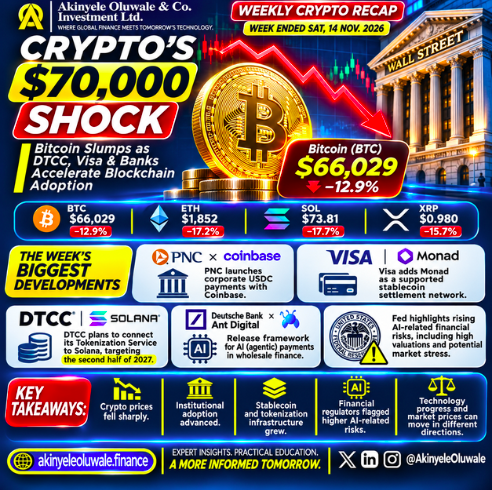
The week ended Saturday, 14 November 2026, was defined by five major developments. First, Bitcoin experienced a sharp market correction. The cryptocurrency fell from approximately $75,776 at the beginning of the reporting period to around $66,029 by Saturday afternoon, a decline of approximately 12.9%. Ethereum, Solana and XRP also recorded substantial losses. Second, institutional investment flows weakened. U.S. spot Bitcoin exchange-traded funds experienced significant withdrawals, indicating reduced demand through one of the industry's most important regulated investment channels. Third, stablecoin payment infrastructure advanced. PNC Bank and Coinbase announced a corporate USDC payment service, while Visa expanded its stablecoin settlement options by adding the Monad blockchain. Fourth, real-world asset tokenization recorded an important development. DTCC announced plans to connect its Tokenization Service to Solana, with eligible tokenized securities expected to become available through that integration in the second half of 2027. Fifth, financial stability and artificial intelligence became increasingly connected. Deutsche Bank and Ant Digital Technologies released a framework for agentic payments, while the U.S. Federal Reserve highlighted rising concerns about AI-related financial risks.
Taken together, these developments suggest that the cryptocurrency market is experiencing a test of valuation, liquidity and investor confidence while the underlying financial infrastructure continues to evolve. The central lesson is that institutional participation does not eliminate market volatility. A growing financial technology industry can still experience significant declines in the market value of its associated assets.
Why This Matters
Institutional Adoption Does Not Guarantee Higher Crypto Prices
For several years, investors have associated institutional cryptocurrency adoption with the expectation of rising digital-asset prices. The argument is understandable. If major banks, payment networks and securities infrastructure providers increasingly use blockchain technology, demand for related services may expand. However, the relationship between technological adoption and investment returns is not automatic. Consider DTCC's announcement involving Solana. The planned integration represents a significant development for blockchain-based securities infrastructure but it does not establish how much demand for Solana's native cryptocurrency will result from the service. Similarly, Visa's adoption of an additional stablecoin settlement network demonstrates infrastructure expansion. It does not guarantee that the market price of the network's associated token will appreciate.
Investors must distinguish between three different developments:
1. A financial institution adopting blockchain technology.
2. The technology generating measurable commercial activity.
3. That commercial activity creating economic value for a particular investment asset.
These stages are related, but they are not interchangeable. The week's market declines provide a practical reminder that broader financial conditions, liquidity and investor expectations continue to influence cryptocurrency valuations.
What Happened?
The Seven Stories That Defined the Week
This suggests that the weakness was not confined to Bitcoin. The broader digital-asset market experienced a reduction in risk appetite. Several developments contributed to the difficult environment. U.S. inflation data raised concerns about the future path of monetary policy. Government bond yields increased. Financial-market participants reassessed the outlook for interest rates and highly valued technology-related assets. However, no single event can be established as the sole cause of the cryptocurrency decline. Markets reflect multiple forces operating simultaneously. The important point is that cryptocurrency prices remain sensitive to global financial conditions.
Market implication: Digital assets may have distinct technological characteristics, but their prices are still influenced by liquidity, interest rates and changes in investor confidence.
Another important development involved regulated cryptocurrency investment products. Reporting published on 14 November indicated that U.S. spot Bitcoin ETFs had experienced approximately $1.91 billion in cumulative withdrawals over seven consecutive trading days. Separate reporting placed weekly withdrawals across major cryptocurrency ETF categories at approximately $1.53 billion. These figures describe different measurement periods and product groups and should not be treated as interchangeable. The significance is the direction of investment flows. ETF outflows can indicate that investors are reducing exposure through regulated investment vehicles. However, they do not necessarily establish that all institutional investors are abandoning cryptocurrency. Some institutions may rebalance portfolios, manage liquidity requirements or change exposure for reasons unrelated to their long-term assessment of blockchain technology. ETF activity also does not capture every institutional holding or transaction. Nevertheless, sustained withdrawals can contribute to market pressure.
Market implication: Institutional investment flows remain an important indicator of cryptocurrency demand, particularly during periods of financial-market uncertainty.
On 9 November, PNC Bank announced a new incoming USDC payment service for eligible corporate and institutional banking clients. The service is powered by Coinbase payment products. It allows participating businesses to receive USDC on Ethereum, with the funds converted into U.S. dollars and deposited into designated PNC bank accounts. The initial offering is limited in scope. Nevertheless, the announcement represents an important step toward connecting stablecoin payments with conventional corporate banking. For businesses, the practical objective is not simply to receive a digital token. It is to receive usable money efficiently. A stablecoin transfer may be completed quickly on a blockchain but the recipient must still be able to access, convert or redeem the value. PNC's arrangement addresses that connection.
Market implication: Stablecoin adoption is increasingly focused on practical banking services rather than cryptocurrency trading alone.
On 10 November, the Monad Foundation announced that Visa had added Monad as a supported blockchain settlement option. The arrangement allows eligible participating Visa issuers and acquirers to settle certain obligations using stablecoins on the network. This development expands the blockchain infrastructure available within Visa's settlement programme. However, it does not mean that every Visa transaction now operates on Monad. Nor does it mean that consumers automatically use stablecoins whenever they make card payments. The programme concerns participating financial institutions and their eligible settlement arrangements. The broader significance is that established payment networks are examining multiple blockchain systems for financial operations. This introduces competition among networks based on technical performance, reliability, compliance capabilities and institutional integration. Market implication: Blockchain networks are increasingly being evaluated as potential components of global payment infrastructure.
On 12 November, DTCC announced plans to connect its Tokenization Service to Solana. The integration is expected to make tokenized representations of eligible DTC-custodied securities available on Solana in the second half of 2027. DTCC's Tokenization Service itself launched on 28 October 2026. The distinction is important. The service is operational, but the Solana integration remains a planned future development. DTCC plays a central role in traditional securities-market infrastructure. Its involvement demonstrates that tokenization is increasingly being examined within established systems for custody, clearing and settlement. Potential applications include improved collateral mobility, operational efficiency and the ability to connect conventional financial assets with approved blockchain networks. However, tokenization does not eliminate the underlying risks of securities.
A tokenized bond remains exposed to the financial condition of its issuer. A tokenized investment fund remains exposed to its underlying portfolio and a digital representation does not automatically guarantee liquidity. Market implication: Institutional tokenization is progressing from conceptual discussion toward financial infrastructure development, but its eventual economic impact depends on implementation.
On 9 November, Deutsche Bank and Ant Digital Technologies jointly released a white paper titled Agentic Payments in Wholesale Finance. The publication examines how artificial intelligence agents could support treasury management, cross-border payments and trade finance. The central issue is governance. An AI agent may be capable of analysing financial information and recommending transactions but that does not automatically mean it should have unrestricted authority to execute those transactions. The proposed framework emphasises defined permissions, identity verification, accountability and auditable processes. For example, an AI agent might identify an opportunity to improve corporate liquidity management. However, the institution must still determine whether the proposed transaction complies with approved financial policies.
Blockchain-based settlement could become relevant in some applications but the paper does not establish that all AI-enabled financial operations require blockchain. Market implication: The convergence of AI and financial technology is creating demand for stronger controls over automated financial decisions.
On 13 November, the U.S. Federal Reserve's latest Financial Stability Report highlighted growing concerns about risks associated with artificial intelligence. According to the report's survey findings, 87% of financial-system contacts identified AI-related risks as a concern, compared with 50% in May. The concerns included high valuations, complex financing arrangements, cybersecurity and the possibility that disappointing AI-related earnings could contribute to broader market stress. This development matters to cryptocurrency markets because digital assets can be affected by shifts in broader financial-market sentiment. If investors become more cautious about highly valued technology-related investments, that caution may extend to other volatile assets. However, the Federal Reserve's findings do not establish that an AI-related market correction is inevitable. They identify vulnerabilities requiring attention. Market implication: Cryptocurrency investors cannot assess digital-asset markets in isolation from global financial conditions.
The week's events reveal two distinct but connected processes. The first is a market adjustment. Cryptocurrency prices declined as investors reassessed risk, liquidity and macroeconomic conditions. The second is institutional infrastructure development.Banks, payment networks and securities infrastructure providers continued working on blockchain-based financial services. These developments can occur at the same time because market prices and technological adoption operate through different mechanisms. Market prices respond to supply, demand, expectations and financing conditions. Institutional infrastructure projects often develop over longer periods. A bank may continue building a digital payment service even while cryptocurrency prices decline. A securities depository may pursue tokenization because it expects operational benefits over several years.
A payment network may add blockchain settlement options because they offer useful capabilities for participating institutions. These decisions do not necessarily depend on short-term cryptocurrency market performance. The critical distinction is between financial-market sentiment and financial infrastructure investment. Investors should understand both.
Nigeria's new stablecoin regulatory framework provides important context for the week's international developments. The Central Bank of Nigeria introduced licensing requirements for stablecoin issuers under regulations issued on 5 November 2026. The framework distinguishes between naira-referenced and foreign-currency-referenced stablecoins. The minimum paid-up capital requirements are ₦10 billion and ₦15 billion respectively. Although the regulations were issued during the preceding week, their implications remained highly relevant during 8–14 November as businesses and market participants assessed the new requirements. The framework reflects a broader international trend toward greater oversight of digital payment infrastructure.
For Nigerian businesses, potential stablecoin applications include eligible cross-border payments, international commerce and digital financial services. However, regulatory clarity does not automatically resolve every payment problem. Businesses still require access to liquidity, reliable conversion arrangements and enforceable settlement procedures. A digital token may move quickly between wallets while the associated fiat-currency transaction remains incomplete. This creates an important question. Who bears responsibility when one component of a transaction succeeds and the other fails? The answer depends on the legal and contractual arrangements governing the transaction. For Nigeria, successful stablecoin adoption will require more than licensing. It will require practical coordination between banks, payment service providers, regulators and customers.
Our assessment is that Nigeria's long-term opportunity lies in developing reliable digital payment infrastructure that supports legitimate commercial activity without compromising financial stability.
At Akinyele Oluwale & Co. Investment Ltd., we believe the week ended 14 November 2026 offers an important lesson about the evolution of digital finance. The cryptocurrency industry is no longer defined solely by speculative trading. It is increasingly connected to banking, payment infrastructure, securities markets and institutional technology. However, investors must avoid assuming that every institutional announcement guarantees positive investment returns.
The DTCC–Solana announcement is a meaningful infrastructure development but its eventual commercial value will depend on implementation and actual institutional use. Visa's addition of Monad demonstrates growing interest in blockchain settlement but it does not automatically establish the investment value of Monad's associated cryptocurrency. PNC's partnership with Coinbase demonstrates practical stablecoin banking integration but it does not prove that stablecoins will replace conventional payment systems. Similarly, AI developments may improve financial operations without eliminating the need for human accountability. We believe five principles should guide the interpretation of this week's developments.
First, separate market prices from technological progress. A declining cryptocurrency market does not automatically mean blockchain adoption has stopped. Second, distinguish announcements from commercial deployment. Plans, pilots and operational services represent different stages of adoption. Third, examine the economic connection between infrastructure and investment value. Institutional use of a blockchain does not guarantee higher prices for its native token. Fourth, assess financial risk independently. Market volatility, liquidity and valuation remain important regardless of technological developments. Fifth, prioritise verifiable outcomes. Transaction volumes, operating efficiency, financial controls and customer benefits provide stronger evidence of progress than promotional claims. Our institutional conclusion is that the digital-finance industry is becoming more mature, but maturity does not eliminate uncertainty. It increases the importance of careful analysis.
Several developments deserve attention in the coming week. Bitcoin and broader market stability: Monitor whether volatility continues and how market liquidity evolves. Cryptocurrency ETF flows: Watch whether institutional withdrawals persist or begin to moderate. U.S. monetary policy: The Federal Reserve's October meeting minutes are scheduled for release on 18 November.
Inflation and bond yields: Follow developments affecting interest-rate expectations and global financial conditions. PNC and Coinbase: Look for additional information about the corporate USDC service and its initial commercial scope. Visa's settlement programme: Monitor participation and the practical use of supported blockchain networks. DTCC tokenization: Watch for further technical and institutional details concerning the planned Solana integration. AI governance: Assess whether institutional frameworks progress toward practical deployment. Nigeria's stablecoin framework: Follow regulatory clarifications and their implications for compliant financial service providers. These developments should be assessed as indicators of financial conditions and institutional progress, not as guarantees of future market performance.
- Bitcoin fell approximately 12.9% over the selected 8–14 November reporting window.
- Ethereum, Solana and XRP experienced even larger percentage declines.
- Cryptocurrency ETF withdrawals reflected weaker demand through important regulated investment channels.
- PNC and Coinbase announced a corporate USDC payment service on 9 November.
- Visa added Monad as a supported stablecoin settlement network on 10 November.
- DTCC announced plans on 12 November to connect its Tokenization Service with Solana in the second half of 2027.
- Deutsche Bank and Ant Digital Technologies released an institutional AI payments framework.
- The Federal Reserve highlighted growing AI-related financial stability concerns.
- Nigeria's new stablecoin rules continued to shape discussions about regulated digital payments.
- Institutional blockchain adoption and cryptocurrency market performance can move in different directions.
Akinyele Oluwale & Co. Investment Ltd. is an institutional financial intelligence platform focused on global financial markets, macroeconomics, central banking, institutional cryptocurrency, stablecoins, digital payments, tokenization, real-world assets, artificial intelligence and blockchain technology. Our editorial mission is to explain important financial developments through evidence-based analysis, practical financial education and an institutional perspective. We examine how emerging technologies, financial institutions and regulatory frameworks interact to shape the future of global finance.
The week ended 14 November 2026 demonstrated that digital finance is entering a more complex stage. Bitcoin and major cryptocurrencies experienced significant declines. Institutional investment flows weakened. Inflation and interest-rate concerns increased pressure on financial markets. Yet banks and payment networks continued expanding stablecoin services.
DTCC advanced its tokenization strategy and financial institutions examined how artificial intelligence could operate within controlled payment systems. These developments do not cancel one another. They demonstrate that technological progress and investment-market performance must be evaluated separately. For financial institutions, the opportunity lies in developing useful, reliable and compliant infrastructure. For businesses, the objective is improving payment efficiency and financial operations. For policymakers, the challenge is balancing innovation with financial stability. For investors, the lesson is to distinguish underlying economic value from market enthusiasm.
The defining lesson of the week is that blockchain adoption can advance even when cryptocurrency prices decline. The long-term significance of that adoption will depend on commercial usefulness, legal certainty and measurable financial outcomes.
Observe the change. Understand the implications. Position with discipline.
Akinyele Oluwale & Co. Investment Ltd.
Where Global Finance Meets Tomorrow's Technology.
Website: www.akinyeleoluwale.finance
Editorial disclaimer: This publication provides general financial education and institutional market analysis. It does not constitute personalised investment advice or a recommendation to buy or sell any financial instrument.