

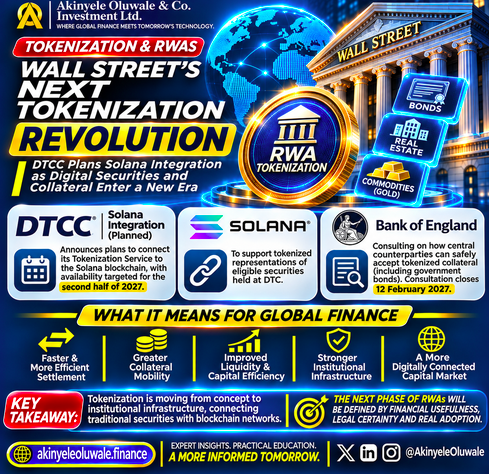
The next phase of blockchain adoption is unfolding inside the infrastructure of traditional finance. As securities depositories, banks and central banks examine tokenized assets, the competition is shifting from issuing digital tokens to improving how financial assets are owned, transferred, financed and settled.
Published: Friday, 13 November 2026
Category: Tokenization & Real-World Assets (RWAs)
By: Akinyele Oluwale & Co. Investment Ltd.
Editorial focus: Institutional Tokenization | Securities Markets | Digital Collateral | Banking | Capital Markets
For years, the cryptocurrency industry promoted tokenization as a technology capable of transforming global finance. The argument was straightforward: conventional financial assets could be represented digitally, transferred more efficiently and potentially made accessible to a wider range of investors.
However, financial markets do not change simply because a new technology becomes available. They change when institutions can demonstrate that the technology improves an existing financial process without weakening legal protections, liquidity management or operational security. That distinction is becoming increasingly important. Recent developments involving the Depository Trust & Clearing Corporation (DTCC), central-bank discussions about tokenized collateral and commercial-bank initiatives demonstrate that tokenization is moving into a more demanding institutional phase.
The focus is shifting away from whether a bond, security or fund can be represented as a blockchain token. The more important question is whether that representation can function within regulated financial markets. Can a tokenized bond be transferred between approved institutions? Can it be used as collateral? Can its ownership be legally enforced? Can the underlying asset be redeemed or sold when necessary? And can tokenization reduce settlement costs or improve access to liquidity?
Our central assessment is that the next stage of real-world asset tokenization will be determined by financial usefulness, legal certainty and institutional adoption not the number of tokens created.
DTCC's Latest Announcement Changes the Conversation
The most important new development came on 12 November 2026, when DTCC announced plans to connect its Tokenization Service to the Solana blockchain. According to DTCC, tokenized representations of eligible securities held through its subsidiary, the Depository Trust Company (DTC), are expected to become available on Solana in the second half of 2027. DTCC
This announcement follows DTCC's launch of its Tokenization Service on 28 October 2026, creating infrastructure for tokenized representations of eligible securities held within the traditional financial system.
The distinction is essential: DTCC's Tokenization Service is live, but the announced Solana integration is planned for 2027. It would be inaccurate to describe DTC-tokenized securities as already available through this integration. Meanwhile, the Bank of England is consulting on how central counterparties could safely accept tokenized forms of eligible collateral, including government bonds. The consultation closes on 12 February 2027. the UK's central bank
Together, these developments highlight three structural shifts in global finance:
Traditional securities are moving toward digital representations that can operate within regulated financial-market infrastructure.
Collateral mobility is becoming a major institutional objective, potentially allowing eligible assets to be transferred and deployed more efficiently.
Interoperability is emerging as a strategic priority, with institutions seeking to connect traditional systems and multiple blockchain networks.
The implications extend beyond cryptocurrency markets. They concern the future of securities ownership, institutional financing, settlement, liquidity management and the architecture of global capital markets.
Why This Matters: Understanding the Real-World Asset Revolution
Tokenization is the process of representing an asset or financial claim digitally, often using blockchain or distributed ledger technology. The underlying asset may be a government bond, corporate bond, investment fund, property interest or another financial instrument. However, not all tokenized assets are structured in the same way. Some tokens represent existing securities held by a regulated custodian or depository. Others are issued directly in digital form. Some represent contractual claims rather than direct ownership of an underlying asset. These differences are fundamental. Consider a government bond worth $1 million. Under a conventional arrangement, the bond may be held through established securities custody and settlement infrastructure.
A tokenization arrangement could create a digital representation of that bond, allowing eligible market participants to transfer or use it through approved digital systems. The potential benefits include faster asset mobilisation, reduced reconciliation requirements and improved operational efficiency but the technology does not change the government's underlying obligation to repay the bond. It does not eliminate interest-rate risk. It does not guarantee that the token can be sold immediately and it does not automatically establish that the token holder has the same legal rights as a conventional securities investor. Those rights depend on the applicable legal and custody arrangements.
The institutional value of tokenization lies in improving how financial assets are administered and transferred not in magically improving the quality of the assets themselves.
The November 12 announcement represents an important development in DTCC's digital-asset strategy. DTCC intends to make tokenized representations of eligible DTC-custodied securities available through Solana, with the integration targeted for the second half of 2027. The stated objective is to connect traditional securities infrastructure with additional blockchain networks. This matters because DTCC is not a newly established cryptocurrency project. It is a major provider of post-trade infrastructure supporting established financial markets. Its involvement connects tokenization with existing systems for securities custody, clearing, settlement and asset servicing. According to DTCC, its subsidiaries processed approximately $4.7 quadrillion in securities transactions during 2025, while DTC provided custody and asset servicing for securities issues valued at approximately $114 trillion.
These figures demonstrate the scale of DTCC's conventional financial-market operations. However, they should not be misinterpreted as the value of securities already tokenized. The announced Solana integration is also not evidence that trillions of dollars of securities will immediately move onto that network. Its eventual commercial significance will depend on eligible assets, participating institutions, operational readiness and actual transaction activity. Our assessment: DTCC's announcement is a meaningful institutional infrastructure commitment, but its financial impact must be measured through implementation and adoption.
On October 28, DTCC announced the launch of its Tokenization Service. The service enables tokenized representations of eligible securities held through DTC. Its intended benefits include greater collateral mobility, access to liquidity and capital efficiency. To understand why this matters, consider the operational complexity of conventional securities markets. Financial assets may be held by custodians, transferred through settlement systems and used to satisfy collateral obligations. Different institutions must maintain accurate records of ownership and financial obligations. Tokenization may allow certain processes to become more automated. For example, an institution holding eligible securities could potentially mobilise those assets more efficiently within an approved digital arrangement. However, tokenization must remain connected to reliable ownership records and enforceable legal rights. The token cannot simply exist independently of the obligations associated with the underlying security.
A critical feature of DTCC's approach is its emphasis on preserving traditional investor protections while introducing new technology. This is fundamentally different from creating a speculative cryptocurrency with no identifiable financial claim. Our assessment: The most credible tokenization models will integrate digital efficiency with established securities-market safeguards.
On October 29, the Bank of England launched a consultation addressing the acceptance of tokenized collateral by central counterparties. A central counterparty, or CCP, is a financial-market institution that helps manage the risks arising between parties to cleared transactions. CCPs require collateral to protect against potential losses if a participant fails to meet its obligations. Government bonds and certain other financial assets can serve as eligible collateral under applicable rules. Tokenization could potentially make these assets easier to transfer and mobilise.
However, the Bank of England has made an important distinction. An asset does not automatically become acceptable collateral simply because it has been tokenized. The institution must still establish that the asset can be valued, transferred and realised when necessary. This is particularly important during periods of financial stress. Imagine a clearing member that must provide additional collateral following a sudden market movement.
A tokenized government bond might be transferred quickly through a digital system but the CCP must also be confident that it can access and realise the value of that bond if the member defaults. If the token cannot be converted, sold or legally enforced when needed, faster transfer technology provides limited protection.
The consultation therefore focuses on liquidity, valuation, interoperability, settlement finality, operational resilience and custody. Our assessment: The Bank of England is approaching tokenization as a financial-risk management issue, not merely a technological innovation.
One of the most promising applications of tokenization concerns collateral mobility. Collateral mobility refers to the ability to move eligible financial assets between institutions or accounts when they are needed to support financial obligations. This is particularly relevant to banks, securities dealers, asset managers and clearing participants. Consider a hypothetical financial institution holding $100 million in eligible government securities. The institution may need to provide $20 million in collateral to satisfy a margin requirement. Under existing arrangements, mobilising that collateral may involve operational processes across custodians, settlement systems and counterparties.
A properly designed tokenization system could potentially simplify some of these processes but several conditions must be satisfied. The recipient must recognise the asset. The transfer must be legally effective. The asset must remain appropriately valued. The institution must be able to recover or realise the collateral when required and the system must operate reliably during market stress.
The benefits are therefore conditional rather than automatic. A tokenized asset that cannot be accepted by a counterparty may offer little improvement in collateral mobility. Our assessment: Tokenization's most valuable institutional application may be improving the usability of existing high-quality financial assets.
DTCC's planned Solana integration highlights another important challenge. Financial institutions do not necessarily want all tokenized assets to operate on a single blockchain network. Different networks may offer different technical capabilities, governance structures and operational characteristics. An institutional infrastructure provider may therefore seek to support several networks while maintaining consistent controls. This creates the need for interoperability. Interoperability means that different systems can exchange information or assets through reliable arrangements. However, connecting blockchain networks introduces additional risks.
These may include inconsistent ownership records, operational dependencies, cybersecurity vulnerabilities and uncertainty about settlement finality. For example, an institution might hold a tokenized security on one network and seek to use it within an arrangement operating on another. The systems must establish that the asset remains valid and that ownership is not duplicated or disputed. A technical bridge alone may not be sufficient. Legal rights, custody responsibilities and operational controls must also be coordinated. Our assessment: Multi-chain access could improve institutional flexibility, but interoperability must be supported by enforceable financial and legal arrangements.
The emerging real-world asset market is increasingly shaped by established financial institutions. Securities depositories are developing tokenization services. Banks are examining tokenized deposits and digital-asset custody. Asset managers are exploring tokenized investment products. Central banks and financial regulators are examining how these arrangements interact with existing financial systems. The common objective is not necessarily to replace conventional finance. It is to improve how conventional financial assets operate. This is an important distinction.
A tokenized government bond remains a government bond. A tokenized investment fund remains subject to the investment risks of its underlying portfolio. A tokenized property interest remains dependent on the legal rights and economics associated with the property. The blockchain may change how the claim is represented or transferred. It does not automatically change the economic substance of the claim.
The most important institutional opportunities may therefore involve reducing operational friction, improving collateral management and connecting different financial systems. However, the scale of future adoption remains uncertain. Technology must compete with established systems that already process substantial financial volumes. The relevant question is whether tokenization provides enough additional value to justify implementation costs and operational changes.
Institutions such as DTCC may develop new services connecting traditional securities with digital networks. Their advantage lies in combining established market infrastructure with new technological capabilities.
For Nigeria, potential applications include government securities, investment funds and selected capital-market instruments. However, successful implementation would require clear regulation, reliable custody arrangements, market liquidity and legally enforceable ownership rights. Tokenization alone cannot solve structural problems such as weak market depth or limited investor confidence.
At Akinyele Oluwale & Co. Investment Ltd., we believe the latest developments demonstrate that real-world asset tokenization is entering a more serious institutional phase. The most important announcements increasingly concern financial infrastructure rather than speculative token launches. This distinction should influence how investors interpret the market. A company announcing the tokenization of a property does not automatically create a liquid investment. A blockchain project claiming exposure to real-world assets does not necessarily provide enforceable ownership of those assets and a major financial institution integrating a blockchain does not automatically guarantee that the network's cryptocurrency will appreciate.
These are separate economic relationships. The DTCC announcement is important because it connects a recognised financial-market infrastructure provider with an established blockchain ecosystem but the announced integration remains a future development. The Bank of England's consultation is important because it addresses the legal and operational requirements for using tokenized collateral but the consultation is not unrestricted approval for all tokenized assets. These distinctions matter because institutional credibility depends on accurate interpretation. We believe five principles should guide the assessment of real-world asset tokenization.
First, establish the underlying asset. Investors must understand what financial claim the token represents. Second, verify ownership rights. The legal relationship between the token and the underlying asset must be clear. Third, assess liquidity. A digital token is not automatically easy to sell. Fourth, evaluate custody and settlement. Financial institutions must establish reliable control and transfer arrangements. Fifth, demand measurable commercial benefits. Tokenization should improve efficiency, access or risk management in ways that can be demonstrated. These principles distinguish serious financial innovation from technological marketing.
Our institutional assessment is that the next phase of tokenization will be led by systems that preserve the economic and legal integrity of traditional assets while improving the efficiency of financial-market operations.
Several developments deserve close attention.
DTCC's Solana integration: Monitor technical progress and whether the planned second-half 2027 launch remains on schedule. Eligible securities: Watch which categories of DTC-custodied assets become available through supported blockchain networks. Institutional participation: Look for evidence of actual usage by banks, custodians, brokers and asset managers. Collateral applications: Assess whether tokenized securities become usable in more financing and clearing arrangements. Bank of England consultation: Monitor industry responses before the February 12, 2027 deadline. Interoperability: Examine whether financial institutions can transfer or use tokenized assets across different systems without weakening ownership protections. Settlement arrangements: Watch how tokenized securities transactions connect with reliable cash settlement. Regulatory clarity: Monitor developments concerning custody, settlement finality and investor protection. Commercial economics: Look for measurable reductions in operating costs, improved collateral mobility and increased market efficiency. These indicators will provide a more reliable measure of tokenization's progress than speculative market-price movements.
Akinyele Oluwale & Co. Investment Ltd. is an institutional financial intelligence platform focused on global macroeconomics, central banking, institutional cryptocurrency, stablecoins, digital payments, tokenization, real-world assets, artificial intelligence and blockchain technology. Our editorial mission is to explain consequential financial developments through evidence-based research, practical financial education and an institutional perspective.
We examine what has changed, why it matters and how investors, businesses and policymakers can better understand the implications.
The November 12 announcement from DTCC represents an important development in the institutional tokenization market. It demonstrates that established securities infrastructure providers are continuing to build connections between traditional finance and blockchain networks. The planned Solana integration could eventually expand the options available to institutions seeking to access or use tokenized securities. Meanwhile, the Bank of England's work on tokenized collateral demonstrates that financial regulators are examining how these assets can operate within existing safeguards. Together, these developments reveal a broader transformation. The financial industry is moving beyond asking whether assets can be tokenized.
It is beginning to ask whether tokenized assets can be trusted, transferred, financed and settled within established financial systems. That is the real institutional challenge. For banks, the priority is operational efficiency without sacrificing financial stability.
For asset managers, it is preserving investor rights while exploring new infrastructure. For regulators, it is ensuring that technological innovation remains consistent with sound financial-market practices and for investors, it is distinguishing genuine financial innovation from speculative narratives.
The next revolution in real-world assets will not be defined by how many securities are converted into tokens. It will be defined by how effectively those tokens improve the ownership, movement and use of financial assets.
That is where the next phase of global capital-market infrastructure is taking shape.
Observe the change. Understand the implications. Position with discipline.
Akinyele Oluwale & Co. Investment Ltd.
Where Global Finance Meets Tomorrow's Technology.
Website: akinyeleoluwale.finance
Editorial disclaimer: This article provides general financial education and institutional market analysis. It does not constitute personalised investment advice, legal advice or a recommendation to purchase any cryptocurrency or tokenized asset.