

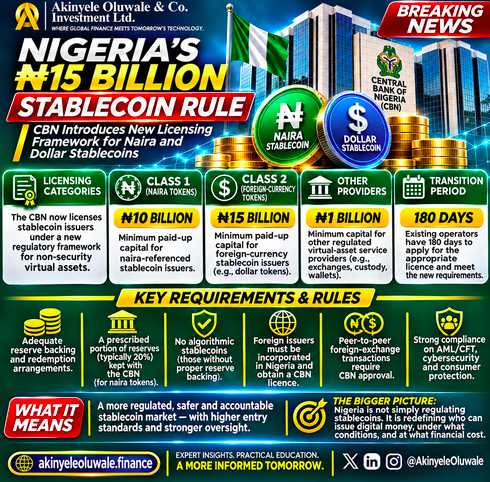
The Central Bank of Nigeria has introduced a comprehensive regulatory framework for stablecoins and other non-security virtual assets. With minimum capital requirements of ₦10 billion for naira-linked issuers and ₦15 billion for foreign-currency issuers, Nigeria is moving toward a tightly supervised digital payments market. The implications extend to banks, international stablecoin companies, fintech operators, cross-border payments and the future of financial innovation in Africa.
Published: November 7, 2026
Author: Akinyele Oluwale & Co. Investment Ltd.
Category: Stablecoins & Payments
Focus: CBN Regulation | Stablecoin Licensing | Digital Finance | Nigeria
The latest announcement concerning Nigeria's stablecoin industry is more significant than a routine regulatory update. It represents a fundamental change in how the Central Bank of Nigeria intends to supervise digital money used for payments, transfers, custody and settlement.
According to the CBN's Regulations for the Operations of Non-Security Virtual Assets in Nigeria, effective November 5, 2026, companies issuing stablecoins must meet specific licensing, capital, reserve and operational requirements.
The framework distinguishes between naira-referenced and foreign-currency-referenced stablecoins. It also imposes requirements on providers of other regulated virtual-asset services.
Crucially, the regulation is not simply a prohibition on cryptocurrency activity. It establishes a licensing regime under which qualifying businesses may operate, subject to regulatory approval and ongoing supervision.
The development raises an important economic question:
Is Nigeria building the foundations of a more credible digital payments industry, or could the cost of regulatory compliance discourage competition and innovation?
The answer depends on how effectively the new framework balances financial stability, consumer protection, access to foreign currency and the commercial realities of financial technology businesses.
Nigeria has entered a new phase in the regulation of stablecoins and digital payment infrastructure.
On November 5, 2026, the Central Bank of Nigeria introduced its Regulations for the Operations of Non-Security Virtual Assets in Nigeria, establishing licensing and supervisory requirements for stablecoin issuers and other regulated virtual-asset service providers.
The framework creates two principal categories of stablecoin issuers:
Class 1: Naira-referenced stablecoins, requiring minimum paid-up capital of ₦10 billion.
Class 2: Foreign-currency-referenced stablecoins, requiring minimum paid-up capital of ₦15 billion.
Other regulated non-security virtual-asset service providers generally face a minimum capital requirement of ₦1 billion, subject to the applicable licensing category and additional requirements.
The regulations also address reserve backing, redemption rights, cybersecurity, anti-money laundering controls, foreign-exchange transactions and consumer protection.
Foreign stablecoin issuers seeking to serve the Nigerian market must meet local incorporation and licensing requirements rather than relying exclusively on authorisations obtained abroad.
Algorithmic stablecoins that depend primarily on market mechanisms rather than eligible reserve assets are prohibited.
The regulations took effect on November 5, with transitional provisions for existing operators, including a 180-day period to apply for the appropriate authorisation.
These developments have implications beyond cryptocurrency trading.
Stablecoins are increasingly relevant to international commerce, remittances, payment processing and digital financial infrastructure.
Nigeria's new framework therefore addresses a broader question: how should digital representations of money operate within a regulated national financial system?
Our institutional assessment is that the CBN has taken a significant step toward formalising stablecoin activity. However, the framework's success will depend on regulatory clarity, proportionate supervision, competitive market access and the ability of compliant operators to deliver useful financial services.
A stablecoin is a digital token designed to maintain a relatively stable value against a reference asset, commonly a national currency.
For example, a dollar-referenced stablecoin is designed to track the value of the United States dollar.
A naira-referenced stablecoin is designed to maintain its value against the Nigerian naira.
However, the term stablecoin does not mean that a token is automatically risk-free. Its stability depends on factors such as reserve backing, redemption arrangements, governance, market confidence and the financial strength of its issuer.
Consider a Nigerian business importing goods from an overseas supplier.
The business may need to convert naira into foreign currency and make an international payment.
Conventional payment arrangements may involve banks, correspondent institutions, foreign-exchange procedures and settlement delays.
A properly regulated stablecoin payment arrangement could potentially provide an additional mechanism for transferring value but the technology does not remove the need for foreign-exchange compliance, customer verification or access to redeemable funds.
This is particularly important in Nigeria, where foreign-exchange availability, exchange-rate stability and international payment efficiency have significant implications for businesses.
Stablecoins could offer useful financial infrastructure.
However, without adequate supervision, they could also create risks involving capital flows, reserve management, financial crime and consumer losses.
The CBN's new framework attempts to address these competing considerations.
The CBN has established two distinct categories for stablecoin issuers.
| Regulatory category | Type of stablecoin | Minimum paid-up capital |
|---|---|---|
| Class 1 | Naira-referenced stablecoins | ₦10 billion |
| Class 2 | Foreign-currency-referenced stablecoins | ₦15 billion |
| Other regulated non-security virtual-asset service providers | Applicable exchange, custody, wallet and payment activities | Generally ₦1 billion |
These requirements establish substantial financial thresholds for companies seeking to enter the market.
For example, a company proposing to issue a naira-referenced stablecoin must demonstrate the financial capacity required under the Class 1 framework.
A company proposing to issue a dollar-referenced stablecoin for the Nigerian market must meet the higher Class 2 capital requirement.
Importantly, regulatory capital is separate from the assets held to back outstanding stablecoins.
A company cannot simply count customer reserve assets as its own paid-up capital.
This distinction protects against the possibility of an issuer using funds belonging economically to token holders to satisfy its corporate capital obligations.
The lesson: The CBN is treating stablecoin issuance as a financially significant activity requiring substantial capital and ongoing supervision.
One of the most consequential provisions concerns international stablecoin issuers.
Under the new framework, foreign-currency-referenced stablecoins intended for the Nigerian market must be issued through a Nigerian-incorporated entity holding the appropriate Class 2 licence.
A foreign regulatory approval does not automatically substitute for Nigerian authorisation.
This has potentially important implications for global stablecoin companies seeking to serve Nigerian users.
The policy creates a clear distinction between the global availability of a digital token and its lawful distribution or operation within a particular jurisdiction.
A token may circulate internationally, but that does not automatically mean its issuer satisfies every country's financial regulations.
From the CBN's perspective, local incorporation and supervision may improve regulatory accountability.
However, international issuers will need to assess whether the size and economics of the Nigerian market justify the required capital, compliance infrastructure and operational arrangements.
The lesson: Access to Nigeria's digital payments market is becoming more dependent on local regulatory authorisation.
Obtaining an issuer licence does not automatically provide unrestricted permission to issue any digital token.
The CBN framework also requires approval for individual stablecoins.
Relevant information includes the token's reference currency, reserve arrangements, name, ticker and supported blockchain networks.
This is important because different stablecoins can have different financial and technological characteristics.
Two dollar-referenced tokens may appear similar to consumers while operating under very different reserve, custody and redemption structures.
By requiring token-specific approval, the regulator can assess these differences.
The lesson: Regulatory approval is intended to cover both the institution issuing a stablecoin and the characteristics of the stablecoin itself.
The CBN's regulations prohibit certain algorithmic stablecoins.
These are tokens that rely primarily on market mechanisms or algorithmic arrangements rather than eligible reserve assets to maintain their reference value.
The regulatory concern is straightforward.
A stablecoin designed to maintain a fixed value must have credible arrangements supporting that objective.
If its stability depends mainly on investor confidence, token incentives or market arbitrage, the arrangement may become vulnerable during periods of financial stress.
A loss of confidence can undermine the mechanism intended to maintain the peg.
The CBN's approach places greater emphasis on reserve-backed stablecoin structures.
However, reserve backing alone is not sufficient.
The reserves must also be appropriately managed, accessible and legally available to meet redemption obligations.
The lesson: Stablecoin stability should be supported by credible financial resources and enforceable redemption arrangements, not merely technological design.
The framework introduces requirements intended to protect stablecoin holders.
For Class 1 naira-referenced stablecoins, issuers must maintain a prescribed portion of their reserves with the CBN.
The ordinary requirement is a 20% deposit in a dedicated reserve account, alongside additional reserve composition and liquidity requirements.
The regulations also provide for redemption rights and require issuers to explain their redemption arrangements.
These safeguards address a fundamental question:
What happens when a stablecoin holder wants to exchange the token for the currency it represents?
Consider a hypothetical issuer with ₦50 billion in outstanding naira-referenced stablecoins.
The issuer must maintain sufficient eligible backing to support those obligations.
The 20% ordinary CBN reserve-deposit requirement would represent ₦10 billion of that reserve pool, assuming the stated ₦50 billion amount is the relevant reserve base and no higher requirement applies.
That reserve deposit is not the same thing as the issuer's separate ₦10 billion minimum paid-up capital.
The distinction is essential.
Capital protects the institution's financial resilience. Reserves support the value and redemption of the tokens issued.
For consumers, these arrangements are intended to reduce the risk that an issuer cannot honour its obligations.
The regulations prohibit issuers from paying interest, yield, dividends or similar financial benefits merely for holding their stablecoins.
They also distinguish stablecoins from conventional bank deposits.
Stablecoins are not automatically covered by Nigeria Deposit Insurance Corporation deposit insurance.
This is an important consumer-protection issue.
A stablecoin may be designed to maintain a fixed currency value, but it does not necessarily provide the same legal protections as a regulated bank deposit.
Investors and businesses must therefore understand what rights they hold.
A digital token should not be assumed to have deposit insurance simply because its value is linked to the naira or dollar.
The lesson: Stablecoins and bank deposits may serve some similar payment functions, but they are not legally or financially identical.
The new framework also addresses peer-to-peer transactions involving conversions between naira and foreign-currency-referenced stablecoins.
Providers facilitating such conversions must obtain the necessary CBN approval.
The rules require relevant foreign-exchange transactions to operate within the applicable regulatory framework.
This is particularly significant for Nigeria.
Digital-asset platforms have become part of the wider discussion about access to foreign currency, cross-border payments and the operation of informal exchange markets.
The CBN's position indicates that stablecoin-based foreign-exchange services should not operate as an alternative regulatory system outside established foreign-exchange requirements.
However, the rules should not be misinterpreted as a declaration that every private digital-asset transfer is automatically a criminal offence.
The regulatory treatment depends on the activity, the parties involved and the applicable provisions.
The lesson: Blockchain technology does not remove foreign-exchange regulatory obligations.
The regulations impose requirements concerning customer due diligence, anti-money laundering controls, sanctions screening, transaction monitoring and regulatory reporting.
These requirements reflect the risks associated with digital financial systems.
Stablecoin transactions can move across networks and jurisdictions.
That flexibility can be commercially useful, but it also creates challenges for financial supervision and fraud prevention.
Issuers and service providers must therefore demonstrate that their systems can support effective compliance.
The regulations also provide for financial penalties and other supervisory actions where operators breach applicable requirements.
The broader message is clear.
The CBN is moving from general caution about digital assets toward a more structured system of licensing, supervision and enforcement.
Nigeria's new framework reflects a wider international development.
Governments and financial regulators are increasingly distinguishing between the technology supporting digital assets and the financial activities performed through that technology.
Stablecoins are no longer relevant only to cryptocurrency exchanges.
They may also support payments, remittances, institutional settlement and digital commerce.
As these applications expand, regulators must consider how stablecoins interact with national monetary systems.
For Nigeria, three issues are particularly important.
First, the CBN must protect confidence in the naira and the wider payments system.
Second, it must manage the risks associated with foreign-currency-denominated digital money.
Third, it must allow room for financial innovation capable of improving economic activity.
These objectives can sometimes conflict.
Very strict regulation may reduce certain financial risks while increasing the cost of market entry.
Very permissive regulation may encourage innovation but expose consumers to poorly managed issuers.
The policy challenge is to establish a framework that protects the financial system without unnecessarily excluding credible competitors.
This is where the quality of implementation becomes decisive.
Banks may find opportunities to provide reserve custody, settlement services and other infrastructure to licensed digital-finance businesses.
However, they must also manage compliance and operational risks.
Foreign issuers face potentially substantial costs associated with local incorporation, capital requirements and licensing.
Some may pursue Nigerian market entry, while others may reconsider their commercial strategies.
The framework creates a clearer route toward formal regulatory participation.
However, the capital requirements could be challenging for smaller firms, especially those seeking to issue stablecoins rather than provide supporting technology services.
Licensed payment providers may find opportunities in cross-border settlement and digital commerce.
But they must distinguish between technical payment capabilities and the regulatory permissions required to operate them.
Reserve, redemption and disclosure requirements could improve consumer protection.
Nevertheless, consumers must remain aware that stablecoins can involve issuer, technology, liquidity and regulatory risks.
The regulation may influence how digital-asset businesses structure their Nigerian operations.
However, the introduction of stablecoin licensing should not be interpreted as approval of every cryptocurrency or investment product.
If properly implemented, the framework could support more accountable digital payment infrastructure.
Its wider economic benefits will depend on actual adoption, operating costs, regulatory consistency and integration with the formal financial system.
At Akinyele Oluwale & Co. Investment Ltd., we believe the CBN's new stablecoin framework deserves serious attention.
The most important question is not whether Nigeria supports or opposes cryptocurrency.
That framing is too simplistic.
The real question is whether Nigeria can develop a credible regulatory environment for digital financial services.
Stablecoins create opportunities, but they also create financial obligations.
If a company issues a token promising redemption at a fixed value, it must be capable of honouring that promise.
If a platform facilitates cross-border payments, it must comply with relevant financial regulations.
And if a digital asset is marketed to consumers, its risks should be clearly disclosed.
These are legitimate regulatory concerns.
However, financial stability should not be pursued without considering market structure.
A ₦15 billion minimum capital requirement represents a significant threshold.
It may favour large financial institutions and well-capitalised international companies.
Smaller innovative businesses may find direct stablecoin issuance commercially impractical.
That does not necessarily mean the requirement is inappropriate.
It means the regulator should assess whether the capital threshold is proportionate to the risks involved.
There is also an important distinction between issuing a stablecoin and developing technology that supports stablecoin payments.
These activities do not necessarily carry identical financial risks.
Regulatory requirements should reflect those differences.
Our assessment is that Nigeria should pursue four complementary objectives:
Financial stability: Ensure stablecoins have credible backing, liquidity and redemption arrangements.
Consumer protection: Require transparent disclosures and enforceable rights.
Competitive innovation: Preserve opportunities for responsible financial technology development.
Regulatory consistency: Provide clear, predictable procedures that allow legitimate businesses to plan their operations.
The ultimate measure of success will not be the number of licences issued.
It will be whether the framework produces safer, more efficient and commercially useful financial services.
Several developments deserve close monitoring over the coming months.
Licensing applications: Which domestic and international companies apply for Class 1 and Class 2 licences?
Transitional compliance: How will existing operators meet the framework's application and operational requirements?
Foreign issuer participation: Will major international stablecoin companies establish the required Nigerian structures?
Capital requirements: How will the ₦10 billion and ₦15 billion thresholds influence competition?
Reserve supervision: How effectively will the CBN monitor reserve backing, liquidity and redemption arrangements?
Foreign-exchange compliance: How will the new approval requirements affect regulated stablecoin-based payment services?
Banking partnerships: Will Nigerian banks develop new services for licensed digital-asset operators?
Consumer outcomes: Will the framework improve transparency, dispute resolution and confidence?
Regional influence: Will other African financial regulators adopt similar licensing structures?
These developments will determine whether the framework becomes an effective foundation for digital finance or a source of excessive market-entry costs.
The CBN introduced new regulations for non-security virtual assets effective November 5, 2026.
Naira-referenced stablecoin issuers require minimum paid-up capital of ₦10 billion.
Foreign-currency-referenced stablecoin issuers require minimum paid-up capital of ₦15 billion.
Foreign issuers must satisfy Nigerian incorporation, licensing and token-approval requirements.
Certain algorithmic stablecoins are prohibited.
Stablecoin issuers must comply with applicable reserve, liquidity and redemption requirements.
Stablecoins are not automatically protected by bank deposit insurance.
Peer-to-peer foreign-exchange services involving foreign-currency stablecoins face specific regulatory approval requirements.
The new framework creates opportunities for regulated financial innovation but raises questions about competition and compliance costs.
Its long-term success will depend on balancing financial stability, consumer protection and commercial innovation.
Akinyele Oluwale & Co. Investment Ltd. is an institutional financial intelligence platform focused on global macroeconomics, central banking, institutional cryptocurrency, stablecoins, digital payments, tokenization, real-world assets, artificial intelligence and blockchain technology.
Our editorial mission is to provide evidence-based analysis that helps readers understand important financial developments, their economic implications and the opportunities and risks associated with emerging technologies.
We believe that responsible financial innovation requires strong institutions, credible regulation and informed decision-making.
Nigeria's new stablecoin regulations represent an important development in the country's digital-finance landscape.
The CBN has established a formal framework covering stablecoin issuance, licensing, capital requirements, reserve backing and regulatory supervision.
This could strengthen accountability and create a clearer operating environment for compliant businesses.
However, the substantial capital requirements may also influence which companies can participate directly in stablecoin issuance.
The next phase will therefore be determined by implementation.
Will the framework attract credible financial institutions?
Will it encourage useful payment innovations?
Will it protect consumers without creating unnecessary barriers to competition?
And will Nigerian businesses gain access to more efficient, properly regulated financial services?
These are the questions that matter.
Nigeria's digital-finance future will not be determined by regulation alone, nor by blockchain innovation alone. It will depend on whether the two can work together to create a trustworthy, competitive and economically useful financial system.
Observe the change. Understand the implications. Position with discipline.
Akinyele Oluwale & Co. Investment Ltd.
Where Global Finance Meets Tomorrow's Technology.
Website: akinyeleoluwale.finance
Editorial disclaimer: This article is for financial education and regulatory analysis. It is not legal advice, investment advice or confirmation that any particular stablecoin or provider has received CBN approval.