

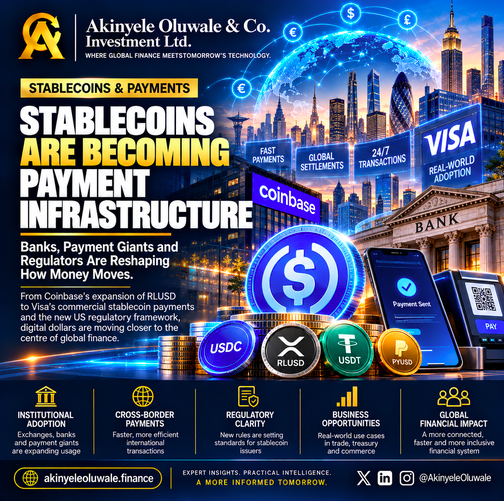
From Coinbase's expansion of Ripple's RLUSD to Visa's commercial stablecoin settlement services and America's new regulatory framework, digital dollars are moving closer to the centre of global payments.
Published: October 29, 2026 | Category: Stablecoins & Payments | By: Akinyele Oluwale
The next stage of digital finance is not simply about holding cryptocurrency. It is about how money moves, how businesses settle transactions, and who provides the trusted infrastructure behind tomorrow's payment systems.
For years, stablecoins were discussed mainly within the cryptocurrency industry.
They helped traders move between digital assets, provided dollar-denominated liquidity on cryptocurrency exchanges and supported transactions across blockchain networks.
That story is changing.
Stablecoins are increasingly being considered for a much broader purpose: moving money between businesses, financial institutions and countries.
The latest developments in October 2026 demonstrate how this transition is taking shape.
On October 28, Coinbase expanded access to Ripple's dollar-backed stablecoin, RLUSD, across its retail and institutional platforms. The development broadens distribution for a stablecoin designed to support applications including cross-border payments.
Earlier in October, Visa announced that its Visa Direct stablecoin-enabled prefunding service had moved beyond pilot testing into commercial deployment, initially through Inyo Global for eligible clients and partners.
Meanwhile, the United States Office of the Comptroller of the Currency finalised regulations implementing major provisions of the GENIUS Act, establishing a supervisory framework for payment stablecoin issuers under its jurisdiction.
These developments matter because they address three different requirements for a functioning financial system:
Distribution, commercial utility and regulatory confidence.
A stablecoin cannot become widely useful simply because its blockchain processes transactions quickly.
It also needs institutions willing to support it, businesses with genuine reasons to use it, reliable redemption arrangements and a legal framework that establishes responsibilities.
The central question is no longer whether stablecoins can transfer digital value.
They already can.
The more important question is whether stablecoins can become a dependable component of everyday financial infrastructure.
Consider a Nigerian business purchasing equipment from an overseas supplier.
The business needs to arrange payment, comply with foreign-exchange and financial regulations, and ensure that the supplier receives the agreed amount.
Traditional international payments may involve several institutions, different operating hours, compliance reviews, foreign-exchange conversion and settlement processes.
These arrangements provide important safeguards, but they can also create delays and costs.
Now consider a payment system in which a regulated financial institution uses a properly backed digital-dollar instrument to settle part of the transaction.
In principle, such infrastructure could allow participating institutions to transfer value outside conventional banking hours and reduce certain settlement delays.
But there is an important distinction.
Moving a digital token quickly is not the same as completing an entire international payment quickly.
The sender may still need to convert local currency into the payment instrument. The receiving institution may need to conduct compliance checks. The recipient may need to convert the stablecoin into local currency.
Fees, liquidity availability, financial regulations and the quality of the institutions involved will determine the actual outcome.
This is where the business opportunity becomes clearer.
Stablecoins may improve particular stages of payment processing, especially settlement and treasury funding, without necessarily replacing every function performed by banks.
For corporate executives, the subject is therefore not simply about blockchain technology.
It is about working capital, payment efficiency, liquidity management and financial risk.
A company that receives funds faster may be able to manage cash more efficiently.
A payment provider that can settle obligations outside normal banking hours may reduce certain operational constraints.
A financial institution that can access new settlement networks may develop additional services.
However, none of these benefits should be assumed without examining actual costs, regulatory requirements and operational performance.
The future of stablecoin payments will be determined by measurable financial value, not technological excitement.
On October 28, Reuters reported that Coinbase was adding Ripple's dollar-backed RLUSD stablecoin to its retail and institutional platforms.
Ripple launched RLUSD in December 2024, and the token's market capitalisation had exceeded $2.5 billion, according to the market data cited in the report.
The significance extends beyond another digital asset becoming available on an exchange.
Stablecoins need distribution channels and market liquidity to support wider adoption.
Greater access through established platforms can improve visibility and potentially make a stablecoin more useful to businesses and financial institutions exploring payment applications.
Nevertheless, an exchange listing does not establish that a stablecoin has achieved widespread merchant adoption or that every potential payment use case is commercially viable.
It is a distribution development, not proof that traditional payment systems have been replaced.
On October 15, Visa announced that Visa Direct's stablecoin-enabled prefunding capabilities had advanced from pilots to commercial deployment.
Inyo Global became the first enabler of the service, initially supporting eligible Visa Direct clients and partners.
The development is particularly important because it shows an established global payment company incorporating stablecoin technology into its existing payment infrastructure.
Rather than asking businesses to abandon familiar payment networks, the model explores how stablecoins can support the movement and availability of funds behind those networks.
For a payment company, prefunding refers to making money available in advance so that payment obligations can be met.
If eligible institutions can use stablecoins to manage these funding requirements more flexibly, they may improve the timing of cross-border liquidity movements.
That is a practical financial application.
However, the announcement concerns an initial commercial rollout. It should not be interpreted as evidence that all Visa Direct payments now use stablecoins.
Another development came from Visa and Lloyds Banking Group.
In a seven-day live pilot announced on September 30, Lloyds used stablecoins to settle $750,000 in payment obligations with Visa.
According to Visa, the funds reached the payment network in under an hour, including during the weekend.
This experiment demonstrated how stablecoin settlement could function beyond conventional banking hours.
The trial also explored settlement across public and private blockchain environments.
The significance lies in the involvement of a major banking group and a global payment network.
But the result must be interpreted carefully.
A successful pilot establishes that a particular process worked under tested conditions.
It does not automatically demonstrate that the system can operate at unlimited scale, across every jurisdiction or without additional risks.
Commercial adoption requires further evidence concerning reliability, cost, controls and regulatory compliance.
On October 21, the US Office of the Comptroller of the Currency issued a final rule implementing major provisions of the GENIUS Act for entities within its jurisdiction.
The rule addresses important matters including permitted activities, reserve assets, redemption, risk management, supervision, custody and regulatory applications.
The framework is scheduled to become effective on January 18, 2027.
This distinction is essential: the rule has been finalised, but its stated effective date remains in the future.
The OCC also indicated that certain anti-money-laundering and sanctions-related requirements would be addressed through separate rulemaking.
For the stablecoin industry, the broader significance is the movement towards more clearly defined responsibilities for issuers and supervisors.
A payment instrument intended for widespread use needs more than technological functionality.
It needs credible arrangements for protecting holders and maintaining confidence.
Stablecoins sit at the intersection of two financial systems.
The first is traditional finance, built around banks, regulated payment providers, established currencies and legal obligations.
The second is blockchain-based finance, where digital assets can move across compatible networks according to programmed rules.
The opportunity is to connect useful features of both systems.
Traditional finance provides established legal structures, customer relationships, compliance processes and institutional oversight.
Blockchain networks can provide programmable transfers, transaction visibility and settlement functionality outside conventional banking hours.
However, integration is not straightforward.
A stablecoin represents a claim or arrangement whose value depends on its design, issuer, reserves and redemption terms.
It is not automatically equivalent to a commercial bank deposit.
Nor does holding a token necessarily provide the same legal rights or protections as holding money in an insured deposit account.
This distinction is especially important for institutional adoption.
Banks and businesses must understand who is responsible if an issuer fails, reserve assets become inaccessible or a payment is sent incorrectly.
They must also understand how the instrument is treated under applicable law.
There is another important development worth watching.
Stablecoin adoption could increase competition between different forms of digital money.
Payment stablecoins, tokenised bank deposits, conventional electronic bank money and central bank digital currencies represent different approaches to moving or representing monetary value.
They should not be treated as interchangeable.
Each has different institutional, legal and operational characteristics.
The future may involve several forms of digital money operating alongside one another rather than a single technology replacing every existing payment method.
The growth of stablecoin payment infrastructure has implications across several industries.
Banks: Financial institutions may face both competitive pressure and new opportunities. Some may provide custody, settlement, liquidity or other services connected to regulated stablecoins. Others may develop tokenised deposit products or strengthen their existing payment offerings.
Payment companies: Established providers can investigate whether stablecoins improve international settlement, merchant payouts and treasury operations. Their advantage may come from combining new technology with existing distribution networks and compliance capabilities.
Stablecoin issuers: Competition may increasingly depend on reserve quality, redemption reliability, regulatory standing, liquidity and institutional partnerships rather than token supply alone.
Corporate treasuries: Businesses may assess whether stablecoin-based settlement offers practical benefits in managing international cash movements. Such assessments should include legal, operational, counterparty and currency risks.
Emerging markets: Stablecoin payment infrastructure may create opportunities for international commerce and financial innovation. However, widespread foreign-currency stablecoin use can also raise questions about monetary sovereignty, capital flows and the effectiveness of domestic financial regulation.
Government securities markets: Some reserve-backed stablecoin arrangements hold short-term government instruments. Changes in stablecoin issuance may therefore influence demand for eligible reserve assets, although the wider market effect depends on the scale and composition of holdings.
Digital-asset markets: Wider stablecoin distribution can support liquidity across digital-asset platforms. But growth in stablecoin use for payments should not be confused with a guaranteed increase in the prices of Bitcoin or other cryptocurrencies.
The important point is that stablecoins are developing into a financial infrastructure issue, not merely a cryptocurrency-market issue.
The financial industry should resist two extreme assumptions.
The first is that stablecoins will automatically replace banks.
The second is that stablecoins have no meaningful purpose outside cryptocurrency trading.
Neither position adequately reflects the developments now taking place.
Banks perform several functions that stablecoins alone do not replicate.
They provide credit, manage deposits, support payment services, assess financial risks and operate within extensive regulatory frameworks.
Stablecoins may improve certain payment and settlement processes without replacing those functions.
At the same time, the participation of companies such as Visa, Lloyds and Coinbase demonstrates that stablecoin technology is attracting attention beyond speculative trading.
For chief executives and financial managers, the right question is not whether their organisations should adopt every new financial technology.
It is whether a particular technology solves a genuine business problem more effectively than existing alternatives.
Consider a company making frequent international payments.
Management should examine the total transaction cost, including conversion charges, settlement fees, compliance requirements and any cost of converting funds at the receiving end.
It should also assess the financial strength and legal obligations of the stablecoin issuer.
A payment that settles in minutes may still be unattractive if the overall process is expensive, legally uncertain or operationally unreliable.
Likewise, a system that operates around the clock may be valuable for businesses managing international liquidity, but less important for companies whose payment requirements are already adequately served.
Technology should support sound financial management, not replace it.
Our editorial assessment is that the stablecoin industry's next competitive advantage will increasingly depend on trust, regulation, institutional integration and demonstrable payment efficiency.
The most successful infrastructure will not necessarily be the network with the loudest marketing.
It will be the infrastructure that businesses can use reliably, lawfully and economically.
Several developments deserve close attention.
First, implementation of the GENIUS Act framework. The January 18, 2027 effective date will be an important regulatory milestone. Investors and financial institutions should monitor licensing processes, supervisory expectations and additional rulemaking.
Second, commercial adoption of Visa Direct's stablecoin capabilities. The key question is whether the initial deployment expands to more eligible partners and demonstrates measurable improvements in payment operations.
Third, RLUSD distribution and payment use cases. Wider exchange availability is one development. Evidence of sustained commercial payment demand would represent another.
Fourth, bank participation. More partnerships between banks and blockchain-based payment providers could indicate growing institutional confidence, although each arrangement must be assessed individually.
Fifth, redemption and reserve transparency. Stablecoin users need confidence that issuers can meet obligations under both normal and stressed market conditions.
Sixth, international regulation. Stablecoin payment services operate across jurisdictions with different legal requirements. Regulatory compatibility will influence the pace of cross-border adoption.
Seventh, Africa's position in the emerging payment system. African financial institutions, regulators and technology companies will need to assess how new settlement arrangements interact with domestic currencies, payment systems and financial inclusion objectives.
The central question is whether stablecoins can move from promising technical capabilities to consistently reliable financial services.
Stablecoins are increasingly being explored and deployed for payment settlement, treasury funding and cross-border financial operations.
Coinbase's October 28 expansion of RLUSD access strengthens distribution but does not, by itself, prove widespread payment adoption.
Visa Direct's October commercial deployment represents a meaningful transition from testing towards operational use for eligible partners.
Visa and Lloyds demonstrated faster settlement in a live pilot, but broader commercial performance must still be evaluated.
The OCC's final GENIUS Act rule establishes important regulatory requirements, with an effective date of January 18, 2027.
Reserve backing, redemption rights, supervision and operational resilience are essential to institutional confidence.
Stablecoins may complement existing banking and payment infrastructure rather than replace it entirely.
Businesses should judge stablecoin payment solutions by cost, reliability, legal compliance and financial value.
Akinyele Oluwale & Co. Investment Ltd. is a financial intelligence platform dedicated to analysing the developments shaping global finance and emerging financial technologies.
Our coverage includes institutional finance, stablecoins and digital payments, tokenisation, central banking, artificial intelligence, blockchain infrastructure and macroeconomic developments.
We believe that serious financial analysis must go beyond headlines.
It should explain what happened, why it matters, the risks involved and the developments that decision-makers should monitor.
Our objective is to make complex financial issues understandable while maintaining professional judgement, editorial independence and a commitment to evidence-based reporting.
The latest stablecoin developments reveal a gradual but important transformation.
Digital-dollar instruments are being integrated into the infrastructure used by payment companies, financial institutions and businesses.
That transformation is not complete, and it should not be exaggerated.
Regulation, institutional trust, liquidity, operational reliability and real customer demand will determine how far adoption progresses.
Nevertheless, the direction is becoming clearer.
The conversation is moving beyond whether stablecoins can exist.
It is increasingly about whether they can perform useful financial functions within a trusted, regulated global payment system.
For investors and business leaders, that is the development worth understanding.
Observe the change. Understand the implications. Position with discipline.
Akinyele Oluwale & Co. Investment Ltd.
Where Global Finance Meets Tomorrow's Technology.