

Published: October 22, 2026
Category: Institutional Finance
By: Akinyele Oluwale
The future of finance will not be determined by technology alone. It will be determined by how effectively capital, technology and trusted institutions combine to create productive economic value.
For 45 days, we followed the forces reshaping global finance.
Artificial intelligence.
Central banks.
Interest rates.
Global liquidity.
Institutional digital assets.
Stablecoins.
Tokenization.
Government debt.
Infrastructure.
Private capital.
Productivity.
At first glance, these appear to be separate stories.
They increasingly are not.
A new financial architecture is emerging in which money, assets, payments, settlement, financial infrastructure, artificial intelligence and capital allocation are becoming increasingly interconnected.
The IMF's October 2026 Global Financial Stability Report illustrates the transition particularly well. It examines AI-related market risks, sovereign-bond pressures, cyber threats and tokenization within the same broader financial-stability framework. International Monetary Fund
The Financial Stability Board is simultaneously working on responsible AI adoption and the cross-border vulnerabilities associated with global stablecoins. Financial Stability Board
The ECB has launched Pontes, enabling wholesale tokenized-asset transactions to settle in central-bank money. European Central Bank
And BIS-led Project Agorá is exploring whether tokenized commercial-bank money and wholesale central-bank money can operate together on programmable infrastructure for cross-border payments while preserving the existing two-tier monetary system. Bank for International Settlements
These are not isolated experiments anymore.
Together, they point toward a broader transformation.
Financial systems have always performed several fundamental functions.
They store value.
They move money.
They allocate capital.
They manage risk.
They establish ownership.
They provide credit.
They settle transactions.
Technology does not eliminate these functions.
It changes how they are performed.
That distinction matters.
Blockchain does not automatically eliminate banks.
Stablecoins do not automatically eliminate sovereign currencies.
AI does not automatically eliminate financial professionals.
Tokenization does not automatically eliminate traditional exchanges.
Instead, technology can alter the infrastructure connecting these institutions.
The emerging transformation therefore looks less like:
and more like:
That is a much more realistic interpretation of what we have observed during this experiment.
Several major structural developments converged during our 45-day observation period.
The AI boom expanded beyond software.
It became:
Chips → Data Centres → Electricity → Financing → Cash Flow → Productivity
The IMF now explicitly identifies the possibility of an AI-related market correction among potential triggers for broader financial stress if investment or profit expectations disappoint. International Monetary Fund
The FSB has gone further, finalising 12 sound practices for responsible AI adoption across financial institutions. Financial Stability Board
AI has therefore moved from technology experimentation toward financial-system governance.
The IMF says tokenization could streamline the asset lifecycle, improve transparency and enable greater automation by bringing functions currently performed across multiple intermediaries onto shared programmable platforms.
But it also identifies four important constraints:
Legal certainty
Regulatory clarity
Interoperability
Settlement assets International Monetary Fund
The ECB's Pontes initiative now allows wholesale tokenized-asset transactions to settle in central-bank money.
The ECB has also begun preparatory work to invest a small portion of its own funds in tokenized securities. European Central Bank
That is materially different from merely discussing blockchain technology.
The FSB now describes global stablecoins as inherently cross-border and cross-sectoral arrangements that could potentially become systemically important in some jurisdictions. Financial Stability Board
The conversation has therefore progressed from:
Can stablecoins work?
toward:
How should stablecoins integrate safely into the financial system?
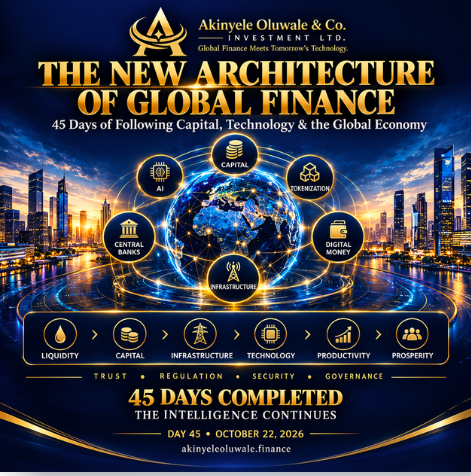
The financial system can increasingly be understood as a series of interconnected layers.
Everything begins with capital.
Who controls it?
What does it cost?
Where does it move?
Capital finances:
Electricity.
Networks.
Data centres.
Transportation.
Digital infrastructure.
AI increasingly influences:
Analysis.
Risk management.
Operations.
Customer services.
Productivity.
Tokenization could change how assets are:
Issued.
Owned.
Traded.
Used as collateral.
Settled.
Serviced.
CBDCs, bank deposits and regulated stablecoins represent different approaches to increasingly digital forms of money.
Programmable infrastructure could increasingly connect money and assets.
Ultimately, however, finance must connect back to the real economy.
Businesses.
Workers.
Investment.
Productivity.
Income.
Growth.
That gives us our signature Day 45 framework:
↓
↓
↓
↓
↓
↓
↓
What does this architecture mean for investors and institutions?
It means we should increasingly analyse systems rather than individual technologies.
Consider stablecoins.
A stablecoin by itself is simply a digital representation of value.
Its broader importance depends on:
Reserve assets → Regulation → Payment infrastructure → Interoperability → Merchant/Institutional adoption
Consider tokenization.
A tokenized bond alone does not transform capital markets.
Transformation requires:
Legal ownership → Trading → Liquidity → Settlement → Custody → Interoperability
Consider AI.
A sophisticated model alone does not guarantee productivity.
AI requires:
Power → Compute → Data → Skills → Business Adoption → Productivity
The same principle appears repeatedly.
This means investors should increasingly understand the entire value chain, rather than concentrating solely on the most visible technology.
Forty-five days of financial intelligence have produced one overriding conclusion:
The most important future may not be:
Banks versus blockchain.
It could be:
Not:
Central banks versus tokenization.
But:
Not:
Traditional finance versus AI.
But:
Not:
Fiat currency versus digital money.
But:
Current institutional developments support this integration thesis.
Project Agorá explicitly explores enhancing correspondent banking rather than simply replacing it. Bank for International Settlements
The ECB is integrating central-bank money with tokenized settlement. European Central Bank
The FSB is developing frameworks for financial institutions to adopt AI responsibly rather than attempting to stop its use. Financial Stability Board
And the IMF argues for a technology-neutral policy approach to tokenization while protecting financial stability. International Monetary Fund
The future of finance will not be determined by technology alone. It will be determined by how effectively capital, technology and trusted institutions combine to create productive economic value.
But underneath the entire architecture sits one word:
Trust in money.
Trust in ownership.
Trust in institutions.
Trust in settlement.
Trust in data.
Trust in technology.
Trust in regulation.
Therefore:
Technology can change the rails of finance. Trust determines whether capital will travel on them.
The AI investment boom must eventually demonstrate sustainable productivity and cash-flow improvements.
Watch the transition:
AI Investment → Adoption → Productivity → Revenue → Returns
Watch whether tokenized markets develop greater liquidity, interoperability and legal certainty.
The IMF notes that current tokenized markets remain small and fragmented despite their potential. International Monetary Fund
Watch the interaction among:
Central-bank money
Commercial-bank deposits
Stablecoins
Tokenized deposits
The winner may not be one instrument.
Interoperability may matter more.
Central banks will increasingly need to think about both monetary policy and the technological infrastructure supporting money and settlement.
A more digital and interconnected financial system can create new vulnerabilities.
The IMF specifically identifies increasingly sophisticated cyber threats as a growing financial-stability risk. International Monetary Fund
The regulatory challenge is becoming:
Protect stability without preventing useful innovation.
For African economies, the opportunity extends beyond consuming financial technology.
The larger strategic question is whether the continent can build competitive positions across:
Digital infrastructure → Payments → Financial services → AI adoption → Productive businesses
That is where technology begins translating into economic development.
1. Global finance is evolving through integration rather than simple replacement.
2. AI is becoming part of financial infrastructure and financial-system governance. Financial Stability Board
3. Tokenization is moving toward institutional experimentation, but scale, liquidity, regulation and interoperability remain critical. International Monetary Fund
4. Central banks are increasingly engaging directly with tokenized settlement infrastructure. European Central Bank
5. Stablecoins are moving from a niche digital-asset issue toward cross-border financial-stability oversight. Financial Stability Board
6. Capital remains the connecting variable across AI, infrastructure and financial innovation.
7. Productivity remains the ultimate economic test.
8. Trust remains the foundation underneath the entire system.
↓
↓
↓
↓
↓
↓
↓
↓
Surrounding everything:
Akinyele Oluwale & Co. Investment Ltd. provides institutional financial intelligence at the intersection of global finance and tomorrow's technology.
Our intelligence coverage spans:
Artificial Intelligence
Blockchain & Technology
Crypto & Digital Assets
Institutional Finance
Stablecoins & Payments
Tokenization & RWAs
Central Banks
Macro & Global Markets
Our objective is not simply to report what happened.
We ask:
What changed?
Why does it matter?
Where is capital moving?
Which technologies are becoming infrastructure?
What risks are being created?
Where could long-term economic value emerge?
And throughout this 45-day experiment, one discipline has remained constant:
Akinyele Oluwale & Co. Investment Ltd.
Where Global Finance Meets Tomorrow's Technology.