

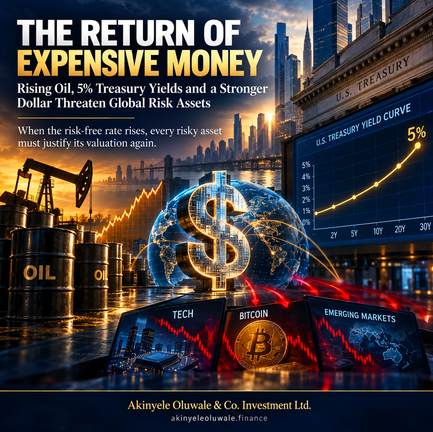
The Return of Expensive Money
Rising Oil, 5% Treasury Yields and a Stronger Dollar Threaten Global Risk Assets
Published: 29 September 2026
Category: Macro & Global Markets • Central Banks • Digital Assets
By: Akinyele Oluwale
Executive Summary
Global investors are confronting the return of expensive money.
The benchmark US 10-year Treasury yield has risen to approximately 5.27% its highest level in 19 years while Brent crude is trading above $106 per barrel. The US dollar is near a two-month high, and markets are again pricing the possibility of further Federal Reserve interest-rate increases.
These developments represent more than temporary movements in individual markets.
Higher oil prices can renew inflationary pressure. Higher government-bond yields increase borrowing costs throughout the economy. A stronger dollar tightens financial conditions for countries and companies with dollar-denominated obligations.
Together, these forces can reduce the liquidity available to support equities, technology companies, Bitcoin and other risk-sensitive assets.
The central investment question is therefore changing.
Investors are no longer asking only whether an asset has an attractive long-term story. They must also determine whether its expected return adequately compensates them when relatively low-risk government debt yields more than 5%.
When the risk-free rate rises, every risky asset must justify its valuation again.
Why This Matters
The yield on US Treasury securities serves as a foundation for global asset pricing.
When Treasury yields increase, investors can earn higher returns without accepting the operating, credit or market risks associated with companies and speculative assets.
This affects financial markets through several channels:
- Corporate borrowing becomes more expensive.
- Mortgage and consumer-credit costs increase.
- Governments face higher debt-servicing expenses.
- Future corporate earnings are discounted at higher rates.
- Leveraged investors face greater financing costs.
- Emerging markets experience pressure from a stronger dollar.
- Capital can move away from speculative assets toward government bonds.
A 5% Treasury yield therefore creates a much higher hurdle for risk assets.
A technology company, Bitcoin position or emerging-market investment must offer sufficient potential return to compensate for its additional volatility and uncertainty.
What Happened?
Global sovereign-bond markets have experienced a significant sell-off.
The US 10-year Treasury yield has climbed to around 5.27%, while the two-year yield has approached 5%. Markets are also anticipating the possibility of additional Federal Reserve increases through 2027.
At the same time, Brent crude has moved above $106 per barrel amid continuing geopolitical uncertainty and concerns about energy supply.
The dollar has remained close to a two-month high as investors respond to rising US yields and expectations that American interest rates may stay higher for longer. The euro and British pound have traded near three-month lows against the dollar.
These developments have weakened government bonds and unsettled global equities.
The pressure is not confined to the United States. Bond markets in Japan, Australia, South Korea and other economies are also adjusting to higher inflation expectations, tighter policy and strained public finances.
The Bigger Picture
For much of the period following the global financial crisis, investors operated in an environment of unusually low interest rates.
Cheap capital encouraged:
- Higher equity valuations;
- Greater corporate borrowing;
- Venture-capital expansion;
- Leveraged investment strategies;
- Rapid growth in technology spending; and
- Increased demand for speculative assets.
That environment is changing.
The financial system may be moving toward a structurally higher neutral interest rate one more closely resembling the conditions of the 1990s than the ultra-low-rate period following 2008.
Several forces could keep rates elevated:
- Persistent fiscal deficits;
- Higher government borrowing;
- Energy-market instability;
- Defence and infrastructure spending;
- AI-related capital expenditure;
- Supply-chain restructuring; and
- Reduced willingness by central banks to tolerate inflation.
If this assessment is correct, investors cannot assume that every economic slowdown will quickly produce aggressive monetary easing.
The cost of capital may remain structurally higher.
Market Impact
Bonds
Bond prices fall when yields rise.
Investors holding long-duration bonds are particularly exposed because their prices are more sensitive to changes in interest rates.
Higher yields may create better income opportunities for new buyers, but existing bondholders can experience significant capital losses.
Equities and AI stocks
Technology and AI companies are often valued on earnings expected many years into the future.
When discount rates rise, the present value of those distant earnings declines. Companies financing data centres, chips and AI infrastructure with debt may also face higher interest expenses.
Strong revenue growth can offset this pressure but market expectations must be supported by actual cash generation.
Bitcoin and digital assets
Bitcoin does not produce contractual cash flow.
Its valuation depends heavily on scarcity, adoption, liquidity, institutional demand and investor confidence.
Higher real yields and a stronger dollar can reduce the relative attraction of assets that do not pay income. They can also discourage leveraged crypto positions.
However, Bitcoin may remain resilient if institutional demand, ETF inflows and concerns about sovereign debt outweigh the effects of tighter liquidity.
The outcome will depend on whether demand is strong enough to absorb reduced speculative buying power.
Emerging markets
A stronger dollar increases the local-currency cost of servicing dollar-denominated debt.
Countries dependent on imported energy face a double burden:
- More expensive oil; and
- A stronger currency in which that oil is priced.
This can weaken local currencies, increase inflation and restrict the ability of central banks to reduce interest rates.
Consumers and businesses
Higher borrowing costs affect mortgages, loans, credit cards and business investment.
Companies may postpone expansion, while consumers may reduce discretionary spending.
This can ultimately slow economic activity even if headline growth remains strong in the short term.
Editorial Perspective
The return of 5% Treasury yields does not automatically mean that a financial crisis or broad market collapse is approaching.
It means that valuation discipline has become more important.
When government debt offered little or no real return, investors were pushed into equities, property, private markets and digital assets.
That pressure is weaker when Treasury securities provide meaningful income.
Risk assets can still perform well in a high-rate environment, but performance will become more selective.
Companies must demonstrate:
- Sustainable revenue;
- Reliable cash flow;
- Sensible debt levels;
- Pricing power; and
- Productive use of capital.
Digital assets must demonstrate:
- Genuine demand;
- Deep liquidity;
- Institutional participation;
- Security;
- Regulatory durability; and
- Defensible utility.
Narratives alone become less powerful when capital has a higher opportunity cost.
Investors should therefore distinguish between assets supported by durable demand and those sustained mainly by leverage, momentum or social-media attention.
What to Watch Next
1. US Treasury yields
A sustained move above current levels would place additional pressure on equities, housing, corporate credit and emerging markets.
2. Brent crude
Oil remaining above $100 could reinforce inflation expectations and delay monetary easing.
3. Federal Reserve expectations
Markets will reassess the interest-rate outlook as inflation, employment and consumer-spending data are released.
4. The US dollar
Continued dollar appreciation would tighten global liquidity and increase pressure on emerging-market borrowers.
5. Credit spreads
Widening corporate-bond spreads would indicate that investors are demanding more compensation for credit risk.
6. Bitcoin market leverage
Rising funding rates and excessive futures positioning could make digital assets vulnerable to forced liquidations.
7. AI capital expenditure
Investors should examine whether AI-related borrowing produces sufficient revenue and cash flow to justify its financing cost.
Key Takeaways
- The US 10-year Treasury yield has climbed to approximately 5.27%.
- Brent crude is trading above $106 per barrel.
- The dollar is near a two-month high.
- Higher oil prices can strengthen inflationary pressure.
- Higher bond yields increase borrowing costs and valuation discount rates.
- A stronger dollar tightens global financial conditions.
- Bitcoin, technology stocks and emerging markets remain sensitive to liquidity.
- Strong long-term narratives do not eliminate the effect of expensive capital.
- Risk assets must now compete against government debt offering yields above 5%.
About Akinyele Oluwale & Co. Investment Ltd.
Akinyele Oluwale & Co. Investment Ltd. provides independent intelligence and strategic analysis across global markets, macroeconomics, digital assets, tokenisation, artificial intelligence and institutional finance.
Our objective is to help investors, businesses and policymakers understand how monetary policy, technology and market structure are reshaping capital allocation and the global economy.
Akinyele Oluwale & Co. Investment Ltd.
Where Global Finance Meets Tomorrow’s Technology.