
Nigeria's New Crypto Coordination Framework: Why This Executive Order Could Reshape the Digital Asset Industry
Published: August 2026
By: Akinyele Oluwale & Co. Investment Ltd.
Executive Summary
Nigeria has taken one of its most significant steps yet toward creating a structured digital asset ecosystem.
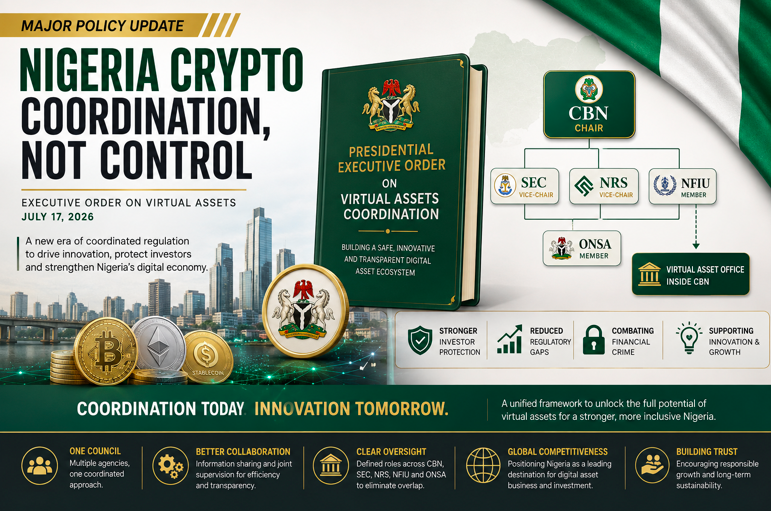
President Bola Tinubu has signed the Presidential Executive Order on Virtual Assets Coordination, 2026, establishing a coordinated framework for the regulation of cryptocurrencies, stablecoins, tokenised assets, and other virtual assets. Rather than creating a new regulator, the Order brings existing agencies together under a common governance structure led by the Central Bank of Nigeria (CBN). (Nairametrics)
The message from Abuja is clear: the focus is no longer on banning crypto it is on coordinating oversight, reducing regulatory gaps, protecting investors, and supporting responsible innovation.
If implemented effectively, the framework could improve regulatory certainty, attract institutional investment, and strengthen Nigeria's position as one of Africa's leading digital asset markets.
A Major Shift in Nigeria's Crypto Policy
Nigeria's relationship with cryptocurrencies has evolved dramatically over the past few years.
In 2021, the Central Bank of Nigeria instructed banks to stop facilitating cryptocurrency transactions, pushing much of the market toward peer-to-peer (P2P) trading.
Since then, digital asset adoption has continued to grow despite regulatory uncertainty.
The new Executive Order represents a different approach.
Instead of treating crypto primarily as a banking issue, the government now recognises that virtual assets sit at the intersection of finance, capital markets, taxation, national security, technology, and anti-money laundering enforcement. (The Guardian Nigeria)
That complexity is exactly what the new coordination framework is designed to address.
Coordination, Not a New Regulator
One of the most important features of the Executive Order is what it doesn't do.
It does not create another regulator.
Instead, it establishes a Virtual Asset Council that coordinates existing agencies while preserving their statutory responsibilities. (Nairametrics)
According to the framework:
This structure recognises that no single institution can regulate every aspect of the digital asset ecosystem.
Why This Matters
For years, businesses operating in Nigeria's crypto sector have faced overlapping regulatory expectations.
Questions such as:
often lacked clear answers.
The new framework aims to reduce these uncertainties by improving cooperation between agencies instead of allowing each institution to work independently. (The Guardian Nigeria)
For investors, regulatory clarity is often just as valuable as favourable regulation.
The Role of the Virtual Asset Office
The Executive Order also creates a Virtual Asset Office, which will operate from the CBN as the Council's operational arm.
Its responsibilities include:
Rather than replacing existing regulators, the office is intended to improve efficiency and reduce duplication.
Investor Protection Becomes a Priority
One of the government's biggest concerns has been the rise of fraudulent investment schemes operating under the banner of cryptocurrency.
The Presidency said fragmented oversight had created opportunities for fraud, money laundering, cybersecurity risks, terrorism financing, and revenue losses.
The Executive Order is intended to close those gaps while still allowing legitimate innovation to flourish. (Channels Television)
For responsible businesses, stronger oversight could increase confidence in the market.
For bad actors, compliance standards are likely to become much tougher.
A Positive Signal for Institutional Adoption
Institutional investors generally avoid markets where regulatory responsibilities are unclear.
This framework could change that.
By clarifying how agencies cooperate, Nigeria becomes more attractive for:
Greater regulatory certainty often translates into increased investment.
What It Could Mean for Stablecoins
Stablecoins are expected to become one of the most important parts of Nigeria's digital economy.
Businesses increasingly use them for:
With both the CBN and SEC participating in the coordination framework, Nigeria may be better positioned to develop a balanced regulatory approach that supports innovation while maintaining financial stability.
The Bigger Picture
This Executive Order reflects a broader global trend.
Countries are increasingly moving away from asking whether digital assets should be regulated.
Instead, they are asking how regulation should be coordinated.
The European Union has MiCA.
The United Arab Emirates has VARA.
Singapore has a structured licensing framework.
The United States continues refining federal oversight.
Nigeria is now moving toward a coordinated institutional model rather than fragmented supervision.
That transition could strengthen the country's competitiveness in Africa's growing digital economy.
Challenges Remain
The Executive Order is an important institutional reform, but implementation will determine its success.
Several questions remain:
The answers will shape market confidence over the coming years.
What This Means for Investors
For investors, the Executive Order is more than a policy announcement.
It signals that Nigeria is moving toward a more mature regulatory environment for digital assets.
That could:
While regulation alone cannot guarantee market growth, predictable rules are often one of the foundations of long-term investment.
Final Thoughts
Nigeria's new Virtual Assets Coordination framework marks an important evolution in the country's approach to cryptocurrencies and blockchain technology.
The emphasis is no longer on fragmented oversight or conflicting mandates. Instead, the government is attempting to build a coordinated system where financial stability, innovation, taxation, market integrity, and national security can coexist.
For crypto businesses, fintech companies, institutional investors, and entrepreneurs, the Executive Order sends a clear message: Nigeria wants a regulated digital asset market not an unregulated one.
If implemented effectively, this could become one of the most consequential policy developments for Nigeria's digital economy in recent years.
Key Takeaways