

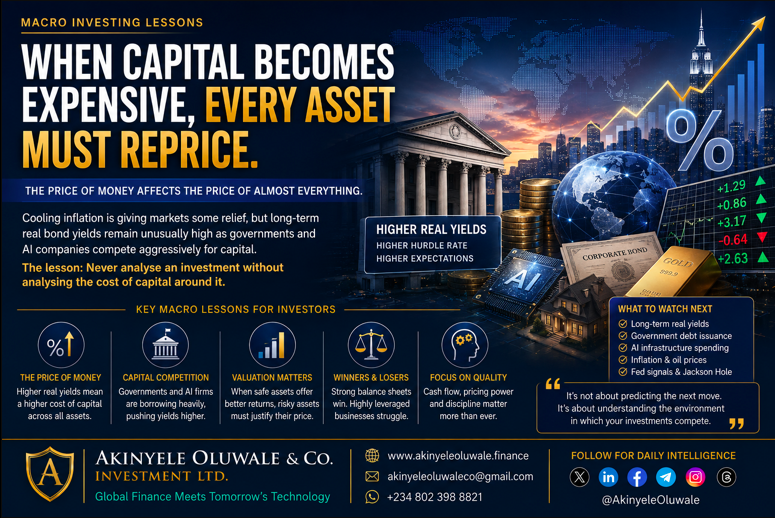
The New Macro Investing Lesson: When Capital Becomes Expensive, Every Asset Must Reprice
Cooling inflation is giving markets some relief, but long-term real bond yields remain unusually high as governments and AI companies compete aggressively for capital. For investors, the lesson is bigger than predicting the next central-bank move: the price of money affects the price of almost everything.
Published: 15 August 2026
Category: Macro & Global Markets • Investing Lessons
By: Akinyele Oluwale & Co. Investment Ltd.
Executive Summary
Global markets are sending investors two very different messages.
U.S. inflation has recently softened, reducing immediate pressure for another Federal Reserve rate increase. Yet long-term inflation-adjusted bond yields remain near multi-year highs. U.S. 30-year real yields are around 3%, near their highest level in roughly 18 years, while long-dated real yields in Britain and Germany are also elevated. (Reuters)
The investing lesson is straightforward:
Never analyse an investment without analysing the cost of capital around it.
When safe assets offer higher real returns, equities, property, crypto and private investments must compete harder for investors' money.
What Happened?
A remarkable amount of capital is being demanded at the same time.
Governments continue borrowing heavily, while the AI investment boom is creating another enormous source of financing demand. Alphabet, Amazon and Meta have collectively raised nearly $220 billion in bonds in 2026, according to Reuters. (Reuters)
Meanwhile, the U.S. 30-year Treasury auction this week produced its highest yield in roughly 25 years. (Reuters)
Yet equities remain resilient. Strong corporate earnings have helped support markets, with the S&P 500 recently reaching record territory. (Reuters)
Background
Interest rates are more than something central banks announce.
They are the price of money.
When capital was exceptionally cheap, investors could justify paying high valuations for assets whose profits might arrive years into the future.
When real yields rise, that calculation changes.
A government bond offering an attractive inflation-adjusted return creates genuine competition for capital. Investors no longer need to accept extraordinary risk simply to pursue a reasonable return.
That affects everything from technology valuations to property financing and leveraged businesses.
Why It Matters
Macro conditions don't necessarily tell investors what to buy.
They help determine what price makes sense.
Consider two identical companies with identical expected profits.
If interest rates are 1%, investors may willingly pay a high multiple for those future earnings.
If safe bonds yield substantially more, the same company's valuation becomes harder to justify.
Nothing inside the business needed to change.
The opportunity cost changed.
That is one of the most important principles in macro investing.
Winners & Losers / Key Stakeholders
Higher real yields can favour savers, bond investors and companies with strong balance sheets and dependable cash flows.
The environment becomes more difficult for heavily indebted businesses, speculative assets and companies whose valuations depend heavily on profits expected far into the future.
But there is an important qualification: higher yields don't automatically mean equities must fall.
Strong earnings can offset valuation pressure and that appears to be happening in parts of today's market. Around 85% of the S&P 500 companies that had reported were beating analysts' profit expectations. (Reuters)
Short-Term Impact
Markets may remain caught between two forces:
Cooling inflation supporting risk assets.
High long-term yields challenging valuations.
The Federal Reserve itself remains divided. Recent inflation data may encourage a prolonged hold, while some policymakers still believe rates should rise further. (Reuters)
That uncertainty makes betting an entire portfolio on one interest-rate prediction particularly dangerous.
Long-Term Impact
However governments, AI infrastructure companies and other borrowers continue competing aggressively for capital, the era of extremely cheap money may not return quickly.
That would have profound implications.
Investors may need to demand stronger cash flows, better balance sheets and more reasonable valuations.
The investment environment could gradually move from:
“Growth at almost any price”
toward:
“Show me the return on the capital.”
Editorial Perspective
One of the easiest mistakes investors make is analysing assets in isolation.
Bitcoin doesn't exist separately from liquidity.
Technology stocks don't exist separately from bond yields.
Property doesn't exist separately from mortgage rates.
Gold doesn't exist separately from real yields, currencies and geopolitical risk.
Every asset competes for capital.
Understanding that relationship doesn't mean becoming a macroeconomic forecaster.
It means recognising that the price you should pay for an investment changes when the price of money changes.
What to Watch Next
Watch long-term real yields, government debt issuance, AI-related corporate borrowing, inflation, oil prices and the Federal Reserve's next signals.
Jackson Hole later this month could provide the next important clue about the Fed's policy direction. (Reuters)
Investing Lesson
Before asking:
“How much can this investment return?”
ask:
“What return can I earn elsewhere for less risk?”
That single question introduces opportunity cost into every investment decision.
And opportunity cost is one of the foundations of intelligent capital allocation.
Key Takeaways
High real yields are increasing competition for capital; AI infrastructure and government borrowing are adding to financing demand; cooling inflation may reduce immediate monetary-policy pressure; and strong corporate earnings are currently helping equities withstand higher yields. (Reuters)
Editorial Bottom Line
Macro investing isn't about correctly predicting every Fed meeting, inflation report or bond-market move.
It is about understanding the environment in which your investments must compete.
When money becomes more expensive, the hurdle rate rises.
And when the hurdle rate rises:
Good investors don't automatically stop investing. They become more selective about the price they are willing to pay.
Sources / Notes
Primary reporting: Reuters, 12–14 August 2026, covering U.S. inflation, real bond yields, AI-related borrowing, equity fund flows and Federal Reserve policy. (Reuters)
Akinyele Oluwale & Co. Investment Ltd.
Global Finance Meets Tomorrow's Technology.