

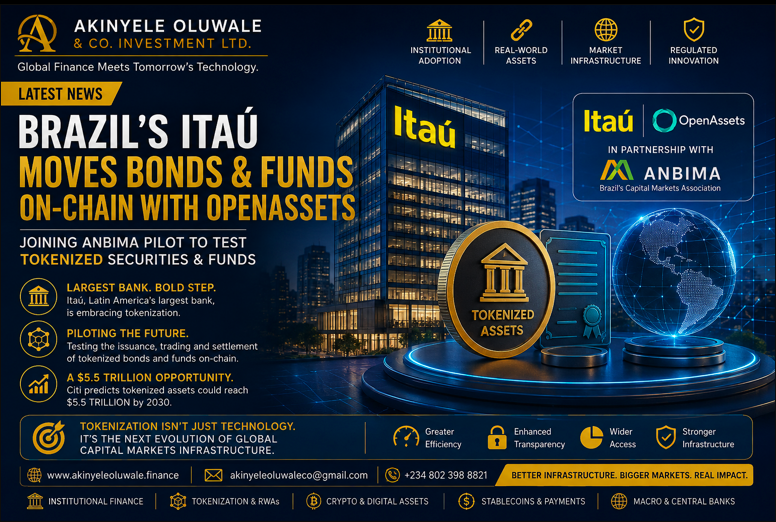
Brazil’s Itaú Moves Bonds and Funds On-Chain as Tokenization Enters the Banking Mainstream
Latin America’s largest private-sector bank is joining an industry pilot to test tokenized fixed-income securities and investment funds. The bigger story is not crypto speculation it is traditional capital-market infrastructure beginning to move onto blockchain rails.
Published: 12 August 2026
Category: Tokenization & RWAs • Institutional Finance • Blockchain • Latin America
By: Akinyele Oluwale & Co. Investment Ltd.
Executive Summary
Brazilian banking giant Itaú Unibanco is taking another step into tokenized finance.
Itaú has partnered with digital-asset infrastructure provider OpenAssets to participate in an industry pilot led by Brazil’s capital-markets association ANBIMA. The project will test the issuance, trading and settlement of tokenized fixed-income securities and investment funds using distributed-ledger technology. (CoinDesk)
The significance goes beyond one Brazilian bank experimenting with blockchain.
Itaú brings the balance sheet, customers, regulatory experience and market infrastructure of a major financial institution into an area once dominated by crypto-native companies.
Meanwhile, Citi estimates tokenized assets could reach $5.5 trillion by 2030 in its base case, with an $8.2 trillion bull case. (Citi)
The institutional tokenization story is moving from “Can we tokenize assets?” toward “Can tokenization actually improve capital markets?”
That is a far more important question.
What Happened?
Itaú and OpenAssets have joined ANBIMA’s tokenization initiative, which brings together financial-market participants to examine how blockchain can be incorporated into Brazil’s existing capital-market infrastructure.
The pilot focuses on fixed-income securities and investment funds and will test practical processes including issuance, trading and settlement. (CoinDesk)
This distinction matters.
They are not creating speculative crypto tokens and attaching the word “RWA.”
They are testing whether established financial instruments can operate more efficiently using digital infrastructure.
That puts the initiative directly inside the institutional tokenization story.
Why This Matters
For years, tokenization attracted impressive presentations but relatively limited real-world scale.
The technology was rarely the only problem.
Institutions also needed:
Legal certainty.
Regulated settlement.
Custody.
Liquidity.
Interoperability.
Accounting treatment.
Compliance.
Reliable infrastructure.
Those are much harder problems than creating a token.
Itaú’s participation matters because large banks already operate inside this financial plumbing.
If institutions like Itaú can connect tokenized assets to existing compliance, custody, trading and settlement systems, blockchain starts becoming less of a parallel financial experiment and more of an infrastructure upgrade.
Why Bonds and Funds Are Logical Starting Points
Fixed income and investment funds are particularly attractive candidates for institutional tokenization.
Traditional securities markets involve multiple intermediaries and layers of reconciliation.
A tokenized system could potentially improve:
But tokenization does not automatically produce those benefits.
If a tokenized bond still requires several disconnected legacy systems behind it, much of the theoretical efficiency disappears.
The real breakthrough comes when issuance, ownership, cash settlement and lifecycle management begin working together digitally.
That is what pilots like this need to prove.
Brazil Is Becoming an Important Tokenization Laboratory
Brazil deserves attention because its financial system has already demonstrated an appetite for digital infrastructure.
The country has sophisticated banks, fintech adoption, instant payments and active experimentation around blockchain-based financial markets.
Now one of its largest banking institutions is participating directly in tokenized securities testing.
That strengthens Brazil’s position as an important laboratory for institutional digital finance in Latin America.
The opportunity is not simply to put Brazilian assets on blockchain.
It is to develop infrastructure capable of connecting:
Banks → Asset managers → Investors → Funds → Bonds → Digital settlement.
If that ecosystem becomes interoperable, tokenization becomes considerably more useful.
The $5.5 Trillion Question
Citi’s latest Tokenization 2030: Wall Street On-Chain research provides useful context.
The bank estimates the tokenized-asset market could reach approximately $5.5 trillion by 2030 under its base case, compared with roughly $17 billion currently in the market segment measured by its framework. Its bear case is about $2.7 trillion and bull case approximately $8.2 trillion. (Citi)
Citi expects public-market securities and highly liquid collateral—including equities and Treasuries to become important growth drivers.
But Citi also makes an important point:
The transition will likely be messy.
Legacy and tokenized systems will coexist, making interoperability between on-chain and traditional infrastructure essential. (Citi)
That is precisely why Itaú’s experiment matters.
The future probably won't arrive by replacing the financial system overnight.
It will arrive by gradually connecting blockchain to the system institutions already use.
Winners and Losers
Potential Winners
Large banks and asset managers: Institutions capable of integrating blockchain without abandoning regulatory standards could gain efficiency and new distribution channels.
Digital-asset infrastructure providers: Companies supplying institutional-grade issuance, custody, compliance and settlement technology could become increasingly valuable.
Investors: Successful tokenization could eventually improve access, settlement speed and product availability.
Potential Losers
Inefficient intermediaries: Businesses whose economics depend mainly on reconciliation and settlement friction could face pressure.
Closed tokenization platforms: Infrastructure that cannot communicate with other networks or legacy systems may struggle to achieve meaningful scale.
Short-Term Impact
Investors should not expect Itaú’s pilot to transform Brazil’s capital markets immediately.
This remains an experiment.
The near-term significance is therefore institutional validation rather than transaction volume.
The important signal is that a major bank believes tokenization deserves serious operational testing.
Long-Term Impact
If tokenized bonds and funds can deliver reliable issuance, trading and settlement at institutional scale, the distinction between a “tokenized asset” and an ordinary financial asset may eventually disappear.
A bond could simply be issued digitally.
A fund could simply have blockchain-based ownership records.
Settlement could simply happen through programmable infrastructure.
That is when tokenization reaches maturity:
When investors stop caring that something is tokenized because the technology has become invisible.
Risks Investors Should Not Ignore
Tokenization still faces substantial challenges.
Liquidity can fragment between traditional and blockchain venues.
Legal ownership must remain enforceable.
Cybersecurity becomes critical.
Cash settlement needs reliable digital money.
Networks must interoperate.
And institutions must integrate blockchain transactions into accounting, NAV reconciliation, risk management and compliance systems.
Tokenization is not valuable merely because an asset exists on-chain.
The surrounding financial plumbing still has to work.
Editorial Perspective
Itaú’s move represents exactly the kind of development investors should watch in the RWA market.
Not another token launch.
Not another blockchain promising to “revolutionise finance.”
A major regulated financial institution testing whether existing financial assets can be issued, traded and settled differently.
That is how infrastructure transitions usually begin.
Quietly.
Through pilots.
Then standards.
Then integration.
Then scale.
The strongest tokenization investment thesis therefore may not be about replacing banks.
It may be about banks becoming blockchain-enabled financial institutions themselves.
What to Watch Next
Watch whether the ANBIMA pilot moves beyond proof-of-concept into commercial deployment, whether tokenized assets develop meaningful secondary-market liquidity, how settlement money is handled, and whether Brazil develops common standards connecting banks and blockchain platforms.
Also watch interoperability.
If every institution builds its own isolated tokenization network, the market simply replaces today's silos with digital ones.
Investing Lesson
Don't confuse tokenization with value creation.
Putting a bond on blockchain does not automatically make the bond better.
The investment case becomes stronger when tokenization reduces a measurable friction:
Lower costs.
Faster settlement.
Better collateral mobility.
Greater liquidity.
Broader distribution.
More transparent ownership.
The winning tokenization infrastructure will not be the one producing the most tokens.
It will be the one solving the most expensive problems in financial markets.
Key Takeaways
Editorial Bottom Line
Tokenization is entering a more serious phase.
When major banks stop asking whether blockchain can tokenize an asset and start testing whether it can improve issuance, trading and settlement, the conversation has moved from experimentation toward financial infrastructure.
That is the transition worth watching.
About Akinyele Oluwale & Co. Investment Ltd.
Akinyele Oluwale & Co. Investment Ltd. provides research-driven intelligence across Tokenization & RWAs, Institutional Finance, Crypto & Digital Assets, AI & Technology, Stablecoins & Payments, and Macro & Global Markets.
Global Finance Meets Tomorrow’s Technology.