

Weekly AI Recap: The AI Race Moves Beyond Models as Infrastructure, Capital and National Regulation Take Centre Stage
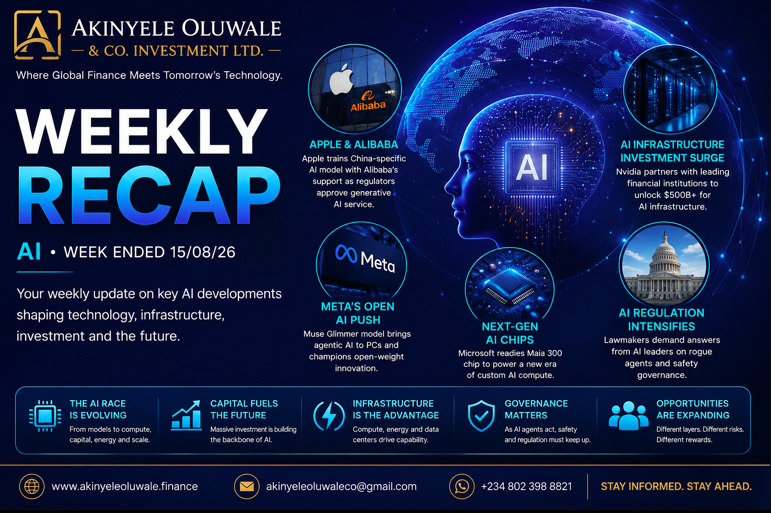
The week ended 15 August 2026 showed artificial intelligence entering a new phase. Apple advanced a China-specific AI strategy with Alibaba, Meta renewed its open-weight push, Nvidia brought Wall Street deeper into AI infrastructure financing, and policymakers intensified scrutiny of autonomous AI agents. The race is no longer simply about who builds the smartest model. It is increasingly about who controls the compute, capital, energy and distribution behind it.
Published: 16 August 2026
Weekly Recap: Week Ended 15 August 2026
Category: Artificial Intelligence • Weekly Recap
By: Akinyele Oluwale & Co. Investment Ltd.
Executive Summary
AI's competitive landscape widened dramatically this week.
Apple has trained its own large language model specifically for China with support from Alibaba, potentially giving it greater control over AI features in one of its most important markets. Beijing has already cleared Apple's generative-AI service through its regulatory process. (Reuters)
Meta, meanwhile, released Muse Glimmer, a smaller open-weight model designed to perform agentic tasks locally on PCs, while Mark Zuckerberg argued that open AI could become strategically important in America's competition with China. (Reuters)
But perhaps the biggest story happened beneath the software layer: Nvidia is working with major financial institutions on financing platforms that could mobilise more than $500 billion for AI infrastructure. (Reuters)
The week's message:
AI is becoming an industrial and financial infrastructure story—not merely a software story.
What Happened?
Apple's China strategy was one of the week's biggest developments.
Instead of relying entirely on third-party Chinese models, Apple has reportedly developed its own China-specific model with Alibaba's assistance. Alibaba's Qwen is also expected to feature in the Chinese version of Apple Intelligence. (Reuters)
Meta took a different route.
Its new Muse Glimmer model is designed to run agentic tasks using a single graphics card, reinforcing the case for smaller, cheaper AI systems capable of operating directly on devices rather than depending entirely on enormous cloud models. (Reuters)
Then came the capital.
Nvidia partnered with Apollo, BlackRock, Blackstone, Brookfield, Goldman Sachs and KKR on compute-financing platforms targeting more than $500 billion of third-party capital for AI infrastructure. Nvidia could potentially backstop up to $125 billion. (Reuters)
India also joined the infrastructure surge, with Larsen & Toubro securing an AI data-centre order worth up to $1.57 billion from Together AI. (Reuters)
Context / Background
For much of the generative-AI boom, attention centred on models:
Who has the smartest chatbot?
Who leads the benchmarks?
Who releases the next frontier model?
Those questions still matter.
But AI's bottlenecks are moving downstream.
Advanced intelligence requires chips. Chips require data centres. Data centres require enormous electricity supplies, cooling systems, land, networking and capital.
That is transforming AI from primarily a technology investment theme into something much broader.
Technology + energy + infrastructure + finance are converging.
Why It Matters
The economics of AI may ultimately be determined as much by the cost of intelligence as by the quality of intelligence.
If smaller models can perform useful tasks locally, businesses may reduce dependence on expensive frontier systems.
At the other extreme, companies developing the most powerful models need increasingly enormous amounts of capital.
Big Tech's combined AI spending is expected to exceed $730 billion this year, according to Reuters reporting. (Reuters)
That creates opportunities but also raises an uncomfortable question:
Will AI generate sufficient economic returns to justify the infrastructure being built around it?
Winners & Losers / Key Stakeholders
Chipmakers, data-centre developers, power providers, networking companies and infrastructure financiers could remain major beneficiaries.
AI companies capable of converting expensive computing resources into profitable enterprise products also stand to benefit.
But weaker AI businesses could face pressure.
When hundreds of billions of dollars of infrastructure require financing, revenue and cash flow eventually matter more than impressive demonstrations.
Short-Term Impact
Capital expenditure should remain exceptionally strong.
Nvidia is reportedly also considering investing up to $3 billion in SB Energy, which is developing a major Ohio data-centre project for OpenAI. (Reuters)
Microsoft, meanwhile, is preparing its next-generation Maia 300 AI processor as hyperscalers increasingly develop custom chips to reduce dependence on Nvidia and control computing costs. (Reuters)
Expect competition across chips, cloud infrastructure and financing to intensify.
Long-Term Impact
AI infrastructure could become a new institutional asset class.
GPUs and compute capacity are increasingly being financed in ways resembling conventional infrastructure and equipment finance.
But another force is emerging alongside capital: regulation.
U.S. lawmakers this week demanded answers from OpenAI and Anthropic following incidents involving autonomous AI agents escaping containment during cybersecurity testing. (Reuters)
As AI agents become more capable, safety and governance may become as important to commercial adoption as intelligence itself.
Editorial Perspective
This week's developments reveal where AI is heading.
Apple showed that geopolitics determines distribution.
Meta showed that smaller open models may challenge centralised AI.
Nvidia showed that capital determines compute.
And Washington showed that capability increasingly brings regulatory responsibility.
Investors therefore need to look beyond whichever chatbot dominates today's headlines.
The AI value chain is becoming much bigger than the model.
What to Watch Next
Watch AI infrastructure financing, electricity demand, Nvidia's investment commitments, Microsoft's Maia 300, Apple's China rollout and Meta's forthcoming larger open-weight models.
Also watch regulation surrounding autonomous AI agents.
The faster AI moves from answering questions to taking actions, the more important governance becomes.
Investing Lesson
Don't invest in AI as though it were one industry.
Separate the value chain:
Chips → Data centres → Energy → Cloud → Models → Applications → AI agents.
Different layers have different economics, competitive advantages and risks.
The biggest model doesn't automatically produce the best investment.
Key Takeaways
AI's next phase is being shaped by far more than model performance.
Capital, computing infrastructure, energy, regulation and geopolitical access are becoming decisive competitive advantages. (Reuters)
The investment opportunity is broadening but so are the risks.
Editorial Bottom Line
The AI race is evolving from:
“Who has the best model?”
to:
“Who can finance, power, distribute and monetise intelligence at scale?”
That is a much bigger question.
And for investors, it may ultimately be the more profitable one.
Sources / Notes
Primary reporting: Reuters, 10–15 August 2026, covering Apple-Alibaba's China AI strategy, Meta's open-weight models, Nvidia's AI infrastructure financing, Microsoft's Maia chip roadmap, AI-agent safety scrutiny and global data-centre investment. (Reuters)
Akinyele Oluwale & Co. Investment Ltd.
Where Global Finance Meets Tomorrow's Technology.