

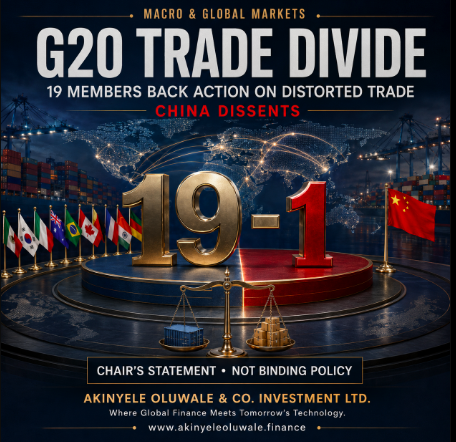
G20 Isolates China as 19 Members Target Distorted Trade and Excessive Exports
Published: 3 September 2026
Category: Macro & Global Markets • Central Banks • Institutional Finance
By: Akinyele Oluwale & Co. Investment Ltd.
Executive Summary
Nineteen G20 members have supported stronger action against economic policies that create persistent trade imbalances, leaving China as the sole dissenter.
The statement issued after the G20 finance ministers and central bank governors met in Asheville, North Carolina, called on countries with excessive external surpluses to remove policies that suppress domestic consumption and create overdependence on exports.
Although China was not directly named in the disputed section, its export-led economic model was clearly the central concern.
However, this was a G20 chair’s statement, not a unanimously approved communiqué. It represents significant political alignment, but it does not impose binding trade measures on China.
Background
China has built enormous manufacturing capacity across electric vehicles, batteries, solar equipment, semiconductors, steel and consumer goods. Weak domestic demand means much of that output must be sold abroad.
China recorded a goods trade surplus of approximately $1.2 trillion in 2025, while its trade surplus with the European Union reached €360.6 billion.
The United States has already erected higher tariff barriers against Chinese imports. Washington argues that these restrictions are redirecting lower-priced Chinese products into Europe, Asia and other markets, threatening local manufacturing and employment.
At the G20 meeting, the United States secured support from every participant except China for language opposing “non-market policies” that worsen global imbalances and encourage export-dependent growth.
China maintains that it does not deliberately pursue trade surpluses and says it is working to strengthen domestic demand and keep its economy open.
Why It Matters
This is not simply another disagreement between Washington and Beijing. It shows that concerns about China’s industrial capacity are spreading beyond the United States.
European and emerging-market economies increasingly fear that heavily supported Chinese production could overwhelm their domestic industries. Cheap imports may help consumers in the short term, but they can weaken local factories, employment and industrial investment.
The statement could therefore become the foundation for coordinated measures involving:
* Higher tariffs or import restrictions.
* Anti-dumping and subsidy investigations.
* Domestic manufacturing incentives.
* Stronger supply-chain protection.
* Pressure on China to stimulate household consumption.
* Closer monitoring of exchange-rate and industrial policies.
The market risk is that economic coordination against industrial overcapacity gradually becomes a wider trade confrontation.
Stakeholders: Winners and Losers
Potential winners include manufacturers competing with Chinese imports, particularly in automobiles, renewable energy, steel and advanced technology. Governments seeking to rebuild domestic production may also gain political support for industrial incentives.
Countries capable of replacing parts of China’s supply chain including India, Vietnam, Mexico and several Southeast Asian economies could attract additional investment.
Potential losers include Chinese exporters and multinational companies dependent on China-centred production. Consumers may also face higher prices if tariffs restrict access to cheaper products.
Commodity exporters could be affected if weaker Chinese production or retaliatory measures reduce demand for industrial materials.
Short-Term Impact
The statement itself does not create immediate tariffs or sanctions. Its short-term importance is political.
Investors should expect stronger rhetoric, more trade investigations and greater scrutiny of Chinese electric vehicles, batteries, solar products, semiconductors and critical minerals.
China may respond through diplomatic pressure, targeted support for exporters or tighter control over strategically important materials. Beijing’s dominance in rare-earth processing gives it meaningful leverage.
Currency markets will also watch the yuan. A stronger currency could reduce criticism by making Chinese exports more expensive, but rapid appreciation would create additional pressure on China’s manufacturers.
Long-Term Impact
If the 19-member alignment survives, globalisation may enter a more defensive phase. Trade policy would increasingly focus on production security and industrial resilience rather than simply obtaining goods at the lowest possible price.
This could lead to parallel supply chains organised around the United States, China and regional powers. Companies would face higher costs but potentially lower geopolitical dependence.
The deeper solution, however, cannot rely entirely on tariffs. China would need to increase household income and domestic consumption, while deficit countries must address their own fiscal, investment and productivity weaknesses.
Editorial Perspective
The G20 statement is politically important, but describing it as complete global unity would be misleading.
The language reflects a broad concern about China’s economic model, yet participating countries do not share identical interests. Some want tougher restrictions; others still depend heavily on Chinese trade and investment.
China also has a legitimate argument that trade imbalances cannot be blamed on one country alone. Large fiscal deficits, weak competitiveness and excessive consumption in importing countries also contribute.
The breakthrough is therefore not a final agreement against China. It is the emergence of a shared diagnosis: unlimited export-led growth by a major economy can destabilise industries elsewhere.
What to Watch Next
Investors should monitor whether G20 members convert the statement into coordinated trade measures, China’s domestic stimulus policies and any retaliation involving critical minerals.
The durability of this alliance not the wording of one meeting statement will determine whether the development becomes a genuine turning point in global trade.
Notes
This analysis is based on the official [G20 Chair’s Statement issued by the US Treasury](https://home.treasury.gov/news/press-releases/sb0620), reporting from [Reuters](https://www.reuters.com/world/china/us-pushes-g20-cut-trade-imbalances-focus-china-2026-09-01/) and coverage by the [Associated Press](https://apnews.com/article/treasury-bessent-g20-trade-tariffs-426a8b4d10c6610c2d7200bab412fe1b).
Akinyele Oluwale & Co. Investment Ltd.
Where Global Finance Meets Tomorrow’s Technology.