

Published: October 1, 2026
Category: Macro & Global Markets • Digital Assets • Investment Strategy
By: Akinyele Oluwale
The fourth quarter of 2026 has begun, but investors are entering October with a very different environment from the one that shaped the beginning of the year.
The central question is no longer simply whether inflation is falling or whether artificial intelligence and digital assets will continue expanding.
The more important question is how several powerful forces are beginning to interact.
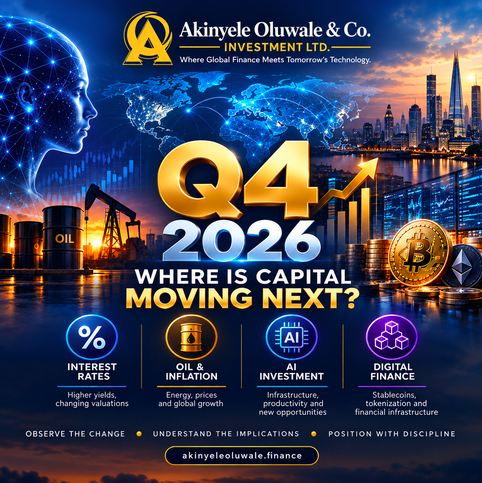
Interest rates. Energy prices. Artificial intelligence. Digital finance.
Together, they could determine the direction of capital through the final quarter of 2026.
September delivered significant pressure across global government-bond markets.
Rising energy costs have complicated the inflation outlook, while resilient economic activity and heavy investment associated with the AI boom have contributed to expectations that interest rates could remain elevated for longer. Reuters reported that major sovereign-bond markets were heading toward their worst month in years at the end of September. Reuters
For investors, this matters far beyond bonds.
Higher government yields increase the return investors can obtain from comparatively lower-risk assets. That raises the hurdle that equities, property and other risk assets must overcome to attract capital.
It also affects company valuations because future earnings are discounted at higher rates.
The inflation picture is not one-directional.
U.S. August PCE inflation increased less than economists expected, according to data reported on September 30. That development gave the Federal Reserve more flexibility over whether another rate increase would be necessary immediately. Reuters
This creates an important Q4 tension:
Markets face elevated yields, but monetary policy remains highly dependent on incoming economic data.
Investors therefore need to watch inflation, employment, economic growth and central-bank communication together rather than treating any single data release as decisive.
Energy is another critical variable.
Oil strengthened significantly during September amid geopolitical tensions and supply concerns. Higher energy costs can eventually affect transportation, manufacturing, consumer prices and inflation expectations. Reuters
That creates a potential chain reaction:
Higher oil → inflation pressure → tighter monetary policy expectations → higher yields → pressure on asset valuations.
Understanding that transmission mechanism is more useful than simply watching the daily oil price.
Artificial intelligence should no longer be viewed only as a technology-sector theme.
Large-scale investment in computing infrastructure, data centres, semiconductors and electricity capacity means AI increasingly intersects with capital expenditure, productivity, energy demand and economic growth.
That makes the AI investment cycle relevant to both equity investors and macroeconomic analysis.
The key question for Q4 is whether investment continues translating into sustainable productivity and earnings growth—or whether valuations move substantially ahead of economic returns.
Crypto should also be examined beyond short-term token prices.
Stablecoins, tokenization, blockchain settlement and institutional digital-asset infrastructure remain important areas of development.
In late September, the U.S. Federal Reserve proposed rules for dollar-backed stablecoin issuers under the federal framework established by the GENIUS Act. Reuters
That is part of a larger structural question:
How much of traditional financial infrastructure eventually moves onto programmable digital rails?
The answer will not be determined by one cryptocurrency cycle.
It will depend on regulation, institutional adoption, settlement efficiency, liquidity, interoperability and genuine economic utility.
Rather than attempting to predict every market movement, investors should monitor the relationships between five variables:
Inflation → Interest Rates → Liquidity → Valuations → Capital Flows
Then overlay three structural themes:
Artificial Intelligence → Tokenization → Digital Financial Infrastructure
This creates a more disciplined framework for interpreting Q4.
The strongest investment opportunities may not necessarily come from predicting which asset rises fastest.
They may come from understanding where capital is moving and why.
October begins with uncertainty, but uncertainty itself is not an investment strategy.
Neither is excitement.
The objective should be to distinguish temporary market narratives from structural financial change.
Observe the change. Understand the implications. Position with discipline.
Akinyele Oluwale & Co. Investment Ltd.
Where Global Finance Meets Tomorrow’s Technology.
akinyeleoluwale.finance