

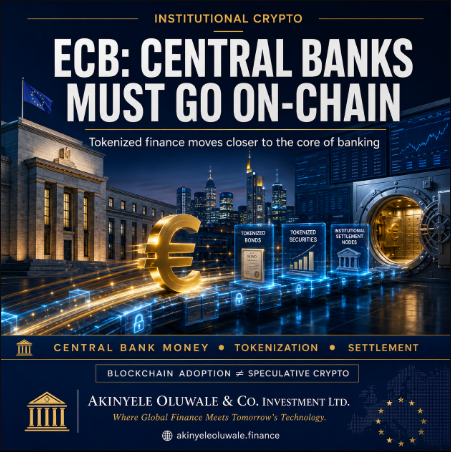
ECB Calls for Central Banks to Go On-Chain as Tokenized Finance Moves Closer to the Core of Banking
Published: 31 August 2026
Category: Institutional Crypto • Banking • Digital Assets
By: Akinyele Oluwale & Co. Investment Ltd.
Executive Summary
The European Central Bank is no longer discussing blockchain only as an external technology to regulate. It is now considering how central-bank money and monetary-policy operations could function directly within tokenized financial markets.
Speaking at the Jackson Hole Economic Policy Symposium on 28 August 2026, ECB Executive Board member Isabel Schnabel argued that central banks must be prepared to “go on-chain.”
Her central message was straightforward: if securities and other financial assets move onto distributed ledgers, central-bank money must remain available as the safest settlement asset. Otherwise, private stablecoins or other digital instruments could occupy that position.
This is a significant institutional shift, but it should not be mistaken for an unrestricted endorsement of cryptocurrencies.
Background
Tokenization allows financial assets including bonds, funds and collateral to be represented and transferred through distributed-ledger infrastructure.
Banks and financial institutions are exploring this technology because it could support faster settlement, automated collateral management, programmable transactions and longer operating hours.
However, tokenized securities still require a reliable payment asset. Today, major financial institutions generally prefer settling important transactions in central-bank money because it carries minimal credit risk.
Schnabel warned that central banks risk losing influence if financial markets migrate to blockchain infrastructure while public money remains confined to traditional payment systems.
The ECB is addressing this through two initiatives. Project Pontes is designed to connect distributed-ledger platforms with existing Eurosystem payment services. Project Appia is developing a longer-term framework for Europe’s tokenized financial market.
Why It Matters
Money and securities must move together for tokenized markets to work efficiently.
If a tokenized bond changes ownership but payment still travels through disconnected traditional systems, many promised efficiencies disappear. On-chain central-bank money could allow both sides of a transaction to settle within a connected environment.
This could reduce settlement delays, improve collateral mobility and lower counterparty exposure. It could also protect Europe’s monetary sovereignty. If dollar-denominated stablecoins become the dominant settlement instrument for tokenized assets, Europe may become increasingly dependent on privately issued foreign digital money.
Stakeholders: Winners and Losers
Banks, regulated tokenization platforms, asset managers and infrastructure providers could benefit from a credible central-bank settlement layer.
Institutional investors may gain faster settlement, improved transparency and more efficient use of collateral. European technology companies could also benefit if the region develops interoperable financial infrastructure rather than relying mainly on American stablecoins and payment platforms.
Stablecoin issuers may face stronger competition, particularly in large institutional settlements. However, stablecoins could remain useful for cross-border payments, digital commerce and markets operating outside conventional banking hours.
Fragmented blockchain networks and poorly governed tokenization projects could lose relevance if institutional markets favour regulated, interoperable systems.
Short-Term Impact
The immediate effect will be greater attention on Project Pontes and its ability to connect tokenized platforms with the Eurosystem’s existing TARGET payment services.
Banks and market participants will examine technical access, settlement finality, operating hours, privacy, compliance obligations and the assets eligible for settlement.
The announcement may also accelerate institutional investment in tokenization infrastructure across Europe.
Long-Term Impact
If central-bank money becomes available on distributed ledgers, tokenization could move from limited pilots into core financial-market operations.
Government bonds, investment funds, bank deposits and collateral could eventually trade and settle through programmable infrastructure while retaining a connection to regulated public money.
Yet technology alone will not create a unified market. Legal ownership, cybersecurity, interoperability and cross-border regulation must also be resolved.
Editorial Perspective
This development confirms that blockchain is gradually entering the architecture of institutional finance but on the terms of central banks and regulated institutions.
The winners may not be projects promising to replace the financial system. They may be the platforms capable of integrating with it.
Investors should therefore separate blockchain adoption from cryptocurrency speculation. A central bank using distributed-ledger technology does not automatically create value for every token associated with “real-world assets” or digital payments.
Infrastructure adoption is real. Investment quality must still be proven.
What to Watch Next
Watch the launch and practical scope of Project Pontes, participation by commercial banks, interoperability between public and private ledgers, and the ECB’s treatment of euro stablecoins and tokenized deposits.
The crucial test is whether Europe can move beyond demonstrations and support meaningful institutional settlement at scale.
Sources and Notes
The analysis is based on Isabel Schnabel’s official [ECB speech, “Central banks on-chain”](https://www.ecb.europa.eu/press/key/date/2026/html/ecb.sp260828~fe9afc86e8.en.html), delivered at Jackson Hole on 28 August 2026, and additional reporting from [Reuters](https://www.reuters.com/business/finance/ecb-should-embrace-blockchain-safeguard-its-role-schnabel-says-2026-08-28/).
Akinyele Oluwale & Co. Investment Ltd
Where Global Finance Meets Tomorrow's Technology.
*This article is for information and education only. It is not personalised investment advice.*