

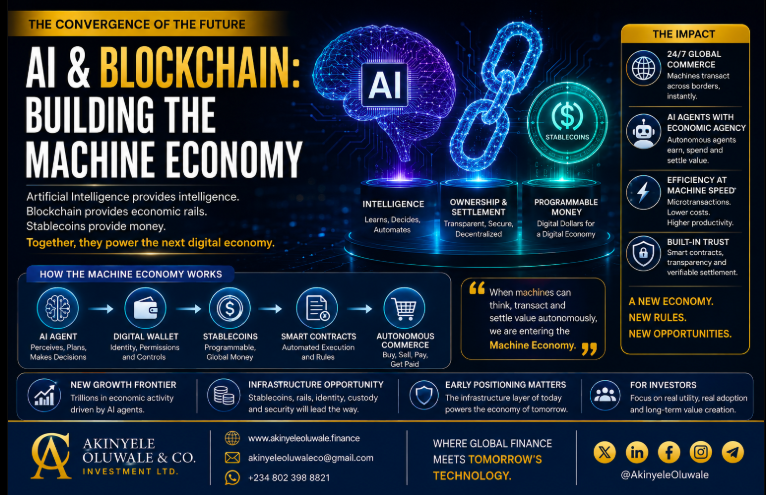
AI & Blockchain: The Two Technologies Behind the Machine Economy
Artificial intelligence is learning to work, negotiate and make decisions for itself. Blockchain is giving software ownership, settlement and value-transfer capabilities. Together, and separately, these two technologies can form the foundation for an economy in which machines can do commerce alongside humans.
Published: 25 August 2026
Category: AI & Blockchain • Stablecoins • Digital Assets • Future of Finance
By: Akinyele Oluwale & Co. Investment Ltd.
Executive Summary
The confluence between artificial intelligence and blockchain is set to create financial infrastructure.
AI agents are learning to research, code, shop, bargain and perform increasingly complex tasks; however, intelligence alone cannot create an autonomous economy. Economic activity also requires compensation and settlement. This is where programmable money and infrastructure can be critical.
Traditional banking was built around humans, businesses and limited banking hours. By contrast, blockchain operates 24/7 and is location-independent. The emerging thesis is therefore straight forward:
AI provides intelligence, blockchain provides rails, and stablecoins provides money.
This triumvirate therefore creates the foundation for a machine economy.
What Happened?
Recent events have demonstrated the potential convergence between AI and blockchain.
Circle CEO Jeremy Allaire has been touting programmable financial infrastructure as stablecoins and tokenized assets displace cash and traditional money market instruments.
Meanwhile, Raoul Pal has argued that the most interesting attribute of stablecoins for an agentic economy is not necessarily their liquidity but their programmability.
Blockchain analytics have also demonstrated increased agent-initiated stablecoin transactions.
The trend is certainly interesting given that AI agents are poised to perform increasingly complex economic tasks.
Background
Modern financial infrastructure is built around the notion that there must be a human or business behind every transaction.
AI agents turn this paradigm on its head.
Consider an autonomous agent that is responsible for running an online business.
Such an agent could potentially perform the following tasks:
• Researching suppliers
• Bargaining with suppliers
• Renting or buying cloud-computing capacity
• Paying another autonomous agent for services rendered
• Collecting payments from customers
• Processing subscriptions
• And potentially even redeploying excess cash
Standard banking infrastructure was never designed to handle tens of thousands of these types of high-frequency transactions.
By contrast, a blockchain wallet could potentially operate 24/7 while smart contracts could facilitate the actual transactions. Stablecoins would then provide the necessary programmable money layer.
Why It Matters
This emerging infrastructure would fundamentally change the nature of commerce.
AI Agents -> Wallets -> Stablecoins -> Smart Contracts -> Autonomous Commerce
The entire value chain would be transformed with significantly lower costs associated with machine-to-machine transactions. Consider the implications of software running inside spending limits, transaction rules and automated compliance.
It is one thing to simply tokenize assets, but it is something else to create money that can be used by machines to acquire other assets.
## Winners & Losers / Key Stakeholders
It stands to reason that stablecoin issuers such as Circle stand to benefit from this paradigm, if autonomous agents require digital dollars to perform transactions.
Blockchain infrastructure that facilitates large-volume transactions cheaply would also benefit.
Payment enablers, exchanges, custodians and identity verification firms could potentially dominate this space as well.
Traditional financial intermediaries would find their relevance increasingly undermined if autonomous agents can transact directly with each other.
However, the emergence of autonomous money also creates new security concerns.
If an AI agent can pay, it can also steal.
Short-Term Impact
Investors should be careful not to conflate the AI agent trend with a hype cycle around yet another token or coin.
The majority of autonomous economic activity is likely to take place in the future. The near-term opportunity is likely to be found in infrastructure such as stablecoins, wallets, identity verification, custody solutions, cybersecurity and settlement.
The key question will therefore not be which token has AI in its name but which infrastructure is being utilized by AI agents.
Long-Term Impact
The long-term impact could be profound.
Billions of autonomous agents could potentially be transacting with humans, businesses and other agents 24/7.
They could be acquiring data, cloud storage, computational power and rendering services to other autonomous agents.
These machines would then essentially form a self-contained economy that operates at the speed of light. It would be similar to the current internet infrastructure, but instead of information being the unit of value, programmable money could potentially be transferred on similar rails.
Editorial Perspective
The emergence of this type of infrastructure is reminiscent of the evolution of the internet.
Software previously gained access to information; now, it is being endowed with economic agency.
The programmable money layer in this context is somewhat analogous to traditional financial systems acting as the gatekeepers of value.
However, autonomous money also requires appropriate safeguards.
Identity management, permissions, cybersecurity, transaction limits and accountability will potentially be as important as the foundational technology itself.
Winners will therefore potentially be decided not necessarily by who has the best AI but by who builds trusted infrastructure around AI.
What to Watch Next
Investors should watch the rise of stablecoin transactions initiated by agents, wallets, protocols, tokenized assets and institutional custody solutions.
Regulatory developments will also be crucial given that liability issues will inevitably arise when autonomous agents control significant sums of capital.
Investing Lesson
Invest in infrastructure before narratives. Focus on users, transactions, revenues and utility rather than simply "AI" or "blockchain".
Key Takeaways
The emerging infrastructure seems likely to enable new types of autonomous economic activity.
AI provides intelligence, blockchain provides ownership settlement, stablecoins provides money and smart contracts provides execution.
They could potentially form the operating system for an entirely new type of digital economy.
Editorial Bottom Line
AI agents could fundamentally change who performs which tasks in the economy.
Blockchain infrastructure could fundamentally change who owns which assets.
The confluence of these two disruptive technologies could therefore potentially create significant investment opportunities.
When machines can think, act and transact for themselves, we will no longer be talking about only artificial intelligence or only blockchain.
We will be talking about a machine economy.
Akinyele Oluwale & Co. Investment Ltd.
Where Global Finance Meets Tomorrow's Technology.