

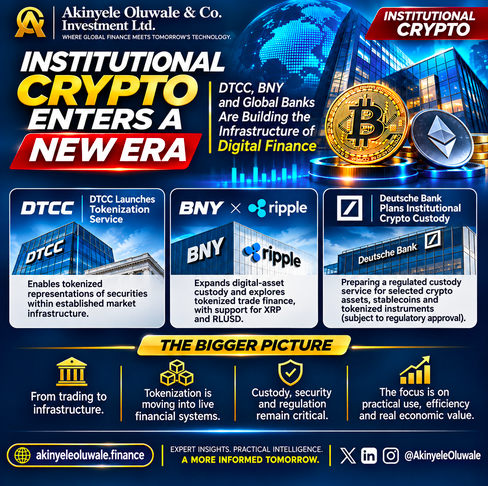
Institutional cryptocurrency adoption is entering a more demanding phase. The focus is shifting from speculative exposure toward custody, tokenized securities, settlement infrastructure, regulatory compliance and the practical economics of digital assets.
Published: Monday, November 2, 2026 | Category: Institutional Crypto | By: Akinyele Oluwale
The most important question facing institutional cryptocurrency markets is no longer simply whether major financial institutions will participate.
It is how they will participate, what infrastructure they will control, and whether their systems can deliver the security, legal certainty and efficiency expected in modern finance.
That distinction matters for investors, banks, asset managers, regulators and businesses preparing for the next stage of digital-finance development.
Institutional crypto is not one market or one technology. It encompasses investment products, asset custody, blockchain settlement, tokenized financial instruments, stablecoin-based payments and the operational systems connecting them.
The developments emerging from late October into early November 2026 illustrate why these activities must be evaluated separately.
Executive Summary
Institutional cryptocurrency is entering a new stage of development, and the latest announcements from major financial institutions reveal a significant change in direction.
On October 28, 2026, the Depository Trust & Clearing Corporation (DTCC) launched its Tokenization Service, connecting blockchain-based securities representations with established financial-market infrastructure.
Just one day earlier, on October 27, BNY and Ripple announced an expanded relationship covering institutional digital-asset custody and the exploration of tokenized trade finance.
Meanwhile, Deutsche Bank's September announcement of a planned institutional custody service, subject to regulatory completion, demonstrated how major commercial banks are positioning themselves to offer digital-asset services within existing banking structures.
These developments represent more than another round of cryptocurrency announcements.
They suggest that financial institutions are increasingly concentrating on the infrastructure required to hold, transfer, settle and administer digital assets.
This is an important distinction.
For several years, much of the public discussion surrounding institutional cryptocurrency focused on whether Bitcoin and other digital assets would attract large investors.
Today, the conversation is expanding.
Banks and financial-market infrastructure providers are examining how blockchain technology can support securities ownership, asset servicing, collateral movement, institutional custody and cross-border financial transactions.
The emerging institutional opportunity is therefore broader than cryptocurrency trading.
It concerns the possible modernisation of financial infrastructure itself. However, institutional participation should not be confused with the elimination of risk.
Digital assets continue to face cybersecurity threats, price volatility, regulatory uncertainty, operational vulnerabilities and questions surrounding legal enforceability.
Our central assessment is that institutional cryptocurrency adoption is becoming more operational, more regulated and more closely integrated with traditional finance—but its long-term success will depend on measurable economic benefits and effective risk management.
Imagine a large financial institution holding billions of dollars in securities. Traditionally, moving those assets between different financial arrangements may involve custodians, settlement systems, reconciliations and multiple operational processes.
These systems perform important functions, particularly in protecting ownership rights and maintaining market integrity.
However, they can also create costs, delays and operational complexity.
Now consider a system in which an eligible security can be represented digitally and transferred through approved blockchain infrastructure while preserving its established legal and economic rights. That is one of the opportunities institutional tokenization is attempting to address.
The potential benefits include faster asset movement, improved collateral mobility, more efficient recordkeeping and better coordination between financial institutions but the technology must satisfy an important condition.
It cannot simply make transactions faster while weakening investor protection. For a bank, asset manager or custodian, the relevant question is not whether blockchain technology is fashionable.
The relevant question is whether the technology can improve financial operations without introducing unacceptable risks.
That is why the recent involvement of DTCC, BNY and Deutsche Bank deserves serious attention.
These organisations operate in financial markets where governance, custody, legal certainty and operational resilience are fundamental requirements.
Their activities suggest that institutional crypto is increasingly being evaluated as a financial infrastructure opportunity rather than merely a speculative investment theme.
On October 28, 2026, DTCC announced the launch of its Tokenization Service through its subsidiary, The Depository Trust Company (DTC). The service allows eligible participants to create tokenized representations of securities already held within DTC infrastructure.
Importantly, these representations are intended to retain the ownership rights, economic entitlements and investor protections associated with their traditional counterparts.
DTCC stated that 20 DTC participants had signed agreements to access the service. These included major financial institutions such as Bank of America, Barclays, BNP Paribas, Citi, J.P. Morgan, Morgan Stanley, State Street, UBS and Fidelity Investments.
The initial infrastructure uses the Canton Network and DTCC's private Besu network, with additional networks planned for 2027.
The significance of this development is substantial. DTCC is not simply launching another cryptocurrency token. It is introducing tokenization capabilities within an established securities-market framework. For example, consider a financial institution holding an eligible security.
Instead of relying exclusively on conventional systems for certain asset movements, it may be able to use a tokenized representation through the new service. The objective is to improve the movement and use of financial assets while maintaining recognised legal and operational safeguards.
However, the launch does not mean that every security held by DTC has automatically been tokenized. Nor does it establish that all participating institutions are conducting substantial transaction volumes. Actual adoption, transaction efficiency and operational performance will need to be assessed over time.
The important development is that tokenization has moved into live institutional infrastructure.
On October 27, 2026, BNY and Ripple announced an expansion of their strategic collaboration.
The relationship includes institutional custody services and exploration of new blockchain applications, including tokenized trade finance. BNY disclosed that its Digital Asset Custody platform now supports XRP and Ripple's RLUSD stablecoin.
This builds upon BNY's existing role as a reserve custodian for RLUSD and its custody relationship with Ripple Prime.
Why is this important?
Institutional investors often require professional custody arrangements before they can hold or use digital assets within established financial processes.
Custody involves much more than storing an asset.
It includes safeguarding access credentials, authorising transfers, maintaining records, establishing internal controls and managing operational risks.
By incorporating selected digital assets into institutional custody infrastructure, financial institutions can offer clients additional ways to manage digital holdings. The exploration of tokenized trade finance is equally important. Trade finance involves financial arrangements supporting domestic and international commercial transactions.
These arrangements often require documents, payment commitments, collateral and coordination between multiple parties.
Blockchain-based systems may help improve information sharing and operational efficiency.
However, the BNY–Ripple announcement should be interpreted carefully.
Expanded custody support is an announced capability.
Tokenized trade finance remains an area of exploration rather than proof of widespread commercial deployment.
The strategic message is that institutional digital assets are increasingly becoming part of custody and asset-servicing discussions.
On September 16, 2026, Deutsche Bank announced plans to introduce a digital-asset custody solution for institutional and corporate clients in Europe.
The planned service includes selected cryptocurrencies, stablecoins and e-money tokens.
The bank identified Bitcoin, Ether, USDC, EURC and EURAU among the assets expected to receive initial support.
Its roadmap also includes tokenized financial instruments.
The service is designed to allow eligible clients to hold and transfer supported digital assets without having to develop their own private-key management systems.
Deutsche Bank described multiple layers of security, including hardware-based key protection, segregation of responsibilities, multi-person approvals and different storage environments.
However, the bank made clear that the service remained subject to completion of the applicable regulatory process.
This distinction matters.
A planned launch is not equivalent to confirmation that a service is fully operational and available to every customer.
Nevertheless, the announcement reveals how traditional banks are approaching digital assets.
Rather than abandoning conventional financial controls, they are seeking to incorporate blockchain-based services into established governance and risk-management structures.
The development also demonstrates that banks may view digital assets as complementary to existing financial systems rather than as complete replacements.
Institutional adoption is also expanding beyond investment and custody.
On September 9, 2026, U.S. Bank announced a successful live pilot transaction using its proprietary dollar-backed stablecoin, USBDC.
The transaction involved a cross-border payment between U.S. Bank entities in North America and Europe using the Stellar blockchain.
The bank explained that the pilot demonstrated how blockchain-based transfers could operate alongside existing finance, risk, compliance and operational infrastructure.
This is an important example of the distinction between technology testing and commercial deployment.
A successful pilot demonstrates that a particular process can work under defined conditions.
It does not automatically establish widespread customer adoption or superior economics across every payment corridor.
For institutional users, the next questions concern reliability, scalability, regulatory compliance, transaction costs and the management of liquidity.
The longer-term opportunity is to make certain financial transfers more efficient while retaining appropriate safeguards.
The common thread connecting these developments is a shift in emphasis.
Institutional cryptocurrency is no longer discussed exclusively in terms of buying and selling digital assets.
Financial institutions are exploring how blockchain technology can support activities that already exist within the financial system.
These include custody, securities settlement, asset servicing, payments and collateral management.
The distinction can be explained through a simple comparison.
Traditional investment question:
Should an institution purchase Bitcoin or another digital asset?
Emerging infrastructure question:
Can blockchain technology improve how the institution holds, transfers, settles or administers financial assets?
The second question opens a much broader discussion.
It includes the tokenization of conventional securities, the use of regulated custody arrangements and the development of interoperable financial networks.
However, the economic value of these systems will depend on whether they solve genuine operational problems.
Tokenization alone does not guarantee liquidity.
A blockchain record does not automatically establish legal ownership.
A stablecoin does not automatically carry the same protections as an insured bank deposit.
And institutional participation does not remove the possibility of operational failure.
The most successful applications will need to combine technological efficiency with recognised financial safeguards.
This is where institutional competition may increasingly develop.
Financial institutions that can deliver reliable custody, efficient settlement and legally enforceable digital-asset services may gain operational advantages.
But these advantages must be demonstrated through actual performance.
Banks may gain opportunities to offer digital-asset custody, payment and asset-servicing solutions.
Potential benefits include additional service revenue, improved client relationships and operational efficiencies.
However, these opportunities also introduce technology, compliance, reputational and cybersecurity risks.
Asset managers may benefit from improved infrastructure for holding and transferring eligible financial instruments.
Tokenized securities could eventually support more efficient collateral management and settlement arrangements.
Nevertheless, managers must assess liquidity, valuation, custody and legal rights independently of the technology used.
Custody is becoming an increasingly important competitive area.
Institutional clients require systems capable of protecting digital assets, authorising transactions and recovering from operational disruptions.
A custody provider's credibility depends on the effectiveness of its controls, not simply the number of supported tokens.
Networks supporting institutional tokenization may gain additional commercial opportunities.
However, institutional usage does not automatically translate into increased prices for associated cryptocurrencies.
The relationship between network activity, transaction fees, token economics and investor returns must be examined carefully.
Stablecoins may find additional institutional applications in payments, settlement and collateral arrangements.
Their reliability depends on reserve quality, redemption arrangements, governance, operational controls and applicable regulation.
Regulators face the challenge of supporting useful innovation while protecting financial stability and market participants.
Their work increasingly involves determining how digital representations of assets fit within existing legal and supervisory frameworks.
For Nigerian and other African financial institutions, these developments offer useful lessons.
Blockchain-based payment and asset-servicing systems may eventually support more efficient financial operations.
However, adoption must be consistent with domestic regulations, currency-management requirements, cybersecurity standards and customer protection.
African institutions should evaluate commercial applications according to their actual costs, benefits and risks rather than assuming that every international development can be adopted immediately.
At Akinyele Oluwale & Co. Investment Ltd., our assessment is that institutional crypto is increasingly developing through the integration of blockchain technology with established financial infrastructure.
This is different from the earlier narrative that cryptocurrencies would simply replace banks and conventional financial systems.
The latest developments suggest a more practical direction. Banks are developing custody capabilities. Market infrastructure providers are enabling tokenized securities. Financial institutions are exploring blockchain-based payments and trade-finance applications.
These activities demonstrate an interest in using new technology to improve existing financial functions. However, it would be premature to declare that the entire financial system is moving onto blockchain. The announcements do not establish universal adoption, comprehensive regulatory approval or proven profitability across all applications. The appropriate measure of progress is not the number of press releases.
It is whether institutions can demonstrate meaningful improvements in cost, efficiency, resilience and customer outcomes.
A financial technology should ultimately be judged by the problem it solves. Consider a bank introducing blockchain-based settlement. If the system reduces settlement delays but creates significant new security risks, its economic value may be questionable. If it improves asset mobility while preserving legal rights and operational controls, the business case becomes stronger.
This is the standard by which institutional digital finance should be assessed.
Our editorial position is that the next phase of institutional cryptocurrency will reward operational credibility more than technological excitement.
As November 2026 progresses, several issues deserve attention.
DTCC adoption: Monitor how participating institutions use the Tokenization Service, which securities are eligible and whether transaction activity produces measurable operational improvements.
BNY and Ripple: Watch for further information about institutional custody usage and whether proposed tokenized trade-finance applications progress beyond exploration.
Deutsche Bank: Monitor confirmation of regulatory completion, actual service availability and the range of eligible institutional clients.
Institutional payments: Follow developments in bank-issued stablecoins and whether successful pilots lead to broader commercial use.
Custody security: Assess the effectiveness of private-key protection, transaction authorisation, segregation of duties and recovery arrangements.
Regulatory clarity: Watch how financial authorities address tokenized ownership, custody obligations, settlement finality and cross-border financial activity.
Economic performance: Look beyond announcements to transaction volumes, operating costs, client adoption and demonstrated financial benefits.
Market valuations: Distinguish the growth of institutional infrastructure from the investment performance of individual cryptocurrencies.
These developments will help determine whether institutional blockchain adoption produces lasting commercial value.
DTCC launched its Tokenization Service on October 28, 2026, representing a significant institutional infrastructure milestone.
Twenty DTC participants had signed agreements to access the service at launch.
BNY and Ripple expanded their institutional custody relationship on October 27.
BNY's custody platform now supports XRP and RLUSD, while tokenized trade finance remains an area of exploration.
Deutsche Bank announced plans for institutional digital-asset custody, subject to regulatory completion.
U.S. Bank demonstrated a live cross-border stablecoin pilot in September.
Institutional crypto is increasingly extending into custody, settlement, collateral and payment infrastructure.
Tokenization does not automatically guarantee liquidity, legal certainty or investor protection.
Financial institutions must assess cybersecurity, operational resilience and regulatory obligations alongside potential efficiency gains.
The long-term significance of institutional cryptocurrency will depend on actual commercial adoption and measurable economic value.
Akinyele Oluwale & Co. Investment Ltd. is a financial intelligence and research platform focused on institutional cryptocurrency, blockchain technology, artificial intelligence, stablecoins, central banking, tokenization, real-world assets and global financial markets.
Our mission is to explain significant financial developments through evidence-based analysis, economic reasoning and practical investment education.
We aim to help readers understand not only what is changing, but why those changes matter to investors, businesses, financial institutions and policymakers.
The latest institutional cryptocurrency developments point toward a financial industry seeking to incorporate blockchain technology into established financial operations.
DTCC's tokenization launch demonstrates progress in securities infrastructure.
BNY's expanded custody capabilities illustrate growing institutional support for selected digital assets.
Deutsche Bank's planned custody service reflects the interest of traditional commercial banks.
Together, these developments suggest that the institutional crypto opportunity is becoming broader than speculative exposure to digital-asset prices but the next stage will be more demanding.
Institutions must demonstrate that digital-asset services are secure, legally reliable, operationally resilient and economically useful.
The institutions that succeed will not necessarily be those making the loudest cryptocurrency announcements. They will be those delivering the most dependable financial infrastructure.
Observe the change. Understand the implications. Position with discipline.
Akinyele Oluwale & Co. Investment Ltd.
Where Global Finance Meets Tomorrow's Technology.
Website: akinyeleoluwale.finance