

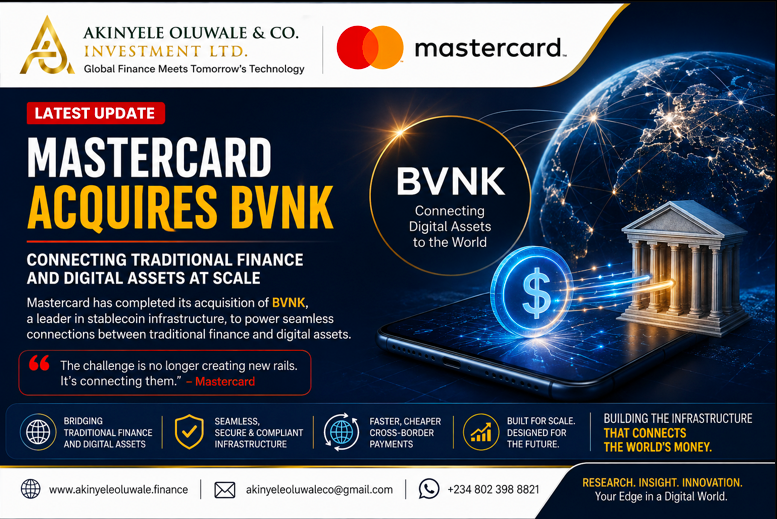
Mastercard Acquires BVNK: A Major Step Toward Connecting Traditional Finance and Digital Assets
By Akinyele Oluwale & Co. Investment Ltd.
Global Finance Meets Tomorrow's Technology
Executive Summary
Mastercard has announced the completion of its acquisition of BVNK, a company specializing in stablecoin-based payment infrastructure. In announcing the deal, Mastercard made its strategic objective clear: "The challenge is no longer creating new rails. It's connecting them."
That statement may prove to be one of the most important observations about the future of global payments.
For years, financial institutions have debated whether digital assets would replace traditional payment systems. Mastercard's latest move suggests a different future one where blockchain-based payment networks and conventional banking infrastructure operate together rather than compete against each other.
For businesses, financial institutions and investors, this acquisition signals that the next phase of financial innovation is less about choosing between traditional finance and digital assets and more about building the infrastructure that allows both to coexist seamlessly.
A New Chapter in Digital Payments
The payments industry has changed dramatically over the past decade.
Consumers now expect money to move instantly.
Businesses increasingly operate across multiple countries.
Cross-border payments continue to expand.
Digital commerce has become a normal part of everyday life.
At the same time, blockchain technology has introduced entirely new ways of transferring value.
Instead of asking whether traditional payment systems or blockchain networks will dominate, Mastercard appears to be pursuing a more practical strategy.
Its acquisition of BVNK suggests that the future lies in connecting both worlds.
Why BVNK Matters
BVNK is best known for developing infrastructure that allows businesses to move money using stablecoins while maintaining connections with traditional banking systems.
Unlike cryptocurrency exchanges that primarily focus on trading digital assets, BVNK has concentrated on payment infrastructure.
Its technology enables businesses to:
This makes BVNK an infrastructure company rather than simply another crypto business.
That distinction is important.
Large financial institutions increasingly invest in infrastructure because infrastructure generates long-term value regardless of short-term market volatility.
Mastercard's Message Says Everything
Perhaps the most revealing part of the announcement wasn't the acquisition itself.
It was Mastercard's statement:
"The challenge is no longer creating new rails. It's connecting them."
That single sentence reflects how the financial industry now views blockchain technology.
Ten years ago, many believed crypto would replace banks.
Today, leading financial institutions are building systems that connect blockchain networks with existing banking infrastructure instead.
Rather than disruption through replacement, the industry is moving toward integration.
The Rise of Stablecoins
Stablecoins have become one of the fastest-growing areas of digital finance.
Unlike cryptocurrencies whose prices fluctuate significantly, stablecoins are generally designed to maintain a stable value by being linked to traditional currencies such as the U.S. dollar.
For businesses, stablecoins offer several advantages:
These benefits explain why payment companies, banks and financial institutions have shown increasing interest in stablecoin infrastructure.
Mastercard's acquisition reinforces this broader trend.
Why This Is Bigger Than Crypto
Many headlines describe this as another cryptocurrency story.
It is actually much bigger.
This is a payments story.
Global payments remain one of the largest financial industries in the world.
Every day, trillions of dollars move through:
Improving even a small percentage of that infrastructure creates enormous economic value.
Mastercard appears to recognise that blockchain technology can improve efficiency without requiring businesses or consumers to abandon existing payment systems.
Infrastructure Is Becoming the Real Competitive Advantage
One of the most important trends in digital finance is the growing importance of infrastructure.
For years, much attention focused on cryptocurrencies themselves.
Today, institutional investors increasingly pay attention to:
These areas determine how effectively digital assets integrate into traditional finance.
Mastercard's acquisition reflects this institutional mindset.
What This Means for Businesses
Businesses could ultimately benefit in several ways.
Future payment systems may allow companies to:
Rather than replacing existing payment methods, businesses may gain additional options for moving money.
What It Means for Banks
Some observers once predicted that blockchain would eliminate banks.
Instead, banks are becoming active participants.
Many financial institutions now:
Mastercard's latest move supports this broader evolution.
The future increasingly appears collaborative rather than competitive.
Implications for Investors
For investors, the acquisition provides several important insights.
First, major financial institutions continue allocating capital toward blockchain infrastructure.
Second, stablecoins are becoming increasingly important to mainstream finance.
Third, payment companies view digital assets as operational technology rather than speculative investments.
These trends may influence future investment opportunities across fintech, payment technology and blockchain infrastructure.
The Bigger Industry Trend
Mastercard is not acting in isolation.
Across the financial sector, we are seeing:
Collectively, these developments point toward a financial system where traditional and digital assets operate side by side.
Editorial Perspective
This acquisition illustrates how institutional thinking around blockchain has evolved.
The early debate centred on whether cryptocurrencies would replace traditional finance.
Today's debate is very different.
Financial institutions are asking:
How can blockchain improve existing payment systems?
How can stablecoins reduce settlement times?
How can digital infrastructure improve cross-border commerce?
Those questions are far more practical.
They also suggest that blockchain's long-term success may depend less on replacing financial institutions and more on making them more efficient.
Conclusion
Mastercard's acquisition of BVNK represents far more than another
corporate transaction.
It reflects a broader transformation taking place across global finance.
The future of payments is unlikely to be built exclusively on traditional banking rails or exclusively on blockchain networks.
Instead, it will likely combine the strengths of both.
Mastercard's own words capture this evolution perfectly:
"The challenge is no longer creating new rails. It's connecting them."
For investors, businesses and policymakers, that statement provides a glimpse into where digital finance is heading.
The next generation of financial infrastructure will not be defined by competition between old and new systems.
It will be defined by how effectively they work together.
As blockchain technology matures and institutional adoption accelerates, companies that successfully bridge traditional finance and digital assets may become some of the most influential players in the future of global payments.