

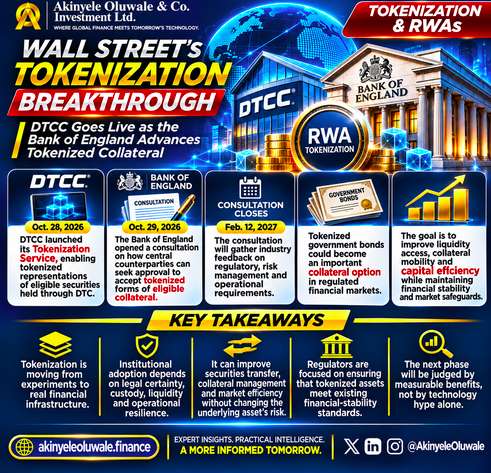
Tokenization is moving beyond experimental blockchain projects into the infrastructure that supports securities ownership, settlement and collateral management. Two major developments in late October 2026 show why established financial institutions are taking the technology seriously and why regulatory safeguards remain essential.
Published: Friday, November 6, 2026
Category: Tokenization & Real-World Assets (RWAs)
By: Akinyele Oluwale & Co. Investment Ltd.
For years, tokenization has been discussed as one of blockchain technology's most promising applications. The idea is straightforward: represent an asset digitally so that ownership records, transfers and certain financial processes can be managed more efficiently but financial markets are not transformed by technology demonstrations alone.
Real change occurs when established institutions begin incorporating new technology into the systems that banks, custodians, investors and clearing houses already depend upon.
That is what makes two recent announcements particularly important.
On October 28, 2026, the Depository Trust & Clearing Corporation (DTCC) announced the launch of its Tokenization Service, designed to create tokenized representations of securities held through its existing infrastructure. dtcc.com
One day later, the Bank of England published a consultation explaining how central counterparties could seek approval to accept tokenized forms of eligible collateral while maintaining established financial-stability standards. the UK's central bank
These developments represent two sides of the same institutional challenge.
DTCC is advancing the infrastructure through which traditional securities can be represented and transferred digitally.
Real change occurs when established institutions begin incorporating new technology into the systems that banks, custodians, investors and clearing houses already depend upon.
That is what makes two recent announcements particularly important.
On October 28, 2026, the Depository Trust & Clearing Corporation (DTCC) announced the launch of its Tokenization Service, designed to create tokenized representations of securities held through its existing infrastructure.
One day later, the Bank of England published a consultation explaining how central counterparties could seek approval to accept tokenized forms of eligible collateral while maintaining established financial-stability standards. These developments represent two sides of the same institutional challenge.
DTCC is advancing the infrastructure through which traditional securities can be represented and transferred digitally.
Executive Summary
A significant development is unfolding in global capital markets.
Tokenization is progressing from proof-of-concept projects toward operational infrastructure supporting traditional securities, collateral management and institutional financial transactions.
Two developments illustrate this transition.
On October 28, 2026, DTCC announced that its Tokenization Service had gone live. The service enables tokenized representations of eligible securities held through the Depository Trust Company (DTC).
On October 29, the Bank of England launched a consultation concerning the acceptance of tokenized collateral by central counterparties.
These developments are significant because they involve institutions responsible for important functions within conventional financial markets.
DTCC provides critical post-trade infrastructure supporting securities processing.
The Bank of England supervises important components of the United Kingdom's financial system.
Their involvement indicates that tokenization is increasingly being examined as a potential improvement to existing market infrastructure, rather than simply as a separate cryptocurrency application.
The commercial possibilities include faster collateral mobilisation, improved operational efficiency, more flexible asset transfers and potentially better use of financial resources. However, these benefits are not automatic.
Tokenized securities must still have enforceable ownership rights, reliable custody arrangements and effective settlement processes.
Likewise, a tokenized asset is not necessarily suitable collateral simply because it exists on a blockchain.
Its liquidity, valuation, credit risk and legal status remain fundamental considerations.
Our central assessment is that institutional tokenization is entering a more practical phase. The next competition will focus on whether digital representations of traditional assets can improve market efficiency while preserving the safeguards on which financial stability depends.
Before examining the latest developments, it is important to understand what tokenization means.
Imagine an investor owns a government bond worth $1 million.
Traditionally, ownership and transfers are recorded through established securities-market infrastructure, involving custodians, depositories and other financial intermediaries.
Tokenization introduces a digital representation of the asset using distributed ledger technology or a similar system.
Depending on its legal structure, that representation may support the recording and transfer of rights associated with the underlying asset.
The investor does not automatically receive additional economic value simply because the bond is tokenized.
The bond's underlying issuer, contractual terms and credit risk remain important.
What may change is how the asset is recorded, transferred or used within financial operations.
For example, a bank may hold government securities that it wishes to use as collateral.
Under some conventional arrangements, transferring that collateral can involve several operational steps.
A properly designed tokenized system may allow the asset to be mobilised more quickly.
But the bank must still establish that the asset is eligible, legally enforceable and available when needed.
This distinction is central to understanding real-world asset tokenization.
Tokenization can change the infrastructure surrounding an asset without necessarily changing the asset's underlying economic risk.
That is why institutional developments involving DTCC and the Bank of England deserve attention.
They address the operational and regulatory conditions required for tokenization to become useful within established financial markets.
On October 28, 2026, DTCC announced the launch of its Tokenization Service.
The service allows eligible securities held through DTC to be represented digitally.
Its stated objectives include improving liquidity access, collateral mobility and capital efficiency.
This is an important development because DTCC operates within the infrastructure that supports traditional securities markets.
Rather than creating an entirely separate financial system, the service connects digital representations of assets with established custody arrangements.
That distinction matters.
Institutional investors generally require clear ownership records, dependable asset servicing, regulatory compliance and established operational controls.
A system that connects tokenization with recognised market infrastructure may help address some of those requirements.
However, the service's launch does not mean that all securities held through DTC have been tokenized.
Nor does it establish that every investor can immediately transfer every eligible security across any blockchain.
Actual usage depends on service eligibility, participating institutions, operating arrangements and applicable requirements.
The lesson: Tokenization becomes more commercially meaningful when it is integrated into established financial-market infrastructure.
The October launch followed an earlier milestone.
On July 15, 2026, DTCC announced that it had successfully processed US securities transactions using DTC-tokenized assets.
The initiative involved converting securities held at DTC into tokenized representations that were then used in production trades.
This matters because financial technology should be evaluated through actual operational performance.
A laboratory demonstration may establish that a system can function under controlled conditions.
Production transactions provide additional evidence that the technology can operate within real financial workflows.
Nevertheless, successful production transactions do not establish that a system is ready for unlimited scale.
Questions remain concerning transaction volumes, operational resilience, interoperability and commercial economics.
The July transactions and October service launch should therefore be viewed as important stages in institutional development, not proof that tokenization has already transformed every aspect of securities settlement.
The lesson: Progress should be measured through functioning systems and real usage, not announcements alone.
On October 29, the Bank of England published a consultation addressing how central counterparties could seek approval to accept tokenized forms of eligible collateral.
The consultation is particularly important because central counterparties play a major role in financial-market risk management.
A central counterparty, commonly called a CCP, stands between buyers and sellers in certain financial transactions.
Its purpose includes helping manage the risk that one party fails to meet its obligations.
To protect the system, CCPs require participants to provide collateral.
That collateral must be dependable, appropriately valued and capable of being accessed or realised when necessary.
The Bank of England's consultation examines how tokenized assets could satisfy these requirements.
Its initial position is that the existing regulatory framework does not inherently prevent CCPs from accepting tokenized forms of eligible collateral. However, the assets must continue to meet the standards required for central clearing.
The consultation closes on February 12, 2027.
This is not a blanket approval of every tokenized asset.
It is a regulatory consultation intended to clarify supervisory expectations.
The lesson: Financial regulators are increasingly considering how existing rules can accommodate tokenization without weakening risk-management standards.
One particularly important feature of the Bank of England's consultation is its discussion of tokenized government bonds.
Government securities are widely used as collateral in financial markets.
Banks and other financial institutions may provide them to satisfy margin requirements or support financing arrangements.
Consider a financial institution holding £100 million in eligible government bonds.
If the institution faces a margin call, it may need to provide additional collateral within a limited period.
A tokenized arrangement could potentially improve the speed at which those bonds are transferred or made available.
That may help the institution manage liquidity and collateral requirements more efficiently.
However, faster transfer does not automatically guarantee that the collateral can be sold or converted into cash during financial stress.
The underlying market must still be sufficiently liquid.
The institution receiving the collateral must also have legally enforceable rights and the operational systems must remain available when market conditions become difficult.
This is why the Bank of England places considerable emphasis on valuation, liquidity, custody and settlement finality.
The lesson: Tokenized government bonds could improve collateral management, but the underlying financial safeguards remain essential.
The Bank of England's consultation highlights several practical issues that institutions must address before accepting tokenized collateral.
These include ownership rights, settlement finality, custody, operational resilience, credit risk and interoperability.
Why do these matters deserve attention?
Imagine a financial institution receives a token representing a government bond.
The institution must know exactly what legal rights the token provides.
Does holding the token establish enforceable ownership?
Can the underlying asset be accessed if the tokenization platform fails?
What happens if a custodian becomes insolvent?
Can the asset be transferred or sold during market disruption?
These questions are not merely technical.
They determine whether the tokenized asset can perform the same economic and legal functions as conventional collateral.
The consultation also recognises that different tokenization structures may create different dependencies.
Some arrangements involve digital representations of securities held elsewhere.
Others involve securities issued directly in digital form.
These models can have different legal and operational characteristics.
The lesson: The long-term success of tokenization depends on enforceable financial rights and resilient infrastructure, not blockchain technology alone.
For several years, much of the public discussion surrounding real-world asset tokenization focused on putting property, commodities or financial instruments on blockchain networks.
Some of those applications may eventually become commercially important.
However, the latest institutional developments suggest that the most immediate opportunities may arise within established financial-market operations.
These include securities custody, collateral management, asset servicing and settlement.
Why?
Because these markets already contain substantial financial activity.
They also face identifiable operational challenges.
For example, financial institutions must track securities ownership, reconcile records, manage collateral and coordinate transactions across different systems.
Where tokenization reduces unnecessary processing steps, it may create measurable value but the commercial benefits depend on integration.
A tokenized bond that cannot interact with the systems used by banks and clearing houses may have limited institutional usefulness.
Likewise, a digital asset that cannot be legally transferred or reliably liquidated may be unsuitable for important financial transactions.
The strongest institutional opportunities may therefore arise from connecting tokenization with regulated custody, dependable settlement and established financial-market standards.
This is a different proposition from creating digital tokens and assuming demand will follow.
Tokenization may improve how institutions manage securities and collateral.
However, banks must maintain effective custody, operational controls and regulatory compliance.
Established market infrastructure providers may play a major role in connecting traditional securities with digital systems.
DTCC's launch demonstrates one approach to this transition.
Tokenized government securities could support more flexible collateral arrangements.
Their economic value, however, continues to depend on the issuer's creditworthiness, interest rates and market conditions.
Tokenization may eventually create opportunities for more efficient asset administration and transfers but investment managers must assess liquidity, legal ownership and operational dependencies.
Financial institutions may require technology supporting secure transactions, recordkeeping and interoperability.
However, increased institutional tokenization does not automatically mean that every blockchain network or native cryptocurrency will benefit financially.
Nigeria's banks, regulators and capital-market institutions may have opportunities to study international developments and assess their relevance to domestic securities infrastructure.
Potential applications could include government securities administration, custody, settlement and collateral management.
Nevertheless, any adoption would require appropriate legal, regulatory and operational arrangements.
International announcements should not be interpreted as evidence that equivalent services have already been implemented in Nigeria.
At Akinyele Oluwale & Co. Investment Ltd., we believe the latest developments represent an important change in how tokenization should be evaluated.
The conversation is moving beyond the simple idea that putting an asset on a blockchain automatically makes it more valuable.
That assumption is misleading.
A poorly performing financial asset does not become a good investment because it has been tokenized. An illiquid asset does not necessarily become liquid because ownership can be represented digitally and a financial instrument with weak legal protections does not become secure merely because transactions are recorded on a distributed ledger.
The underlying economics still matter.
What tokenization may improve is the infrastructure supporting the asset.
This is why DTCC's launch deserves attention.
It connects digital representations of securities with established financial-market infrastructure.
Similarly, the Bank of England's consultation demonstrates the importance of preserving legal certainty and financial stability as new technology enters critical market functions.
These developments also highlight a broader institutional reality.
Financial innovation succeeds when it solves identifiable problems.
A bank may adopt tokenization if it reduces collateral-transfer delays.
An asset manager may consider it if it improves operational efficiency.
A clearing house may evaluate it if the arrangement meets established risk-management standards but none of these institutions should adopt tokenization solely because blockchain technology is fashionable.
Our editorial assessment is that the most durable opportunities in real-world asset tokenization will emerge where technological improvements produce measurable financial benefits without compromising legal rights, liquidity or operational resilience.
That is the standard institutional investors should apply.
Several developments deserve close attention.
DTCC service adoption: Monitor which eligible securities and institutional participants use the new Tokenization Service and how activity develops.
Actual transaction volumes: Distinguish announced capabilities from measurable production usage.
Bank of England consultation: Follow responses to the tokenized-collateral proposals before the February 12, 2027 deadline.
Collateral eligibility: Watch whether central counterparties seek approval to accept tokenized forms of existing eligible assets.
Settlement arrangements: Assess whether digital securities can be transferred alongside reliable payment mechanisms.
Custody and legal certainty: Examine how ownership rights and asset protection operate across different tokenization structures.
Interoperability: Monitor whether tokenized securities can function across different financial-market systems without creating unnecessary complexity.
Operational resilience: Evaluate cybersecurity, system availability and the ability to recover from technical disruptions.
Commercial economics: Look for evidence of reduced processing costs, faster collateral mobilisation and improved capital efficiency.
These indicators will provide a more reliable assessment of institutional adoption than speculative token prices.
DTCC launched its Tokenization Service on October 28, 2026.
The service supports tokenized representations of eligible securities held through DTC.
DTCC's launch followed successful production transactions involving tokenized securities in July 2026.
The Bank of England opened a consultation on tokenized collateral on October 29, 2026.
The consultation does not constitute blanket approval for all tokenized assets.
Tokenized government bonds could become important in collateral-management arrangements.
Liquidity, valuation, custody, legal ownership and settlement finality remain essential.
Tokenization does not automatically improve an asset's underlying investment quality.
Institutional adoption depends on regulatory compliance, operational resilience and measurable commercial benefits.
The next phase of real-world asset tokenization is increasingly focused on financial-market infrastructure rather than speculative narratives.
Akinyele Oluwale & Co. Investment Ltd. is an institutional financial intelligence platform focused on global financial markets, macroeconomics, central banking, institutional cryptocurrency, stablecoins, tokenization, real-world assets, artificial intelligence and blockchain technology.
Our mission is to explain consequential financial developments through evidence-based analysis, practical education and an institutional perspective.
We examine what has changed, why it matters and how emerging technologies may influence the future of financial markets.
The latest developments in tokenization mark an important transition.
DTCC has introduced a service connecting tokenized securities with established market infrastructure.
The Bank of England is examining how tokenized collateral can operate within existing financial-stability requirements.
Together, these developments suggest that tokenization is becoming a more serious subject for financial-market institutions.
However, the industry must avoid confusing technological progress with guaranteed commercial success.
The ability to create a digital representation of an asset is only the beginning.
The real challenge is ensuring that the asset can be owned, transferred, valued, safeguarded and used within reliable financial arrangements.
For investors, the lesson is to focus on institutional adoption and practical economic outcomes.
For banks and financial institutions, the priority is to determine whether tokenization can improve efficiency while maintaining effective controls.
For policymakers, the challenge is to support innovation without weakening market integrity.
The future of tokenization will not be determined by how many assets receive digital tokens. It will be determined by how effectively those assets can function within the financial system.
That is where the next phase of institutional digital finance is taking shape.
Observe the change. Understand the implications. Position with discipline.
Akinyele Oluwale & Co. Investment Ltd.
Where Global Finance Meets Tomorrow's Technology.
Website: akinyeleoluwale.finance