

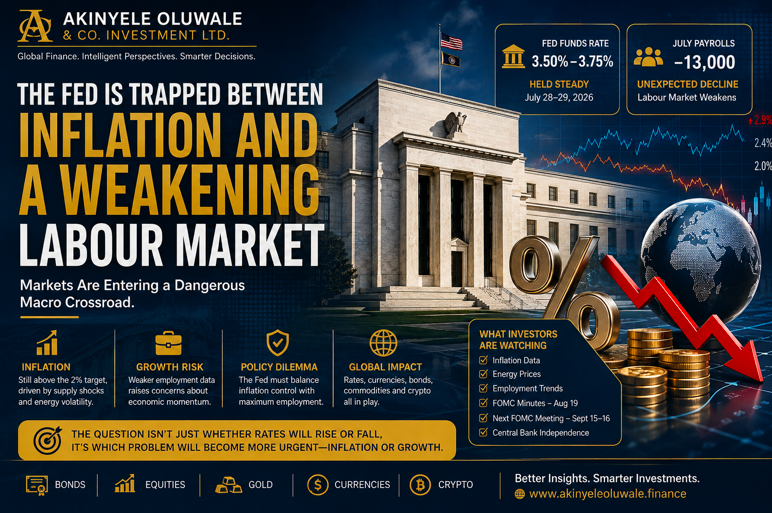
The Fed Is Trapped Between Inflation and a Weakening Labour Market And Markets Are Entering a Dangerous Macro Crossroad
The Federal Reserve held interest rates steady in July, but three policymakers wanted a hike. Then July employment unexpectedly contracted. Now markets are waiting for inflation data that could determine whether the next major move is tighter policy or whether deteriorating growth forces the Fed to stay its hand.
Published: 12 August 2026
Category: Macro & Central Banks • Federal Reserve • Inflation • Global Markets
By: Akinyele Oluwale & Co. Investment Ltd.
Executive Summary
The global macro picture has become considerably more complicated.
At its 28–29 July meeting, the U.S. Federal Reserve kept the federal funds target range unchanged at 3.50%–3.75%. But beneath that headline was an unusually important signal: three FOMC members dissented because they wanted to raise rates by 25 basis points. The Fed said economic activity remained solid, while inflation was still above its 2% objective, partly because supply shocks including energy were pushing prices higher. (federalreserve.gov)
Then the labour-market picture weakened.
Recent employment data showed an unexpected decline in U.S. payrolls in July, complicating the case for additional tightening just as investors prepare for another crucial inflation reading. Markets are therefore confronting an uncomfortable combination:
Inflation remains sticky. Growth risks are increasing. Energy remains a threat. And monetary policy has little room for error. (Reuters)
Meanwhile, political pressure surrounding the Federal Reserve is intensifying, raising another question investors cannot ignore: central-bank independence. Reuters reported on 11 August that renewed political tensions around Fed policy are becoming increasingly relevant for bond markets. (Reuters)
This is no longer a simple “when will rates fall?” environment.
It is becoming a battle between inflation risk and economic weakness.
And whichever side wins will influence bonds, equities, gold, currencies and crypto.
What Happened?
The Federal Reserve Held Rates But the Vote Was Anything But Comfortable
The Fed's July decision initially looked uneventful.
Rates remained at 3.50%–3.75%.
But the vote tells a more interesting story.
The decision passed 9–3.
Beth Hammack, Neel Kashkari and Lorie Logan dissented because they preferred a 25-basis-point rate increase. (federalreserve.gov)
That is significant.
Central banks generally value consensus.
Three policymakers openly supporting tighter monetary policy tells investors that inflation concerns inside the Federal Reserve are not theoretical.
The Fed itself acknowledged that inflation remains elevated relative to its 2% target and specifically pointed to supply shocks affecting sectors including energy. (federalreserve.gov)
So the Fed's message was essentially:
We're holding but the inflation fight isn't necessarily over.
Then came weaker labour data.
That changed the conversation.
Why This Matters
Central banking is relatively straightforward when inflation and economic growth point in the same direction.
If inflation is high and growth is strong:
Raise rates.
If inflation is low and the economy is collapsing:
Cut rates.
The difficult environment occurs when the signals conflict.
That is increasingly what the Fed faces.
Inflation remains uncomfortable.
Energy costs remain vulnerable to geopolitical disruption.
But employment has weakened.
If the Fed raises rates aggressively to fight inflation, it risks worsening economic weakness.
If it eases too early, inflation could reaccelerate.
This is the central-bank nightmare:
The economy may need support at exactly the moment prices still require restraint.
The Labour Market Just Complicated Everything
For years, the U.S. labour market gave the Federal Reserve breathing room.
Employment remained resilient enough that policymakers could focus heavily on inflation.
That luxury may be fading.
The latest employment weakness raises the possibility that restrictive monetary conditions are beginning to bite more deeply.
That matters because employment is not secondary to the Federal Reserve.
The Fed has a dual mandate:
Maximum employment.
Price stability.
When inflation is the dominant problem, the mandates broadly point toward tighter policy.
When employment weakens while inflation remains elevated, the two objectives begin pulling policymakers in opposite directions.
That is where monetary-policy decisions become considerably harder.
Inflation Is Still the Deciding Variable
The next major piece of the puzzle is inflation.
Markets entered this week watching U.S. inflation data closely because the result could materially alter expectations for the Fed's September meeting. Reuters reported that inflation figures were set to test both record-high U.S. equities and market expectations surrounding monetary policy. (Reuters)
A softer inflation print would provide the Fed with breathing room.
It could suggest that policymakers don't need another hike even if energy remains problematic.
But a hotter reading would create a very uncomfortable situation:
Weakening employment + persistent inflation.
That combination begins moving toward stagflationary territory.
Not necessarily full stagflation—but enough to make investors nervous.
Energy Has Become a Monetary-Policy Variable Again
One of the most important macro developments of 2026 has been the return of geopolitical energy risk.
Central banks cannot produce oil.
They cannot reopen shipping routes.
They cannot resolve military conflicts.
But they must respond when those events affect inflation.
That creates a policy dilemma.
Suppose oil rises sharply because supply is disrupted.
Higher energy prices increase headline inflation.
Transportation becomes more expensive.
Manufacturing costs rise.
Food distribution costs increase.
Households have less disposable income.
Businesses face margin pressure.
Economic growth slows.
In other words:
An energy shock can simultaneously increase inflation and weaken growth.
Raising interest rates doesn't produce more oil.
But central banks may still need to tighten if higher energy prices become embedded in wages and inflation expectations.
That is why today's geopolitical environment matters enormously for monetary policy.
The Fed's September Meeting Becomes Critical
The next scheduled FOMC meeting is 15–16 September 2026. (federalreserve.gov)
Between now and then, policymakers will receive additional economic data.
That means September is not predetermined.
The Fed will be evaluating:
Inflation.
Employment.
Wages.
Consumer spending.
Business activity.
Financial conditions.
Energy prices.
Inflation expectations.
And geopolitical developments.
The July meeting already revealed meaningful disagreement.
The next several weeks could determine which side of that debate gains strength.
Another Major Issue Has Returned: Fed Independence
There is also a political dimension.
Reuters reported on 11 August that renewed political pressure around Federal Reserve policy is creating another challenge for Chair Kevin Warsh, particularly because bond investors pay close attention to perceptions of central-bank independence. (Reuters)
This matters far beyond Washington politics.
A credible central bank has something extremely valuable:
Trust.
Investors need confidence that monetary policy will be determined by economic conditions rather than short-term political considerations.
If markets begin questioning that independence, the consequences can appear in:
Treasury yields.
Inflation expectations.
Currency markets.
Risk premiums.
Foreign demand for government debt.
Gold.
The issue isn't whether politicians are entitled to criticise central-bank decisions.
They are.
The issue is whether markets believe policymakers can make decisions independently.
That distinction is crucial.
Why Bond Markets Care About Central-Bank Credibility
Government bonds represent promises extending years or decades into the future.
Imagine buying a 10-year Treasury.
You need some confidence that inflation won't destroy the real value of the money eventually returned to you.
If investors believe monetary policy is becoming politically influenced, they may demand greater compensation for holding long-term debt.
That means:
Higher yields.
And higher Treasury yields ripple through the entire financial system.
Mortgages.
Corporate borrowing.
Government financing.
Equity valuations.
Emerging-market debt.
Currency markets.
Everything is connected.
This is why central-bank independence isn't an abstract academic principle.
It has a market price.
The Global Central-Bank Cycle Is Becoming Less Synchronised
For much of the inflation shock, major central banks broadly moved in the same direction.
Inflation rose.
Rates increased.
Then inflation eased.
Markets anticipated cuts.
That simple global cycle is becoming more fragmented.
Different economies now face very different combinations of:
Inflation.
Growth.
Energy exposure.
Fiscal policy.
Currency pressure.
Labour-market conditions.
That means the Federal Reserve, European Central Bank, Bank of England, Bank of Japan and other major central banks may increasingly move at different speeds—or even in different directions.
For global investors, this creates both risk and opportunity.
Interest-rate divergence affects currencies.
Currencies affect inflation.
Inflation affects central banks.
Central banks affect capital flows.
Capital flows affect markets.
The chain is circular.
The Bank of Japan Remains Especially Important
Japan deserves close attention.
For decades, the Bank of Japan was the world's great monetary-policy outlier.
While other central banks raised rates, Japan maintained extremely accommodative policy.
That environment encouraged the famous yen carry trade:
Borrow cheaply in yen.
Invest in higher-yielding assets elsewhere.
But as Japanese policy normalises and inflation dynamics change, the economics of that trade become less straightforward.
A stronger yen or faster Japanese tightening can force leveraged investors to unwind positions.
That can create volatility far outside Japan.
U.S. equities.
Treasuries.
Emerging markets.
Crypto.
This is why the Bank of Japan matters even to investors who own no Japanese assets.
The Dollar Is Caught in the Middle
The U.S. dollar faces conflicting forces.
Higher-for-longer Fed policy generally supports the dollar because U.S. assets offer attractive yields.
But deteriorating growth can weaken expectations.
Political pressure on the central bank can also affect confidence.
Meanwhile, monetary policy elsewhere influences relative currency attractiveness.
For investors outside the United States, the dollar remains one of the most important variables in global portfolio performance.
A stronger dollar tends to tighten global financial conditions.
A weaker dollar can provide breathing room to emerging markets and dollar-denominated commodities.
This is another reason Fed policy has global consequences.
Gold Is Sending a Message
Gold has remained close to recent highs as investors balance inflation uncertainty, geopolitical risk and expectations around U.S. monetary policy. Reuters reported on 11 August that bullion was hovering near a more than two-month high while markets awaited key U.S. inflation data. (Reuters)
Gold's behaviour deserves attention.
Investors often think of gold only as an inflation hedge.
That is incomplete.
Gold can also function as:
A geopolitical hedge.
A currency hedge.
A monetary-policy hedge.
A hedge against institutional uncertainty.
A reserve-diversification asset.
Central-bank gold demand also remains an important structural factor.
When uncertainty surrounding inflation, debt, currencies and geopolitics increases simultaneously, gold's role becomes more interesting.
What This Means for Equities
Equity investors currently face a delicate balance.
Markets generally like lower interest rates.
Lower rates can reduce discount rates and support valuations.
But investors should always ask:
Why are rates falling?
A rate cut because inflation has fallen while growth remains healthy can be bullish.
A rate cut because the economy is deteriorating rapidly is very different.
Likewise, holding rates steady isn't automatically bearish if economic activity remains resilient.
The economic reason behind the policy decision matters more than the headline itself.
Technology and other long-duration growth stocks are especially sensitive to interest-rate expectations because much of their valuation depends on future earnings.
That makes inflation data particularly important when valuations are already elevated.
What This Means for Bitcoin and Crypto
Crypto investors often reduce macroeconomics to one formula:
Fed cuts = Bitcoin up.
Reality is more complicated.
Bitcoin generally benefits from:
Improving global liquidity.
Lower real yields.
A weaker dollar.
Greater risk appetite.
Expanding money supply.
But a rate cut caused by a serious economic crisis can initially produce risk-off selling.
Likewise, persistent inflation can keep rates high and pressure speculative assets.
The more useful framework is therefore:
Liquidity + growth + inflation + financial conditions.
Not simply:
Rates up or rates down.
Bitcoin increasingly trades within the global liquidity system.
That means serious crypto investors need to understand central banks.
Winners and Losers
Potential Winners
Gold
Persistent inflation, geopolitical uncertainty and concerns about monetary credibility can strengthen gold's strategic role.
Cash and Short-Duration Assets
Higher rates continue to provide meaningful returns without requiring investors to take excessive duration risk.
Quality Companies
Businesses with strong balance sheets, pricing power and dependable cash flows can be better positioned when monetary conditions remain uncertain.
Select Digital Assets
Bitcoin could benefit if weakening growth eventually produces easier liquidity conditions but timing matters.
Potential Losers
Highly Leveraged Companies
Higher-for-longer borrowing costs can expose weak balance sheets.
Long-Duration Bonds
Persistent inflation can keep long-term yields elevated.
Speculative Assets
Assets dependent primarily on cheap liquidity remain vulnerable if central banks stay restrictive.
Highly Indebted Consumers
Credit cards, mortgages and other floating-rate borrowing remain painful when rates stay elevated.
Short-Term Impact
Over the coming weeks, markets may remain unusually sensitive to economic data.
A single inflation print can move:
Treasury yields.
The dollar.
Gold.
Equities.
Bitcoin.
Rate expectations.
That tells us something important.
Markets are not confident about the policy path.
When investors know what central banks are likely to do, data surprises have less power.
When the policy outlook is uncertain, every major economic release becomes a referendum on the next rate decision.
Expect volatility.
Long-Term Impact
The larger issue extends beyond September.
The world may be entering a different macroeconomic regime from the one investors became accustomed to after the Global Financial Crisis.
The 2010s were characterised by:
Low inflation.
Low rates.
Cheap energy.
Globalisation.
Abundant liquidity.
The emerging environment looks different.
Greater geopolitical fragmentation.
Higher defence spending.
Supply-chain restructuring.
Energy-security concerns.
Large fiscal deficits.
Artificial-intelligence investment.
Industrial policy.
Trade restrictions.
These forces can create more persistent inflation pressure.
If so, the neutral level of interest rates may remain structurally higher than investors remember.
That would have enormous implications for asset valuation.
Risks Investors Should Not Ignore
Stagflation Risk
Persistent inflation combined with weakening growth would leave central banks with few attractive options.
Policy Error
Tightening too aggressively could damage employment.
Easing prematurely could revive inflation.
Geopolitical Risk
Energy disruptions can change the inflation outlook quickly.
Fiscal Risk
Large government deficits can keep bond supply and yields elevated.
Political Pressure
Perceptions that central-bank independence is weakening can raise risk premiums.
Market Valuation Risk
Expensive assets are particularly vulnerable when discount rates remain high.
Editorial Perspective
For months, investors have asked:
“When will the Fed cut rates?”
That may now be the wrong question.
The better question is:
“What economic environment will force the Fed's next move?”
That distinction matters enormously.
A rate cut is not automatically bullish.
A rate hike is not automatically bearish.
The context determines the outcome.
If inflation falls, employment stabilises and growth remains healthy, the Fed gains flexibility.
That is the ideal scenario.
But if inflation remains sticky while employment deteriorates, policymakers face an increasingly uncomfortable trade-off.
And this is why macro investing requires patience.
Markets desperately want simple narratives.
Inflation is finished.
Rate cuts are coming.
The economy is strong.
The Fed will rescue markets.
Reality rarely cooperates.
The Federal Reserve's July vote showed genuine disagreement about the appropriate policy stance. (federalreserve.gov)
That disagreement isn't necessarily a weakness.
It reflects the fact that the economic signals themselves are conflicting.
Investors should therefore resist making portfolios dependent on a single prediction about September.
The smarter approach is to prepare for several outcomes.
Because right now, the Fed isn't the only institution waiting for clarity.
The market is waiting too.
What to Watch Next
The next few weeks could be decisive. Investors should monitor:
The key question isn't simply:
Will the Fed hike, hold or cut?
It is:
Which problem will become more urgent—inflation or growth?
Investing Lesson
Never invest based on the direction of interest rates alone. Invest based on why rates are moving.
Consider two scenarios.
Scenario A
Inflation falls.
Growth remains healthy.
Employment remains stable.
The Fed gradually eases.
That can be supportive for risk assets.
Scenario B
Employment collapses.
Consumer spending weakens.
Credit stress increases.
The Fed cuts aggressively.
Rates are falling in both scenarios.
But the investment environment is completely different.
This is why sophisticated investors don't simply watch central-bank decisions.
They watch the economic conditions producing those decisions.
The lesson is straightforward:
Monetary policy is the response. The economy is the cause.
Understand the cause, and the policy becomes easier to interpret.
Key Takeaways
Editorial Bottom Line
The Federal Reserve is approaching one of the hardest stages of monetary policy: the point where fighting inflation may increasingly conflict with protecting growth and employment.
The next major market catalyst won't simply be another interest-rate decision.
It will be evidence showing which side of that conflict is winning.
About Akinyele Oluwale & Co. Investment Ltd.
Akinyele Oluwale & Co. Investment Ltd. provides research-driven intelligence across Macro & Central Banks, Institutional Finance, Crypto & Digital Assets, AI & Technology, Stablecoins & Payments, and Tokenization & RWAs.
Our objective is to move beyond headlines and explain:
What happened?
Why does it matter?
Who wins and who loses?
What is the short- and long-term impact?
What should investors watch next?
Global Finance Meets Tomorrow's Technology.