

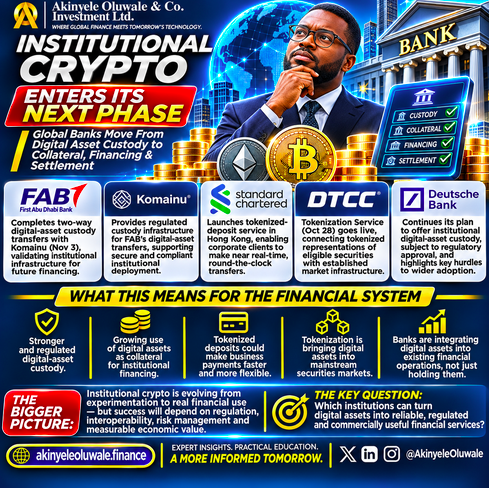
First Abu Dhabi Bank's latest digital-asset custody milestone, Standard Chartered's tokenized-deposit launch in Hong Kong and DTCC's operational tokenization service reveal an important shift: financial institutions are no longer examining blockchain solely as an investment technology. They are increasingly exploring how digital assets can function within the infrastructure of banking, securities markets and institutional finance.
Publication date: Monday, November 9, 2026
Category: Institutional Crypto
Focus: Global Banking | Digital Asset Custody | Institutional Financing | Tokenized Deposits | Securities Tokenization
The institutional cryptocurrency industry is entering a more demanding phase.
For several years, much of the conversation focused on whether major banks would accept digital assets, provide custody services or allow clients to gain exposure to Bitcoin and other cryptocurrencies.
Those questions remain relevant. However, the latest developments suggest that institutional attention is moving toward a more practical challenge. How can banks use digital assets within their existing financial operations without compromising security, liquidity, regulatory compliance or financial stability?
On November 3, 2026, First Abu Dhabi Bank announced that it had completed two-way transfers of a digital-asset portfolio through regulated custody infrastructure provided by Komainu. The transfers settled instantly and validated a key operational component of the bank's institutional digital-asset financing infrastructure. FAB UAE+1
In Hong Kong, Standard Chartered announced a tokenized-deposit service for corporate clients, supporting round-the-clock transfers through the Hong Kong Monetary Authority's Ensemble infrastructure. CoinDesk
Meanwhile, DTCC's Tokenization Service, launched on October 28, is providing a connection between securities held in traditional market infrastructure and their tokenized representations. DTCC
Together, these developments illustrate a broader transformation.
Institutional crypto is evolving from the question of whether banks should participate toward the question of which financial functions can be improved through digital-asset infrastructure. The distinction is critical because technological capability alone does not establish commercial success.
Executive Summary
The latest developments in institutional cryptocurrency reveal a significant change in the relationship between digital assets and traditional banking. Major financial institutions are increasingly exploring applications beyond cryptocurrency custody and trading.
The new areas of interest include digital-asset-backed financing, tokenized deposits, securities settlement, collateral management and regulated financial infrastructure.
On November 3, First Abu Dhabi Bank (FAB) announced that it had successfully transferred a portfolio of digital assets into and out of regulated custody through Komainu.
The transfers settled instantly and demonstrated that the bank could integrate digital-asset custody into its institutional financing infrastructure. This is significant because custody is a foundation for more advanced financial services. Before a bank can confidently use digital assets as collateral, it must establish reliable arrangements for holding, transferring and controlling those assets.
FAB's announcement indicates progress toward that objective.
However, the bank also stated that it was working toward its first financing transactions. The successful custody transfers should therefore not be confused with the completion of a digital-asset-backed loan.
In Hong Kong, Standard Chartered announced a tokenized-deposit service for corporate clients. The initiative illustrates how commercial banks are exploring blockchain-enabled transfers of bank deposits while preserving their connection to regulated banking arrangements. Meanwhile, DTCC's Tokenization Service, launched on October 28, supports the creation of tokenized representations of eligible securities held through established securities-market infrastructure.
Deutsche Bank has also continued preparing its institutional digital-asset custody offering, subject to the applicable regulatory process. These developments point toward a common institutional objective.
Banks are increasingly examining how digital assets can become usable financial instruments within regulated banking, financing and settlement operations.
However, the industry's long-term success will depend on measurable commercial value, effective governance, liquidity and financial stability.
Why This Matters: Understanding the Next Stage of Institutional Crypto
To understand the importance of the latest developments, consider how conventional banking operates. A financial institution does not simply hold assets.
It may also provide financing against those assets, transfer them between custodians, use them as collateral and settle financial obligations. For example, an institutional investor may own government bonds.
Those bonds can potentially be held by a custodian, transferred to another institution or pledged as collateral under an eligible financing arrangement. The legal rights, valuation, liquidity and custody arrangements supporting those transactions are essential.
Now consider digital assets. A financial institution may be technically capable of holding Bitcoin or another cryptocurrency but holding an asset is different from using it safely within a financing arrangement.
The bank must understand how the asset is controlled, how it can be transferred, how collateral rights are enforced and what happens if the asset's market value declines. This is why the latest custody and financing developments deserve attention. They concern the financial infrastructure needed to move beyond passive asset holding.
Institutional adoption becomes more meaningful when digital assets can perform useful financial functions under reliable legal and operational arrangements.
What Happened? Six Major Institutional Crypto Developments
Development One: First Abu Dhabi Bank Completes Instant Digital-Asset Custody Transfers
On November 3, 2026, First Abu Dhabi Bank announced that it had successfully completed two-way transfers of a digital-asset portfolio through Komainu's regulated custody infrastructure. The assets were transferred into custody and subsequently transferred out. According to the announcement, the transfers settled instantly. This demonstrated the operational integration of Komainu's custody infrastructure with FAB Global Markets.
Why is this important?
For institutional financial services, custody is not simply about storing digital assets. A bank must be able to demonstrate effective control, accurate records, secure transfers and reliable operational procedures. If assets cannot be transferred or accessed when required, their usefulness in financing arrangements may be limited.
FAB's successful transfers therefore represent an operational milestone. The bank explained that the infrastructure could support future institutional financing transactions, including arrangements backed by digital assets held in regulated custody.
However, there is an important distinction.
FAB completed custody transfers. It did not announce that its first digital-asset-backed financing transaction had already been completed.
That distinction should guide how investors interpret the development. The announcement provides evidence of operational capability, not proof of widespread financing activity.
The FAB–Komainu collaboration also highlights the growing interest in using digital assets as collateral. Collateral is an asset provided to support a financial obligation. For example, a financial institution may accept eligible securities as security for a loan. If the borrower fails to meet the agreed obligations, the lender may have contractual rights over the collateral, subject to applicable law.
Digital-asset-backed financing attempts to apply a similar concept to eligible digital assets.
Consider a hypothetical institutional borrower holding digital assets valued at $10 million. A bank may assess whether those assets could support a financing arrangement. However, the bank would need to consider several factors.
First, the assets may experience substantial price volatility.
Second, the lender must establish legally enforceable rights.
Third, custody arrangements must allow the lender to exercise the necessary controls.
Fourth, the assets must be sufficiently liquid to manage potential losses.
Finally, the financing structure must comply with applicable regulatory requirements.
A rapid blockchain transfer does not eliminate these risks. It may improve one operational component of the financing process.
The institutional lesson is that digital-asset financing requires conventional credit discipline alongside reliable technology.
On November 2, Standard Chartered announced a tokenized-deposit solution for corporate clients in Hong Kong. The initiative uses the Hong Kong Monetary Authority's Ensemble infrastructure to support transfers between participating banks. An important feature is the potential for transfers outside conventional banking hours.
This could improve flexibility for certain corporate treasury operations. However, tokenized deposits should not be confused with ordinary cryptocurrency tokens.
A tokenized deposit generally represents a claim associated with money held at a commercial bank. A stablecoin, by contrast, may represent a claim against a separate issuer under a different legal and reserve structure. These distinctions affect regulatory treatment, redemption arrangements and financial risk.
For businesses, tokenized deposits may eventually offer more flexible methods of transferring bank money. For banks, they may provide additional ways to manage payment and settlement services. Nevertheless, adoption depends on participating institutions, technical integration and applicable regulatory arrangements.
The institutional lesson is that blockchain technology may increasingly support conventional bank money rather than replace it.
On October 28, DTCC announced the launch of its Tokenization Service. Although the launch occurred shortly before the current reporting period, it remains one of the most important recent developments in institutional digital finance.
The service supports tokenized representations of eligible securities held through the Depository Trust Company. Its stated objectives include improving collateral mobility, liquidity access and capital efficiency.
Why does this matter?
Traditional securities markets rely on established arrangements for recording ownership, custody and settlement.
Tokenization may allow certain processes to operate more efficiently.
For example, a tokenized representation of an eligible security may support faster mobilisation of collateral under an appropriately designed arrangement.
However, the underlying financial asset does not become risk-free. A tokenized government bond remains exposed to relevant interest-rate and credit risks. A tokenized equity security remains exposed to the financial performance and valuation of the underlying company.
Tokenization can improve the infrastructure surrounding an asset without changing its underlying investment economics.
This is why DTCC's involvement is significant. The focus is on integrating digital representations with recognised financial-market infrastructure.
Deutsche Bank's digital-asset custody initiative provides another example of how major financial institutions are approaching the industry.
In September 2026, the bank announced plans to introduce custody services for selected digital assets for institutional and corporate clients. The proposed launch remains subject to the applicable regulatory timeline. The bank has also outlined broader ambitions involving digital-asset services and tokenized financial products.
This reflects a wider banking strategy.
Rather than treating digital assets as an entirely separate financial system, banks are increasingly considering how they can complement existing products. However, a planned launch must not be reported as a completed commercial deployment.
Investors should distinguish between regulatory approval, product readiness, initial customer onboarding and large-scale commercial adoption. Each represents a different stage of development.
The institutional lesson is that credible digital-asset expansion requires careful implementation, not simply ambitious announcements.
On November 4, Deutsche Bank published an analysis examining the next stage of digital-asset adoption. The publication highlighted important industry challenges, including fragmented systems, regulatory uncertainty and limited interoperability.
These issues deserve attention. Financial institutions operate across different jurisdictions and technology platforms.
A digital asset recorded on one system may not be readily transferable or usable within another. This creates potential inefficiencies. For example, a bank may develop a tokenized securities platform that functions effectively within its own environment. However, if the platform cannot communicate with other financial institutions, its commercial usefulness may remain limited.
Similarly, differences in legal treatment can complicate cross-border transactions. The industry therefore faces a challenge beyond developing individual blockchain products. It must establish systems capable of interacting reliably with broader financial infrastructure.
The institutional lesson is that interoperability, legal certainty and operational resilience are essential to scaling digital finance.
The institutional cryptocurrency market is increasingly becoming a competition over financial infrastructure. Different institutions are pursuing different roles. Commercial banks are exploring custody, tokenized deposits and financing services.
Custodians are developing secure systems for holding and transferring digital assets. Securities depositories are examining tokenization and settlement. Payment networks are incorporating new forms of digital settlement. Technology providers are building the infrastructure connecting these activities. The strategic question is not simply which institution holds the most cryptocurrency.
It is which institutions can provide reliable services that customers and financial-market participants actually need.
Consider a multinational business managing cash across several jurisdictions. Its priorities may include access to liquidity, secure transfers, regulatory compliance and predictable settlement. A digital financial service that improves these outcomes could be commercially valuable but the business may have little interest in the underlying blockchain technology itself.
The technology is useful only to the extent that it improves the financial service. This is why institutional crypto should increasingly be evaluated through operational performance and commercial economics.
However, these activities introduce technology, legal and financial risks that must be managed.
The competitive advantage will depend on security, governance, operational reliability and integration with banking systems.
However, businesses must assess the legal nature of the deposits and the availability of participating institutions.
Its benefits will depend on actual transaction volumes, interoperability and implementation costs.
However, they do not guarantee higher prices for individual cryptocurrencies.
Price performance remains influenced by supply, demand, liquidity and investor expectations.
Potential opportunities include regulated custody, digital settlement and collateral infrastructure.
However, each market requires appropriate regulatory arrangements and commercial justification.
At Akinyele Oluwale & Co. Investment Ltd., we believe the institutional cryptocurrency industry is moving into a more mature phase. The earlier conversation focused heavily on whether traditional financial institutions would participate in cryptocurrency markets. The latest developments suggest that the question is becoming more practical.
Banks are examining how digital assets can be integrated into their existing financial operations.
This is important progress.
However, institutional involvement should not be confused with guaranteed investment success. A bank may develop a digital-asset custody service because customers require secure storage. That does not necessarily mean the bank expects every cryptocurrency to appreciate.
A financial institution may use tokenized deposits because they improve settlement arrangements. That does not imply that conventional deposits are becoming obsolete.
And a securities depository may introduce tokenization because it improves operational efficiency. That does not automatically increase the economic value of the securities involved.
These distinctions are fundamental.
The institutional crypto industry should be evaluated through five questions:
Does the service solve a genuine financial problem?
Are the legal rights and obligations clearly established?
Can the institution manage liquidity and operational risks?
Does the technology integrate effectively with existing financial systems?
Can the institution demonstrate measurable commercial benefits?
If these questions cannot be answered satisfactorily, the technology may remain commercially limited regardless of its sophistication.
Our editorial assessment is that the next phase of institutional crypto will be determined by the quality of financial infrastructure, not the volume of cryptocurrency publicity.
First Abu Dhabi Bank: Monitor whether the completed custody transfers lead to actual institutional financing transactions.
Komainu: Watch for additional banking partnerships and evidence of commercial custody activity.
Standard Chartered: Assess corporate adoption of its tokenized-deposit service in Hong Kong.
DTCC: Monitor participation, eligible securities and transaction activity through its Tokenization Service.
Deutsche Bank: Follow regulatory developments and confirmation of its proposed institutional custody launch.
Interoperability: Watch whether different digital-asset platforms establish reliable connections.
Regulatory supervision: Examine how financial authorities address custody, collateral and settlement risks.
Commercial economics: Look for evidence of reduced operating costs, improved liquidity management and increased transaction efficiency.
Institutional risk management: Assess how banks manage cybersecurity, collateral valuation and operational resilience.
These indicators will provide a more useful measure of institutional progress than speculative market commentary.
First Abu Dhabi Bank completed instant two-way digital-asset custody transfers through Komainu on November 3, 2026.
The transfers validated an operational component of FAB's institutional digital-asset financing infrastructure.
FAB's first financing transactions remain a future objective; the custody milestone should not be described as a completed loan.
Standard Chartered introduced a tokenized-deposit solution for corporate clients in Hong Kong.
Tokenized deposits and stablecoins can have different legal and financial characteristics.
DTCC's Tokenization Service connects tokenized representations with eligible securities held through established market infrastructure.
Deutsche Bank continues preparing institutional digital-asset custody services, subject to regulatory requirements.
Fragmented systems, regulatory uncertainty and interoperability remain barriers to wider adoption.
Institutional participation does not automatically guarantee cryptocurrency investment returns.
Sustainable digital-asset adoption will depend on financial usefulness, legal certainty, liquidity and operational resilience.
Akinyele Oluwale & Co. Investment Ltd. is an institutional financial intelligence platform focused on global financial markets, macroeconomics, central banking, institutional cryptocurrency, stablecoins, digital payments, tokenization, real-world assets, artificial intelligence and blockchain technology.
Our editorial mission is to explain consequential financial developments through evidence-based analysis, practical education and an institutional perspective.
We examine how financial institutions, emerging technologies and regulatory frameworks interact to shape the future of global finance.
First Abu Dhabi Bank has validated digital-asset custody transfers within infrastructure designed to support future financing. Standard Chartered is exploring how tokenized deposits can improve corporate payment flexibility. DTCC has introduced tokenization into established securities infrastructure.
Deutsche Bank continues preparing institutional custody capabilities.
Together, these developments suggest that digital assets are becoming increasingly relevant to traditional financial operations. However, the industry must maintain a clear distinction between technological capability and commercial success.
A completed custody transfer is not the same as an established financing business. A tokenized deposit service does not automatically replace conventional banking and a new tokenization platform does not guarantee immediate improvements in market liquidity. The next phase will depend on actual usage, financial controls and measurable economic outcomes.
The institutional crypto revolution will not be defined simply by how many banks enter the industry. It will be defined by how effectively those banks can use digital assets to improve custody, financing, payments and financial-market infrastructure.
That is where the next stage of institutional digital finance is taking shape.
Observe the change. Understand the implications. Position with discipline.
Akinyele Oluwale & Co. Investment Ltd.
Where Global Finance Meets Tomorrow's Technology.
Website: akinyeleoluwale.finance
Editorial disclaimer: This article provides financial education and institutional market analysis. It does not constitute personalised investment advice or a recommendation to purchase or sell digital assets.