

Singapore Tightens the Rules: Stablecoins Must Be Backed by Real Value
Published: 3 September 2026
Category: Stablecoins & Payments • Crypto & Digital Assets • Institutional Finance
By: Akinyele Oluwale & Co. Investment Ltd.
Executive Summary
Singapore is taking another decisive step towards making stablecoins safer and more useful in mainstream finance.
The Monetary Authority of Singapore (MAS) has released proposed legislative amendments for its stablecoin regulatory framework. The proposals cover reserve backing, redemption, consumer protection, foreign-issued stablecoins and multi-jurisdictional issuance.
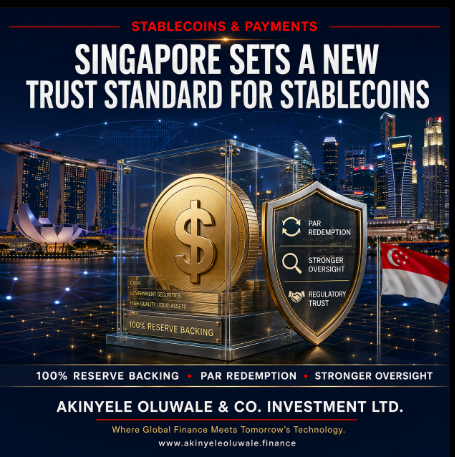
The central principle is straightforward: a stablecoin marketed as reliable money must be supported by reliable assets. Under the proposed framework, qualifying issuers would maintain reserve assets equal to at least 100% of the value of their coins in circulation.
This is currently a consultation not yet a completed law. Feedback is expected by 16 October 2026.
Background
Stablecoins were created to combine the speed of blockchain transactions with the stability of traditional currencies. Unlike Bitcoin, their value is normally linked to assets such as the US dollar or Singapore dollar.
However, a promised peg is only as credible as the assets, governance and redemption process supporting it. Recent failures within the digital-asset market have shown that a token called “stable” can still collapse when its reserves are weak or inaccessible.
Singapore first finalised its policy framework for single-currency stablecoins in 2023. The latest consultation proposes the legislative changes needed to implement and expand that framework.
The rules would introduce a dedicated licence for stablecoin issuers. Only approved issuers would be permitted to describe their tokens as “MAS-regulated stablecoins.”
Why It Matters
Stablecoins are becoming more than instruments used by cryptocurrency traders. They are increasingly being considered for international payments, corporate settlements, tokenised securities and digital commerce. For these uses to scale, businesses must know that one token can genuinely be redeemed for one unit of the currency it represents.
MAS therefore proposes that regulated issuers should:
* Maintain reserves covering at least 100% of circulating tokens.
* Segregate reserve assets from the issuer’s operating assets.
* Permit redemption at par within prescribed timelines.
* Conduct regular stress tests.
* Maintain recovery and orderly wind-down plans.
* Provide clear disclosures about reserves, risks and governance.
* Develop the ability to trace, freeze or burn tokens linked to unlawful activity.
The framework would also prevent issuers from presenting stablecoins as interest-bearing savings products. Singapore wants regulated stablecoins to function primarily as payment and settlement instruments not disguised investment schemes.
Stakeholders: Winners and Losers
Likely winners include consumers, payment companies, institutional investors and responsible stablecoin issuers. Stronger reserve and redemption standards could make regulated tokens more credible for everyday and institutional transactions.
Foreign issuers may also benefit from a proposed recognition system. MAS could recognise a limited number of overseas stablecoins where their home-country rules and supervision are considered substantially equivalent.
Likely losers are poorly capitalised issuers and operators that depend on vague reserve disclosures or weak redemption arrangements. Compliance costs will increase, but that is partly the point: issuing money-like instruments should require financial strength and operational discipline.
Short-Term Impact
The immediate effect will be preparation rather than transformation.
Issuers and exchanges serving Singapore will need to examine their reserve structures, custody arrangements, disclosures and marketing language. Bank groups considering stablecoins may need separate licensed non-bank entities for issuance.
Investors should also understand that stablecoins without MAS approval may remain available as digital payment tokens. However, they would not receive the regulator’s value-stability label.
Long-Term Impact
If implemented successfully, the framework could strengthen Singapore’s position as a trusted centre for regulated digital payments and tokenised finance.
The most important development may be Singapore’s openness to multi-jurisdictional stablecoins. A token could potentially be issued through related entities in several countries, provided their combined reserves cover global circulation and their regulatory standards are compatible.
That could help create stablecoins capable of moving across borders without abandoning national supervision.
Editorial Perspective
Singapore is not attempting to eliminate risk through slogans. It is asking a practical question: what conditions must exist before a private digital token can be trusted as money?
The answer begins with full reserves, dependable redemption and clear accountability.
Regulation will not make every stablecoin safe. But it can make the difference between an unsupported promise and a credible payment instrument. For Africa and other regions where cross-border payments remain slow and expensive, well-regulated stablecoins could eventually provide meaningful benefits provided local currency, consumer-protection and anti-money-laundering rules are respected.
What to Watch Next
Market participants should monitor the consultation deadline of 16 October 2026, the final legislative amendments and the later subsidiary rules covering reserve composition, redemption timelines and stress testing.
The real test will be which issuers qualify and whether businesses and consumers choose regulated tokens over cheaper but less transparent alternatives.
Notes
This analysis is based on the [MAS announcement on its proposed legislative amendments](https://www.mas.gov.sg/news/media-releases/2026/mas-consults-on-legislative-amendments-to-implement-stablecoin-regulatory-framework), the [detailed consultation analysis by Gibson Dunn](https://www.gibsondunn.com/singapore-publishes-draft-legislation-to-implement-its-stablecoin-framework/) and background reporting on [Singapore’s original stablecoin framework](https://www.reuters.com/markets/currencies/singapore-releases-regulatory-framework-single-currency-stablecoins-2023-08-15/).
Akinyele Oluwale & Co. Investment Ltd.
Where Global Finance Meets Tomorrow’s Technology.