

Published: 29 August 2026
Category: AI & Blockchain • Institutional Crypto • Digital Finance
By: Akinyele Oluwale & Co. Investment Ltd.
The underlying news is confirmed.
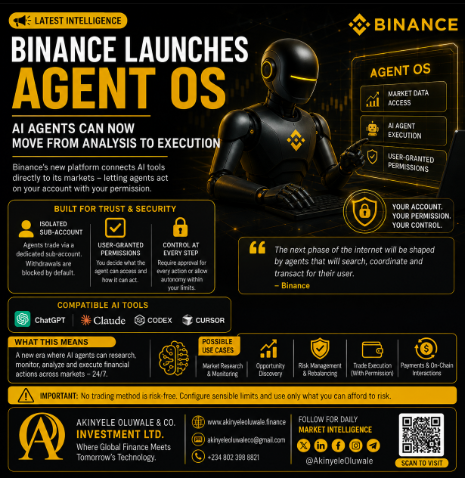
On 20 August 2026, Binance launched Agent OS, a developer platform connecting AI applications and agents with Binance's financial infrastructure. Compatible tools include ChatGPT, Codex, Claude Code and Cursor. With explicit user authorization, agents can access market information, inspect permitted account data and execute supported transactions. (TechCrunch)
But the viral headline “ChatGPT can trade crypto for you” needs context.
ChatGPT does not automatically gain access to someone's Binance account. An agent must be deliberately connected and granted permissions.
That distinction is critical.
Agent OS uses the Model Context Protocol (MCP) alongside Binance's existing APIs and agent infrastructure to connect AI applications with financial services. (Binance Academy)
Binance designed trading access around dedicated sub-accounts rather than unrestricted access to a user's primary account.
Withdrawals from those agent sub-accounts are blocked by default. Users determine what an agent can access and whether transactions require individual approval or can operate more autonomously within previously granted permissions.
This represents a fundamental change:
AI Advice → AI Analysis → AI Agents → Financial Execution
Most consumer AI has historically operated primarily as an information layer. Ask a question. Receive an answer. The human takes the action. Agentic AI changes that model.
An AI system can potentially research information, interpret conditions and interact with external software to complete authorized tasks.
Crypto is particularly compatible with this development because digital-asset markets and blockchain networks are already programmable and operate continuously.
Binance isn't alone. Other major crypto platforms have also been developing infrastructure connecting AI agents with financial services.
The bigger story isn't automated trading.
It is machine-accessible finance.
Imagine agents eventually being able to:
Research → Monitor → Analyse → Coordinate → Pay → Settle
Binance's architecture already extends beyond exchange trading into payments and on-chain interactions. That connects several major technology trends:
AI Agents + Blockchain + Stablecoins + Digital Assets + Programmable Payments
The internet gave machines information.
Blockchain may increasingly give machines an economic settlement layer.
Potential beneficiaries include exchanges, stablecoin issuers, blockchain networks, custody providers, cybersecurity companies and developers building agent infrastructure. Traditional financial institutions will also need to respond.
If customers increasingly expect financial services to be accessible through AI agents, banks and brokers may eventually have to expose more of their infrastructure through secure machine-readable interfaces.
The weakest position could belong to closed financial systems that remain difficult for software to interact with.
Expect substantial experimentation but also substantial risk.
AI agents can make incorrect decisions, misunderstand information or respond badly to manipulated inputs. Importantly, Binance does not impose a separate maximum trading-loss limit on Agent OS exchange trading; the amount placed into the dedicated sub-account effectively determines the capital exposed. That makes permission design and human oversight essential.
AI automation should never be confused with guaranteed investment performance.
The long-term implication is much larger. Today's internet was built primarily around humans clicking buttons.
Tomorrow's internet could contain billions of software agents conducting economic activities for people and businesses.
Those agents will require:
Identity + Wallets + Payments + Assets + Settlement + Permission Systems
Crypto infrastructure already provides several of those building blocks. That may prove more consequential than AI-powered trading itself.
The phrase “AI can trade crypto” attracts attention but it understates the development. The real breakthrough occurs when AI stops merely discussing financial markets and begins interacting with financial infrastructure.
However, autonomy introduces a new principle:
The more authority we give machines, the stronger the controls around that authority must become.
Financial intelligence without risk governance is not innovation. It is uncontrolled exposure.
Watch institutional adoption of AI agents, stablecoin-based machine payments, agent wallets, security standards, transaction volumes and whether banks introduce comparable infrastructure.
Above all, watch where fees and economic value accumulate.
Don't simply ask:
“Which AI token will benefit?”
Ask:
Who owns the infrastructure that agents repeatedly use? Who provides settlement? Who controls distribution? Who gets paid when machines transact?
That is the deeper investment thesis.
The evolution has begun:
Chatbots → Copilots → Agents → Transactions → Autonomous Commerce
Agent OS provides another important bridge between the third and fourth stages.
Binance Agent OS is real. But its importance should not be reduced to letting an AI buy or sell crypto. The larger development is the emergence of financial infrastructure designed to be accessed by both humans and machines.
If the agentic economy develops at scale, crypto's next major user base may not consist solely of millions of new human traders.
It could include billions of software agents requiring programmable money and financial rails.
Akinyele Oluwale & Co. Investment Ltd.
Where Global Finance Meets Tomorrow's Technology.