

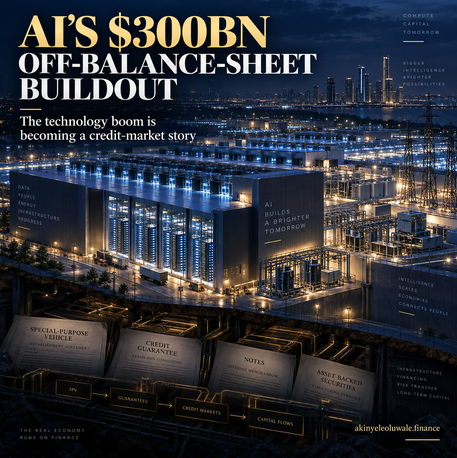
AI’s $300 Billion Off-Balance-Sheet Buildout
The artificial-intelligence boom is no longer only a technology story it is becoming a major test of credit markets, corporate transparency and financial risk management.
Published: September 21, 2026
Category: AI / Institutional Finance
By: Akinyele Oluwale
Executive Summary
The global artificial-intelligence investment boom is entering a more complicated financial phase.
Major technology companies and their commercial partners are reportedly supporting as much as $300 billion of financing for data centres, advanced semiconductors and related AI infrastructure through special-purpose vehicles, long-term leases, purchase commitments and residual-value guarantees.
These financing arrangements allow separately structured entities to own and fund expensive infrastructure. The technology companies then obtain access to the assets through leases, commercial agreements or financial guarantees without necessarily reporting all the project debt as ordinary corporate borrowing.
This does not mean that $300 billion of losses has been concealed. It also does not automatically make the financing structures improper. Special-purpose vehicles are commonly used to finance property, aircraft, energy infrastructure and other capital-intensive projects.
However, investors must distinguish between the accounting location of an obligation and the party that ultimately bears its economic risk.
If demand for artificial intelligence continues expanding and the infrastructure generates sufficient revenue, these structures could represent an efficient way to finance productive assets.
If AI revenues disappoint, data-centre capacity exceeds commercial demand or computing equipment becomes obsolete more quickly than projected, some guarantees and long-term commitments could become financially significant.
The AI revolution must therefore be evaluated through two separate lenses: its technological potential and the financial risks being created to support it.
Why This Matters
Artificial intelligence requires enormous physical investment.
Advanced AI models depend on specialised processors, high-speed memory, networking equipment, cooling systems, electricity infrastructure and large data centres. These facilities can require billions of dollars before producing meaningful commercial revenue.
Even the world’s largest technology companies face limits on how much infrastructure they can finance directly without affecting their cash reserves, debt ratios and credit ratings.
Off-balance-sheet and project-financing structures offer an alternative. They enable outside investors to provide capital while technology companies preserve some financial flexibility.
The concern is that a company can transfer the legal ownership of infrastructure without fully removing its commercial exposure to that infrastructure.
A residual-value guarantee, for example, may require the guarantor to compensate investors if the asset is worth less than an agreed amount at a future date. A long-term lease may require payments even when the infrastructure is no longer as profitable or technologically competitive as expected.
The issue is therefore not simply whether an obligation appears as conventional debt on a company’s balance sheet. The more important question is whether the company may still suffer a future cash outflow if the underlying investment underperforms.
These arrangements also expand the number of financial institutions exposed to the AI boom. Bond funds, private-credit firms, banks, insurers and pension funds may all provide capital to AI infrastructure projects.
A technology-sector slowdown could consequently become a broader credit-market issue.
What Happened?
According to a Financial Times investigation, Big Tech companies and their commercial partners are increasingly using financial guarantees to support as much as $300 billion of debt financing connected to AI data centres and computing equipment.
The financing is often arranged through special-purpose vehicles. These are separate legal entities created to own particular assets, raise financing and isolate specific project risks.
One prominent example is Meta’s Hyperion data-centre project in Louisiana.
The project was structured through a joint venture with Blue Owl Capital. Meta retained a minority ownership interest, while the separately structured entity raised approximately $27 billion to support the project.
Meta’s lease commitments and other forms of support helped make the financing attractive to institutional investors. However, much of the project debt was not presented as ordinary Meta corporate borrowing.
Other arrangements across the industry reportedly involve chip suppliers, cloud-service providers, AI developers and infrastructure investors. Guarantees may cover minimum asset values or support financing for customers purchasing large quantities of computing equipment.
These structures make it possible to continue expanding AI infrastructure without every dollar of associated project debt appearing directly on the technology companies’ conventional balance sheets.
The reported $300 billion should be understood as financing exposure supported through these arrangements not as an established loss or proof of accounting misconduct.
The Bigger Picture
The development reflects the extraordinary amount of capital required to build the infrastructure behind artificial intelligence.
The AI market is often discussed in terms of models, software capabilities and future productivity. Beneath that digital narrative is a physical economy involving land, construction, power generation, cooling equipment, fibre networks and semiconductor supply chains.
Financing this infrastructure requires the AI industry to move beyond traditional corporate capital expenditure.
The result is a growing relationship between technology companies and private capital. Investment banks design the structures. Institutional investors purchase the debt. Asset managers provide equity capital. Technology companies provide the commercial demand and financial commitments supporting the projects.
The arrangement works when demand assumptions prove correct.
The risk emerges when several participants rely on the same optimistic expectations: continued AI adoption, high data-centre utilisation, strong pricing and valuable computing equipment.
AI hardware can become obsolete faster than traditional infrastructure. A building may operate for decades, but its processors may lose economic competitiveness within a much shorter period.
Therefore, an AI data centre combines long-duration financing with assets exposed to rapid technological change. That mismatch deserves close attention.
Market Impact
In the short term, these financing structures are likely to support continued investment across the AI supply chain.
Data-centre developers, semiconductor manufacturers, electricity providers and construction companies could benefit from sustained capital expenditure.
Technology companies also benefit because they can expand computing capacity without funding every project directly. This may protect cash reserves and reduce immediate pressure on headline corporate leverage.
Investment banks and private-credit firms gain new opportunities to structure and finance large projects. Institutional investors receive access to long-duration debt supported by commitments from financially strong technology companies.
However, markets may begin demanding more transparency.
Credit-rating agencies are not limited to the debt reported on a company’s balance sheet. They can adjust their leverage calculations to reflect guarantees, leases and other debt-like commitments.
If analysts conclude that the economic exposure is materially larger than the reported corporate debt, financing costs could rise and credit ratings could face pressure.
Equity investors may also reconsider company valuations if infrastructure commitments begin consuming more cash than anticipated.
The greatest risk would be a simultaneous decline in AI revenue expectations and the market value of data-centre assets. Such a development could affect technology shares, private-credit portfolios, corporate bonds and infrastructure investors.
Editorial Perspective
Artificial intelligence may become one of the most important general-purpose technologies of the modern economy. That does not mean every AI company, data centre or financing structure will produce an acceptable return.
Investors must separate technological importance from investment profitability.
The internet transformed the global economy, but many companies financed during the dot-com boom still failed. Railways changed commerce, yet railway investment produced repeated financial crises. A transformative technology can create lasting economic value while destroying capital in poorly structured or excessively valued projects.
Off-balance-sheet financing is not automatically evidence of deception. It can allocate risk efficiently and connect long-term capital with infrastructure development.
The problem arises when accounting presentation creates the impression that risk has disappeared.
Risk does not disappear because it has been transferred to a special-purpose vehicle. It moves among shareholders, lenders, guarantors, tenants and asset owners.
Investors must therefore look beyond headline debt figures and examine the complete network of guarantees, leases, purchase commitments and commercial dependencies.
The critical principle is straightforward:
Moving an obligation outside the accounting balance sheet does not necessarily move the economic risk outside the company.
What to Watch Next
Investors should monitor the guarantees and long-term contractual commitments disclosed by major technology companies.
Particular attention should be given to residual-value guarantees, minimum purchase agreements, long-term data-centre leases and commitments to support separately financed customers or infrastructure providers.
Data-centre utilisation will be another important indicator. Large facilities must generate sufficient usage and revenue to justify their construction and financing costs.
The depreciation and secondary-market value of advanced processors should also be monitored. Rapid technological improvement could cause existing hardware to lose economic value faster than financing models assume.
Credit-rating agencies’ treatment of these obligations will be critical. If agencies begin counting more guarantees and lease commitments as adjusted debt, the financing advantages of these structures could narrow.
Investors should also compare AI-related revenue growth with capital expenditure and contractual commitments. Spending can rise rapidly, but the long-term investment case depends on whether recurring cash flow grows alongside it.
Finally, disclosure standards should improve. Companies should explain not only whether an arrangement meets the accounting definition of a liability, but also the circumstances under which it could require future payment.
Key Takeaways
* Big Tech and its partners are reportedly supporting up to $300 billion of AI infrastructure financing through special-purpose vehicles, leases and guarantees.
* The reported amount represents financing exposure—not an established financial loss.
* Off-balance-sheet financing is not automatically improper, but investors must assess the underlying economic obligations.
* Separately financed infrastructure can still expose technology companies through guarantees, leases and purchase commitments.
* AI hardware may become obsolete faster than traditional infrastructure, increasing residual-value risk.
* The AI boom is connecting technology companies more deeply with bond markets, private credit, insurers and institutional investors.
* AI may transform the global economy while some individual infrastructure projects still produce poor financial returns.
* Investors should follow cash flow, data-centre utilisation, guarantees and credit exposure not only technological announcements.
About Akinyele Oluwale & Co. Investment Ltd.
Akinyele Oluwale & Co. Investment Ltd. is a digital finance and market-intelligence company providing institutional analysis across artificial intelligence, blockchain technology, digital assets, tokenisation, real-world assets, stablecoins, central banks and global markets.
Our editorial approach goes beyond reporting headlines. We examine what happened, why it matters, how markets and stakeholders may be affected, and what investors should watch next.
Our objective is to make complex financial and technological developments understandable without sacrificing analytical depth, professional discipline or intellectual independence.
Sources: [Financial Times](https://www.ft.com/content/7f11afae-c4e3-4054-a65b-873f3647f563) and [Reuters](https://www.reuters.com/technology/meta-forms-joint-venture-with-blue-owl-capital-louisiana-data-center-2025-10-21/).
This publication is provided for information and education. It does not constitute investment, accounting, legal or financial advice.
Akinyele Oluwale & Co. Investment Ltd.
Where Global Finance Meets Tomorrow’s Technology.