

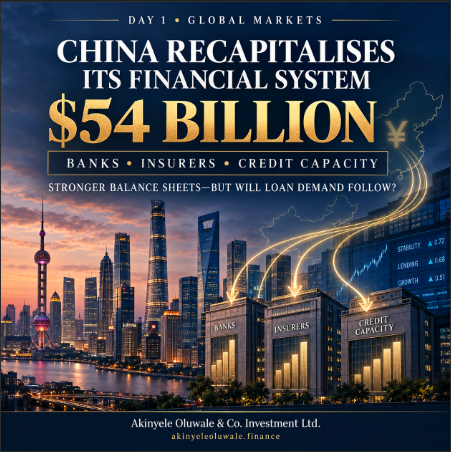
China Injects $54 Billion Into Banks and Insurers but Capital Alone Cannot Create Growth
Published: 7 September 2026
Category: Macro & Global Markets • Institutional Finance • Central Banks
By: Akinyele Oluwale & Co. Investment Ltd.
Executive Summary
China is coordinating approximately 360 billion yuan about $54 billion in capital injections across major state-owned banks and insurers.
Three lenders will raise a combined 290 billion yuan, while five insurers will receive approximately 70 billion yuan. The programme is intended to strengthen capital buffers, preserve lending capacity and improve the financial system’s ability to absorb losses.
This is significant support, but it is not proof that China’s economy has recovered. Better-capitalised banks can supply more credit; they cannot force cautious households and businesses to borrow.
The decisive question is whether stronger balance sheets produce productive investment, consumption and sustainable growth.
Background
Agricultural Bank of China plans to raise up to 160 billion yuan, Industrial and Commercial Bank of China 100 billion yuan, and the Export-Import Bank of China will receive 30 billion yuan.
China Life Insurance will receive 35 billion yuan, while China Taiping, People’s Insurance Company of China, China Export and Credit Insurance Corporation and China Reinsurance will receive or raise additional capital.
The programme extends Beijing’s attempt to stabilise financial institutions facing weak loan demand, lower profitability and prolonged pressure from China’s property slowdown.
State insurers have also been encouraged to provide medium and long-term support for domestic equities and assist regulators in managing weaker insurance companies.
Why It Matters
Capital is the financial system’s shock absorber. Stronger core capital allows banks to withstand losses while continuing to lend.
The injections may:
* Strengthen core Tier 1 capital.
* Improve insurer solvency.
* Protect credit availability.
* Support strategic industries and infrastructure.
* Increase long-term institutional participation in Chinese equities.
* Reduce the risk of stress spreading from weaker financial institutions.
However, recapitalisation addresses the supply of finance not necessarily demand for it. If businesses lack confidence and households remain cautious, additional lending capacity may remain unused or flow into low-return projects.
Stakeholders: Winners and Losers
Potential winners include the recipient banks and insurers, which gain stronger capital positions and greater operating flexibility. Chinese equities could also benefit if insurers deploy more long-term funds into the market.
Companies in infrastructure, advanced manufacturing and strategic technology may receive improved access to credit.
Potential losers include private financial institutions competing with state-backed institutions for customers and assets. Existing shareholders may also face dilution where recapitalisation occurs through private share placements.
The wider economy could lose if banks are pressured to expand lending without sufficient attention to credit quality.
Short-Term Impact
Chinese bank and insurance shares may receive some support as investors price in lower solvency and systemic risks.
The yuan could also benefit if the programme improves confidence in financial stability. However, its currency effect may remain limited if markets interpret the injections as evidence of deeper economic weakness.
Commodity exporters should watch closely. More productive Chinese lending could strengthen demand for energy and industrial materials, while poor transmission would limit that benefit.
Long-Term Impact
The programme’s success will depend on where the money ultimately goes.
Credit directed towards productive companies, household demand and commercially sound projects could support recovery. Credit used mainly to refinance weak borrowers or preserve inefficient institutions would postpone losses rather than resolve them.
China’s long-term challenge is not simply insufficient bank capital. It is restoring private-sector confidence and generating investment opportunities capable of producing acceptable returns.
Editorial Perspective
This is a serious financial-stability intervention, but calling it a complete economic stimulus would overstate what has happened.
A stronger bank is not automatically a more active bank. More lending is not automatically productive lending. The quality and destination of credit matter as much as its quantity.
Investors should therefore move beyond the $54 billion headline. The real indicators are loan demand, private investment, household consumption, bank margins and non-performing loans.
Beijing has strengthened the machinery. Markets must now determine whether the economic engine responds.
What to Watch Next
Investors should monitor Chinese credit growth, lending to private businesses, household borrowing, property-sector defaults and insurer purchases of domestic equities.
The next test is whether recapitalised institutions generate additional economic activity without weakening lending standards.
Notes
This analysis is based on Reuters reporting on the combined bank and insurer recapitalisation, Reuters reporting on the state banks’ capital plans and earlier Reuters coverage of China’s 2026 financial-sector programme.
Akinyele Oluwale & Co. Investment Ltd.
Where Global Finance Meets Tomorrow’s Technology.