

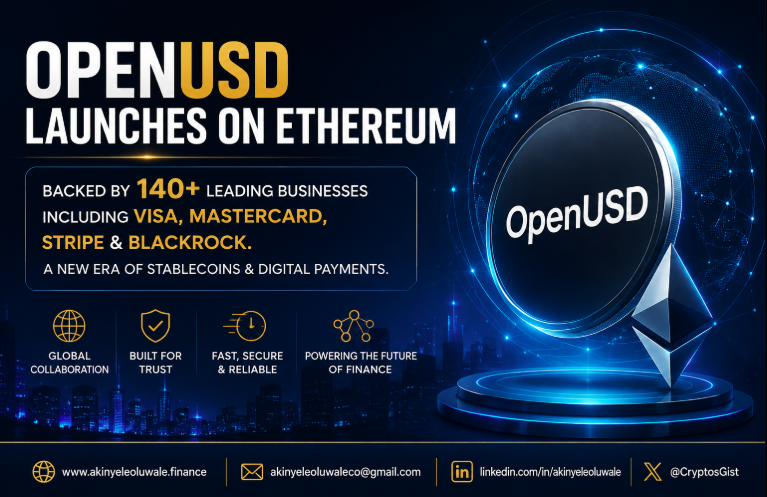
OpenUSD Launches on Ethereum: Why This Could Be a Turning Point for Stablecoins and Digital Payments
By Akinyele Oluwale & Co. Investment Ltd.
Global Finance Meets Tomorrow's Technology
Executive Summary
The stablecoin ecosystem continues to evolve, and one of the latest developments could have far-reaching implications for digital payments and blockchain adoption.
OpenUSD, a new stablecoin initiative backed by more than 140 companies, including global financial and payment leaders such as Visa, Mastercard, Stripe and BlackRock, is launching on the Ethereum blockchain from day one.
While new stablecoins enter the market regularly, OpenUSD stands out because of the breadth of institutional support behind the project. The involvement of major payment processors, financial institutions and technology companies suggests that the industry is moving beyond isolated blockchain projects toward collaborative financial infrastructure.
Rather than competing with traditional finance, initiatives like OpenUSD aim to bridge the gap between conventional payment systems and blockchain technology.
If successful, OpenUSD could contribute to faster cross-border payments, lower transaction costs and wider adoption of blockchain-based financial services.
A New Phase for Stablecoins
Stablecoins have become one of the fastest-growing sectors within digital assets.
Unlike cryptocurrencies whose prices fluctuate significantly, stablecoins are designed to maintain a relatively stable value by being linked to traditional assets, most commonly the U.S. dollar.
Initially, stablecoins were primarily used for cryptocurrency trading.
Today, their role has expanded considerably.
They are increasingly being used for:
OpenUSD represents another step in this broader evolution.
Why Institutional Support Matters
One of the most notable aspects of OpenUSD is the reported participation of more than 140 businesses.
This level of collaboration signals that digital finance is becoming an industry-wide effort rather than being driven by a handful of technology companies.
When organizations such as Visa, Mastercard, Stripe and BlackRock participate in blockchain initiatives, they bring decades of experience in payments, financial infrastructure and risk management.
Institutional participation can help accelerate:
While institutional support alone does not guarantee success, it often increases credibility and encourages broader participation across the financial ecosystem.
Why Ethereum?
Launching on Ethereum is a strategic decision.
Ethereum remains one of the world's most widely used blockchain networks for programmable financial applications.
Its ecosystem supports:
By launching on Ethereum from the outset, OpenUSD gains immediate access to a mature developer community and a broad network of existing financial applications.
This can help accelerate integration with wallets, exchanges, payment providers and enterprise systems.
Connecting Traditional Finance and Blockchain
Perhaps the biggest story is not the stablecoin itself.
It is what the collaboration represents.
For years, blockchain and traditional finance were often portrayed as competing systems.
Increasingly, that narrative is changing.
Banks are exploring blockchain settlement.
Asset managers are tokenizing real-world assets.
Payment companies are integrating stablecoins.
Governments are developing digital currency frameworks.
OpenUSD reflects this convergence.
Rather than replacing traditional financial infrastructure, blockchain is increasingly becoming another layer within it.
The Growing Importance of Open Standards
The name "OpenUSD" highlights another important trend: openness and interoperability.
Financial systems become more valuable when they work together.
Businesses generally prefer technologies that can integrate across multiple platforms instead of creating isolated ecosystems.
Open standards may help encourage:
If OpenUSD succeeds in promoting interoperability, it could strengthen the wider digital payments ecosystem.
Implications for Businesses
Businesses continue searching for faster and more efficient ways to move money.
Traditional cross-border payments can involve:
Blockchain-based stablecoins offer an alternative payment rail that can reduce many of these inefficiencies.
For merchants, this could eventually mean:
For consumers, it could translate into faster, simpler and more affordable global transactions.
What This Means for Investors
Investors should view OpenUSD within the broader context of digital financial infrastructure.
The announcement does not necessarily change the investment outlook for any single cryptocurrency.
Instead, it highlights several long-term themes:
As these trends continue, infrastructure providers may become just as important as digital assets themselves.
Challenges Ahead
Despite the optimism, OpenUSD will still face several important challenges.
Regulation
Stablecoins remain subject to evolving regulatory frameworks around the world.
Future legal developments could influence adoption.
Competition
The stablecoin market is already highly competitive.
Existing products have established user bases and extensive integrations.
OpenUSD will need to demonstrate meaningful advantages.
Security
Maintaining strong cybersecurity and operational resilience will remain essential.
Trust is fundamental for any payment system.
Adoption
Technology alone does not guarantee success.
Long-term adoption depends on whether businesses, consumers and financial institutions choose to use the platform.
A Sign of Industry Maturity
One of the clearest signals from this announcement is that blockchain is becoming less experimental.
Several years ago, discussions largely centred on cryptocurrency prices.
Today's conversations increasingly focus on:
This represents a significant shift in the industry's priorities.
The focus is gradually moving from speculation toward practical utility.
Looking Ahead
The stablecoin market is expected to remain one of the fastest-growing segments of digital finance.
Several trends will likely shape its future:
OpenUSD enters the market at a time when each of these trends is gaining momentum.
Its long-term success will depend not only on technology but also on execution, governance and market adoption.
Final Thoughts
OpenUSD's launch on Ethereum is more than the introduction of another stablecoin.
It represents a broader shift toward collaboration between blockchain innovators and established financial institutions.
The participation of more than 140 organizations suggests that the conversation is no longer about whether blockchain belongs in mainstream finance. Instead, attention is turning to how these technologies can improve existing financial systems.
While challenges remain, the direction of travel is becoming increasingly clear.
Stablecoins are evolving from tools primarily used within cryptocurrency markets into infrastructure capable of supporting global commerce, payments and financial innovation.
For investors, businesses and policymakers, OpenUSD serves as another reminder that the future of finance is likely to be built not through competition between traditional finance and blockchain, but through their continued integration.
Key Takeaways
Editorial Standards
This article is published by Akinyele Oluwale & Co. Investment Ltd. as independent financial analysis for educational and informational purposes. It does not constitute financial, investment or legal advice. Readers should conduct their own research and consult qualified professionals before making investment decisions.