

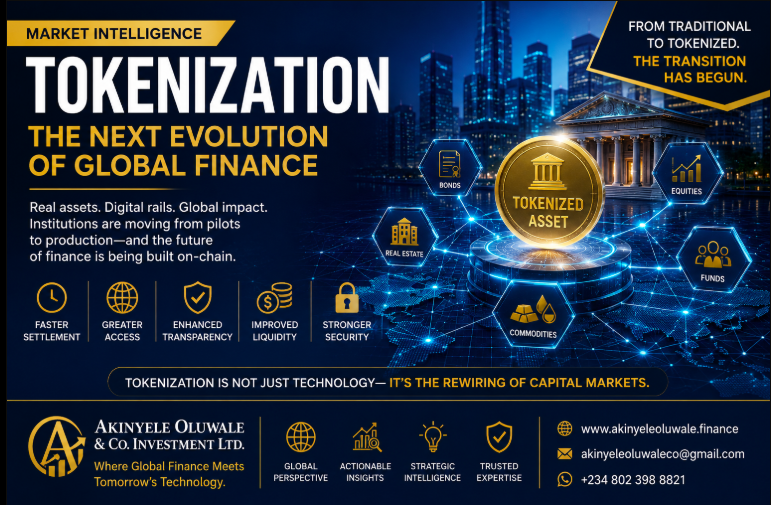
Tokenization Moves From Experiment to Market Infrastructure as Wall Street Brings Real Assets On-Chain
Tokenization is entering a more serious phase. BlackRock is putting regulated money-market funds on-chain, DTCC has successfully processed real U.S. securities as tokens, and institutions across Asia are developing tokenized funds. The question is shifting from whether traditional assets can be tokenized to how quickly tokenized markets can become part of everyday finance.
Published: 20 August 2026
Category: Tokenization & RWAs • Market Intelligence
By: Akinyele Oluwale & Co. Investment Ltd.
Executive Summary
Tokenization is beginning to move beyond pilots and presentations.
In July, DTCC successfully converted DTC-held securities into tokens and used them in production transactions involving equities, U.S. Treasuries, repo, securities lending and collateral. More than 30 traditional and digital-finance firms participated. DTCC plans to launch its Tokenization Service in October 2026. (DTCC)
BlackRock is moving in the same direction. In August it expanded tokenized money-market products in the United States and introduced on-chain share classes for selected institutional cash funds in Europe using J.P. Morgan's tokenization infrastructure and Ethereum. (BlackRock)
The message is becoming difficult to ignore:
Wall Street is not simply experimenting with blockchain. Parts of Wall Street are beginning to put traditional financial infrastructure on-chain.
What Happened?
DTCC's July production exercise may prove particularly significant.
Assets held at DTC were tokenized and used for real transactions, including Treasury/repo delivery-versus-payment, equity trades, collateral pledges and securities lending.
DTCC says its forthcoming service will allow securities to move between traditional and tokenized formats, potentially opening new liquidity pools without removing existing investor protections. (DTCC)
The scale matters. DTC currently custodies more than $114 trillion in assets. (DTCC)
Meanwhile, BlackRock's European initiative provides tokenized functionality across selected money-market funds within a platform representing a combined $311 billion in assets under management across 15 markets. (BlackRock)
Asia is advancing too. South Korea's Shinhan Asset Management recently agreed with Plume Network to explore KRW-denominated tokenized funds. (아시아경제)
Background
Tokenization is relatively simple in concept.
A traditional asset such as a Treasury, fund, bond or property is represented digitally on a blockchain or distributed ledger.
The important part isn't creating the token.
It is ensuring that the token carries enforceable ownership rights and can interact with custody, compliance, settlement and payment infrastructure.
That has been the missing bridge between blockchain demonstrations and institutional finance.
Now that bridge is being built.
Why It Matters
Traditional markets still contain significant friction.
Trading hours are restricted. Settlement takes time. Collateral can become trapped between systems. Ownership records often move through multiple intermediaries.
Tokenization could allow assets and ownership records to exist on programmable infrastructure capable of faster settlement, greater asset mobility and potentially extended trading hours. (DTCC)
But the real breakthrough comes when tokenized assets meet tokenized money.
A tokenized Treasury settling against a regulated stablecoin, tokenized deposit or wholesale digital money can potentially allow both sides of a transaction to move together.
That is when blockchain begins changing financial plumbing rather than simply changing asset packaging.
Winners & Losers / Key Stakeholders
Asset managers could gain new distribution channels.
Banks and custodians can build servicing, settlement and collateral businesses around tokenized assets.
Blockchains capable of supporting regulated institutional activity may gain valuable economic activity.
Investors could eventually benefit from greater accessibility, fractionalisation and more efficient markets.
But intermediaries whose economics depend primarily on slow, fragmented processes may face pressure.
Tokenization doesn't necessarily eliminate financial institutions.
It may force them to reinvent what they do.
Short-Term Impact
Investors shouldn't expect trillions of dollars to migrate on-chain overnight.
Legal ownership, interoperability, liquidity, cybersecurity and regulation remain substantial challenges.
The more immediate development is institutional validation.
When organisations responsible for enormous pools of traditional assets start building production infrastructure, tokenization becomes harder to dismiss as a crypto-sector experiment.
Long-Term Impact
The endgame could be much larger than tokenized funds.
Imagine:
Stocks + Bonds + Funds + Real Estate + Commodities + Cash
existing on interoperable digital infrastructure.
Assets could potentially trade for longer hours, serve as programmable collateral and settle more efficiently across borders.
That represents something deeper than digitisation.
It is potentially a rewiring of capital markets.
Editorial Perspective
Investors should be careful not to reduce tokenization to another blockchain narrative.
The investment opportunity isn't simply:
“Which tokenization coin should I buy?”
The more important question is:
Where will value accumulate when financial assets become programmable?
It may accrue to blockchains, asset managers, custodians, exchanges, stablecoin issuers, banks or infrastructure providers.
Probably several of them.
Follow the economic activity not merely the tokenization label.
What to Watch Next
The biggest near-term milestone is DTCC's planned October 2026 Tokenization Service launch.
Also watch BlackRock's tokenized fund adoption, institutional activity across Ethereum and other networks, tokenized collateral and the connection between RWAs and regulated digital money.
Investing Lesson
Tokenization does not create the value of an asset. It changes how that value can move.
A bad asset doesn't become good because it sits on a blockchain.
The real opportunity appears when better infrastructure makes quality assets more accessible, liquid, programmable and useful.
Key Takeaways
Tokenization is progressing from proof-of-concept toward production infrastructure.
DTCC is processing tokenized securities. BlackRock is expanding tokenized funds. Asian institutions are experimenting with on-chain investment products. (DTCC)
The transition has begun.
Editorial Bottom Line
The first era of blockchain focused on creating new digital assets.
The next may be about bringing existing global assets onto digital rails.
That distinction is enormous.
Tokenization isn't necessarily replacing finance. It is beginning to change how finance moves.
Notes
Primary sources include DTCC's July 2026 production-tokenization announcement, BlackRock's August 2026 tokenized cash-management launches, U.S. banking regulators' guidance on tokenized securities, and recent institutional tokenization initiatives in Asia. (DTCC)
Akinyele Oluwale & Co. Investment Ltd.
Where Global Finance Meets Tomorrow's Technology.