

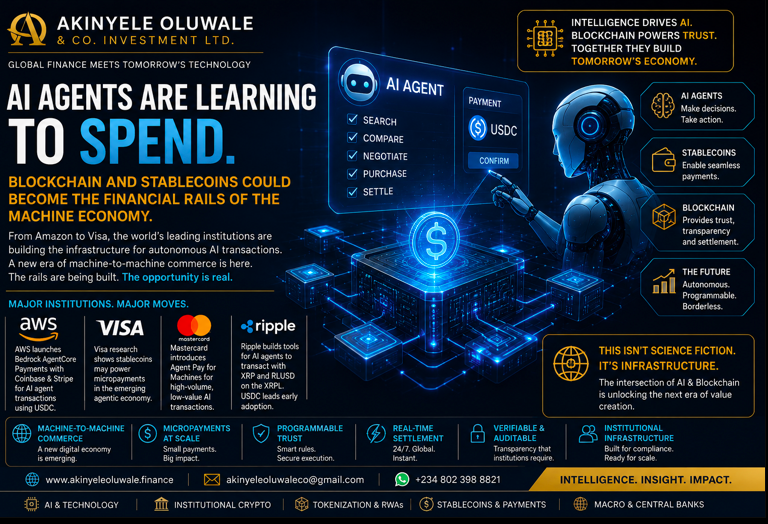
AI Agents Are Learning to Spend: Blockchain and Stablecoins Could Become the Financial Rails of the Machine Economy
The next chapter of artificial intelligence may not be about AI generating better answers. It may be about software becoming an economic actor buying data, paying for computing power, negotiating with other agents and settling transactions without waiting for a human to enter a credit card.
Published: 11 August 2026
Category: AI & Blockchain • Agentic AI • Stablecoins • Digital Infrastructure
By: Akinyele Oluwale & Co. Investment Ltd.
Executive Summary
A significant convergence is developing between artificial intelligence and blockchain technology.
AI agents are evolving from systems that merely answer questions into software capable of performing tasks, interacting with other services and, increasingly, initiating economic transactions.
That creates a surprisingly difficult problem:
How does software pay software?
Recent developments suggest stablecoins and blockchain infrastructure are becoming part of the answer.
Amazon Web Services introduced Amazon Bedrock AgentCore Payments, working with Coinbase and Stripe to enable developers to build AI agents capable of paying for resources such as APIs, web content and other agents, including through USDC-based micropayments. (The Block)
Visa and blockchain analytics firm Artemis have meanwhile examined live on-chain activity surrounding agentic payments. Their research suggests a potentially hybrid future: conventional payment networks could remain important for larger consumer transactions, while stablecoins may prove particularly useful for extremely small, frequent machine-to-machine payments. (Visa)
Mastercard has also introduced Agent Pay for Machines, infrastructure designed for high-volume, low-value autonomous transactions, with more than 30 technology, fintech and crypto participants involved in its ecosystem. (The Block)
And Ripple is developing tools that allow AI agents to transact using XRP and RLUSD on the XRP Ledger, although early agent-payment activity remains heavily concentrated around USDC. (CoinDesk)
The bigger story is becoming clearer:
AI may provide the intelligence for autonomous digital commerce. Blockchain may provide part of its financial infrastructure.
But investors should be careful.
This market is still early, and researchers continue to identify major problems involving authorisation, identity, accountability, security and trust.
The opportunity is enormous.
The plumbing is still being built.
What Happened?
AI Is Moving From Thinking to Transacting
Generative AI's first mainstream phase revolved around creating things.
Text.
Images.
Code.
Research.
Analysis.
The emerging agentic phase is different.
An AI agent can potentially receive a goal, determine the steps required, interact with external software and execute actions on behalf of a person or organisation.
That could mean:
Booking travel.
Ordering inventory.
Purchasing cloud computing.
Paying for an API call.
Acquiring data.
Renewing software services.
Hiring another AI agent.
Eventually, millions—or billions—of small economic decisions could occur between machines.
Visa notes that agents are already beginning to perform activities including booking travel, reordering inventory, querying data providers and purchasing computing resources. (Visa)
That creates a new requirement:
Machines need financial infrastructure designed for machines.
Why This Matters
Today's financial system was fundamentally designed around humans and institutions.
A person opens a bank account.
A person receives a card.
A business establishes a merchant account.
Someone signs agreements.
Someone authorises transactions.
Someone receives invoices.
Someone reconciles the accounts.
AI agents don't naturally fit into that architecture.
A machine might need to purchase an API call costing fractions of a cent, complete thousands of similar transactions automatically and operate continuously across national borders.
Traditional payment systems were not primarily designed for that economic model.
Blockchain offers several characteristics that could become useful:
Stablecoins add another important component:
Digital money with relatively stable value.
Put the two together and the potential becomes easier to understand.
AWS, Coinbase and Stripe: AI Agents Get Payment Infrastructure
One of the strongest signals came from Amazon Web Services.
AWS introduced Bedrock AgentCore Payments, enabling AI agents to access and pay for services such as web content, APIs, MCP servers and even other agents.
Coinbase and Stripe are participating in the infrastructure, with Coinbase supporting stablecoin-based agentic payment capabilities using USDC. (The Block)
Consider what this means.
An AI agent researching financial markets might require access to a premium database.
Instead of:
Requesting access.
Waiting for human approval.
Entering card details.
Selecting a subscription.
The agent could potentially determine that the information is worth purchasing, authorise a permitted micropayment and retrieve the information automatically.
Request → payment → access → execution.
Software begins operating economically.
That is a fundamentally different internet.
Visa Sees Two Different Agentic Economies
Visa's recent research with Artemis offers an important framework.
It distinguishes between what could be described as macro-commerce and micro-commerce.
Macro-Commerce
These are familiar consumer-sized transactions.
An AI agent might:
Book your hotel.
Buy an airline ticket.
Order groceries.
Renew a subscription.
Existing card networks remain extremely well suited to many of these transactions.
Micro-Commerce
This is where things become more interesting for blockchain.
An AI agent might pay:
$0.005 for an API request.
$0.02 for data.
$0.10 for computing resources.
Another AI agent for completing part of a task.
Thousands of transactions could happen automatically.
Visa's research argues that stablecoins could play a significant role in this micro-commerce layer because blockchain rails can accommodate programmable, machine-native settlement. (The Block)
This suggests the future may not be:
Cards versus stablecoins.
It may be:
Cards + stablecoins, each solving different payment problems.
Mastercard Is Building for Machines Too
Visa isn't alone.
Mastercard introduced Agent Pay for Machines in June, designed specifically for autonomous AI transactions.
The infrastructure targets high-volume, relatively low-value payments and involves more than 30 technology and financial participants, including crypto companies. (The Block)
That is strategically significant.
When Visa, Mastercard, AWS, Stripe, Coinbase and other major infrastructure providers begin working on the same problem, investors should pay attention.
They may choose different architectures.
Some will use cards.
Some will use bank rails.
Some will use stablecoins.
Some will combine them.
But they increasingly agree on the underlying premise:
AI agents will need the ability to transact.
Why Stablecoins Could Be Important
Bitcoin is revolutionary digital money.
But Bitcoin's price volatility can make it awkward for routine machine commerce.
Imagine an AI agent receiving a $100 operating budget.
Its objective is not necessarily to speculate on the future price of money.
It needs predictable purchasing power.
Stablecoins solve part of that problem.
One USDC is designed to remain close to one U.S. dollar.
That makes budgeting much easier.
An agent can be instructed:
Spend no more than $20 per day.
Never spend more than $2 per transaction.
Only purchase approved data services.
Stop if the wallet balance falls below $10.
Now programmable money meets programmable intelligence.
That combination could become powerful.
Ripple Wants XRP and RLUSD in the Agent Economy
Competition for this emerging market is already developing.
Ripple has introduced an XRPL AI Starter Kit intended to help developers build agents capable of making payments through the XRP Ledger using XRP and its RLUSD stablecoin.
But there is an important reality check.
According to CoinDesk's reporting, early activity around the x402 machine-payment ecosystem remains dominated by USDC, while Ripple has not yet disclosed meaningful real-world adoption metrics for its agent-payment initiative. (CoinDesk)
That's important for investors.
A compelling narrative is not the same thing as adoption.
The winning network will not necessarily be the blockchain producing the loudest AI marketing.
It will be the infrastructure that developers and machines actually use.
The Bigger Opportunity: Machine-to-Machine Commerce
The internet was largely built around human economic activity.
Humans searched.
Humans clicked.
Humans subscribed.
Humans purchased.
Agentic AI introduces another possibility:
Machines become customers of machines.
Imagine an autonomous logistics agent.
It discovers shipping prices.
Purchases weather data.
Negotiates with transport providers.
Pays another agent to optimise a route.
Purchases additional computing capacity.
Settles invoices.
Reports the results to management.
Potentially, much of that could occur without individual human approval for every transaction.
Now multiply that by:
Millions of businesses.
Billions of software agents.
Thousands of transactions per agent.
The economic implications become enormous.
Blockchain Could Become the Accounting Layer
Payments are only part of the opportunity.
Autonomous agents also create an accountability problem.
Suppose an AI agent spends $25,000.
Management needs to know:
Who authorised it?
Why did the agent make the purchase?
Which policy permitted it?
Who received the money?
What service was delivered?
Was the transaction duplicated?
Can it be audited?
Blockchain can record that a transaction occurred.
But blockchain alone cannot necessarily explain the agent's reasoning or prove that the transaction fulfilled the user's actual intent.
Academic research published in 2026 highlights precisely these weaknesses. Researchers studying blockchain-based agent-to-agent payments identify problems including weak binding between user intent and payment execution, misuse even when an agent technically possesses valid authorisation, and limited accountability. (arXiv)
This is an important warning.
Blockchain can make payments transparent without automatically making AI trustworthy.
AI + Blockchain Is Not Automatically a Perfect Marriage
This is where investors need discipline.
There is enormous hype surrounding the combination of AI and crypto.
Not every AI application needs blockchain.
Not every blockchain needs an AI token.
And giving an autonomous agent a cryptocurrency wallet does not magically create a viable economy.
Recent academic work on agent-to-agent finance argues that blockchain can address specific coordination problems through programmable settlement, smart wallets and verifiable records—but explicitly warns against assuming blockchain should become a universal financial substrate for AI. (arXiv)
The real question is:
Where does blockchain solve a problem better than existing infrastructure?
That should always be the investment test.
Market Impact
Stablecoins
Stablecoins may become one of the strongest bridges between AI and blockchain.
If agents require programmable, always-on, low-cost digital payments, dollar-denominated stablecoins have an obvious potential use case.
This could eventually create stablecoin demand unrelated to crypto trading.
That distinction is important.
Ethereum and Smart-Contract Networks
Programmable blockchains could benefit if agents increasingly need wallets, settlement, identity and smart contracts.
But network effects will matter enormously.
Institutions and developers will evaluate:
Speed.
Cost.
Security.
Liquidity.
Developer tooling.
Stablecoin availability.
Reliability.
Compliance.
The existence of an "AI narrative" alone won't be enough.
Solana and High-Throughput Networks
Networks designed for fast, inexpensive transactions could become particularly relevant to machine micropayments.
If agents transact thousands of times per day, transaction economics become critical.
A $5 fee cannot support a $0.01 purchase.
That simple reality could influence which networks gain traction.
Payment Companies
Visa and Mastercard are demonstrating something strategically important.
They are not waiting for blockchain to replace them.
They are adapting their infrastructure to an agentic future. (The Block)
That means the AI-blockchain economy may not destroy existing financial networks.
It may force them to evolve.
Coinbase and Crypto Infrastructure Providers
Coinbase's involvement with AWS highlights another opportunity.
Companies providing wallets, stablecoin infrastructure, developer tools, custody and payment APIs may become critical bridges between AI applications and blockchain networks. (The Block)
That could be more economically significant than many speculative "AI tokens."
The Risks Investors Should Watch
Giving machines control over money introduces serious risks.
Authorisation Risk
What exactly is an AI permitted to purchase?
Security Risk
What happens if the agent or wallet is compromised?
Hallucination Risk
Could an AI make a financially consequential decision based on incorrect information?
Fraud
Could malicious agents manipulate other agents?
Accountability
Who is legally responsible when autonomous software makes a bad transaction?
Privacy
How much financial information should autonomous systems access?
Runaway Spending
What happens when an agent enters an unintended transaction loop?
These aren't theoretical details.
They may determine whether agentic finance scales.
Editorial Perspective
The most interesting thing about AI and blockchain is not that the technologies sound futuristic together.
It is that each potentially solves something the other lacks.
AI has intelligence but no native money.
Blockchain has programmable money but limited intelligence.
AI can decide.
Blockchain can settle.
AI can negotiate.
Smart contracts can execute.
AI can search for resources.
Stablecoins can pay for them.
That creates an intriguing economic architecture.
But we should resist the temptation to conclude that every autonomous transaction belongs on-chain.
Visa's emerging hybrid model is probably closer to reality.
Large consumer transactions may continue using established card and banking systems.
Tiny machine-to-machine transactions may increasingly use programmable digital money.
Different rails will compete based on economics.
And that is where investors should focus.
The winning infrastructure will not necessarily be the most ideologically decentralised.
It will be the infrastructure that makes autonomous commerce:
Cheaper.
Safer.
Faster.
Auditable.
Programmable.
Reliable.
The real AI-blockchain revolution may therefore happen quietly.
One day, an AI agent may purchase data from another AI agent, pay one cent in a stablecoin, settle the transaction on-chain and continue working—all in milliseconds.
The human user may never even know which blockchain was involved.
That invisibility may ultimately be the strongest evidence of adoption.
What to Watch Next
Investors should monitor several developments closely:
One metric will become especially important:
Are AI agents actually generating economically meaningful transaction volume?
Until that happens, much of the sector remains infrastructure ahead of demand.
Investing Lesson
Don't invest in the phrase “AI + Blockchain.” Invest in the problem being solved.
The combination sounds powerful.
That alone creates no economic value.
Ask:
Does blockchain make the AI application cheaper?
Does it improve settlement?
Does it enable micropayments that weren't previously economical?
Does it create verifiable records?
Does it provide useful digital identity?
Does it remove unnecessary intermediaries?
Does it allow software to transact safely across borders?
If the answer is yes, there may be genuine utility.
If the answer is simply:
“We added an AI token.”
Be careful.
The biggest investment opportunities often appear when two technologies converge around a real economic problem.
AI agents need a way to participate in commerce.
Blockchain may provide part of that infrastructure.
That is the opportunity worth watching.
Key Takeaways
About Akinyele Oluwale & Co. Investment Ltd.
Akinyele Oluwale & Co. Investment Ltd. delivers research-driven intelligence covering AI & Blockchain, Institutional Crypto, Tokenization & RWAs, Stablecoins & Payments, Macro & Central Banks, and Digital Assets.
Every article answers five essential questions:
What happened?
Why does it matter?
What does it mean for investors?
What's our Editorial Perspective?
What should readers watch next?
Global Finance Meets Tomorrow's Technology.