

Weekly Macro Recap: Cooling U.S. Inflation Meets Expensive Capital, Oil Risk and a Weakening Chinese Credit Engine
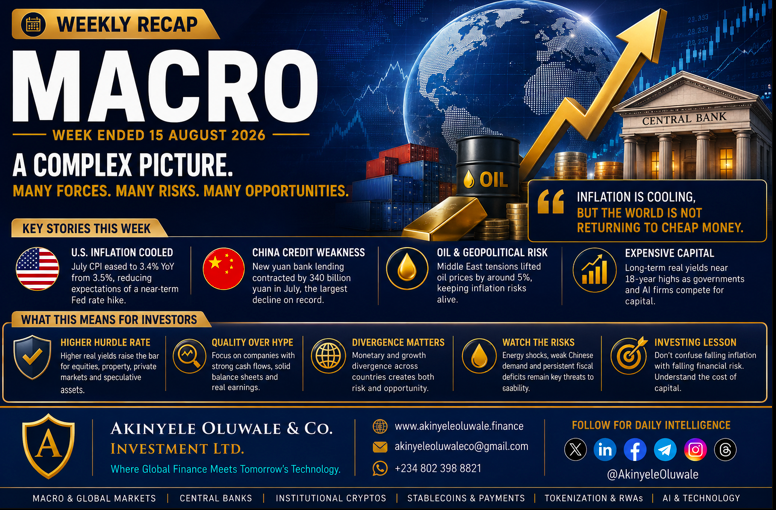
The week ended 15 August 2026 delivered a complicated macro picture: U.S. inflation cooled, equities remained resilient and expectations for another immediate Fed hike faded. Yet long-term borrowing costs stayed historically high, China showed fresh signs of weak credit demand, and Middle East tensions kept energy risk firmly on the global agenda.
Published: 16 August 2026
Weekly Recap: Week Ended 15 August 2026
Category: Macro & Global Markets • Weekly Recap
By: Akinyele Oluwale & Co. Investment Ltd.
Executive Summary
This week's macro story was defined by a contradiction: inflation looked better, but money remained expensive.
U.S. consumer inflation eased to 3.4% year-on-year in July, helping reduce expectations of another immediate Federal Reserve rate increase. (Reuters)
But long-term real borrowing costs remained exceptionally high. U.S. 30-year inflation-adjusted yields hovered around 3%, close to an 18-year high, as governments and AI companies competed aggressively for capital. (Reuters)
Meanwhile, China's bank lending contracted sharply in July, and geopolitical uncertainty around the Strait of Hormuz kept oil and inflation risks alive. (Reuters)
The message for investors:
Cooling inflation does not automatically mean cheap money is returning.
What Happened?
U.S. inflation provided the week's biggest relief.
July CPI rose just 0.1% month-on-month, while annual inflation moderated to 3.4% from 3.5%. Core inflation stood at 2.5% year-on-year. Stocks initially welcomed the data as pressure for another Fed hike diminished. (Reuters)
But bond markets told another story.
Real yields across major economies have climbed to levels not seen in more than a decade. Governments are issuing enormous amounts of debt while AI-related companies are also raising capital for data centres, computing infrastructure and energy requirements. (Reuters)
China added another warning signal: new yuan bank lending contracted by 340 billion yuan in July, the largest decline on record, highlighting weak household and private-sector credit demand. (Reuters)
Context / Background
For years, investors became accustomed to a relatively simple macro playbook:
Lower inflation → lower rates → cheaper capital → higher asset valuations.
That relationship is becoming less reliable.
Today's long-term interest rates aren't being driven by inflation alone.
Government borrowing, AI infrastructure spending, geopolitical risks and concerns about future fiscal sustainability are all competing for the world's savings.
That means central banks can become less restrictive while long-term capital remains expensive.
Why It Matters
This distinction affects almost every major asset class.
Higher real yields increase the return investors can receive from relatively safer government securities. That raises the hurdle rate for equities, property, private markets and speculative assets.
At the same time, expensive financing affects businesses directly.
Projects that made economic sense when capital was extremely cheap may look very different when borrowing costs remain elevated.
The macro environment is therefore shifting from simply asking:
“When will rates fall?”
toward:
“What return justifies putting capital at risk?”
Winners & Losers / Key Stakeholders
High-quality companies with strong cash flows and manageable debt remain better positioned than heavily leveraged businesses dependent on refinancing.
Bond investors can benefit from higher yields, although duration risk remains significant.
Equities can still perform if earnings growth compensates for expensive capital which helps explain the resilience of U.S. stocks despite elevated yields.
China-sensitive businesses face another challenge: weak domestic credit demand suggests households and companies remain cautious about borrowing and spending. (Reuters)
Energy producers could benefit from persistent geopolitical risk, while consumers and energy-intensive businesses remain vulnerable to another oil-price shock.
Short-Term Impact
Markets will remain caught between competing forces.
Cooling inflation supports risk appetite.
High bond yields restrain valuations.
Strong earnings support equities.
Weak Chinese credit raises global growth concerns.
And Middle East tensions threaten another inflationary energy shock.
Oil surged around 5% early in the week as uncertainty surrounding the Strait of Hormuz intensified. (Reuters)
That combination makes the macro environment unusually sensitive to new data.
Long-Term Impact
The deeper question is whether the world has entered an era of structurally more expensive capital.
If governments continue borrowing heavily while AI, energy and infrastructure projects demand trillions in investment, long-term yields may remain higher than investors became accustomed to during the post-financial-crisis era.
If so, portfolio construction will need to adapt.
Cash flow, balance-sheet quality, valuation and genuine return on invested capital become increasingly important.
Editorial Perspective
The week's biggest lesson isn't that inflation is falling.
It is that inflation and the cost of capital are no longer telling exactly the same story.
Investors waiting for a return to the ultra-cheap-money world may be waiting for something that doesn't arrive.
The better strategy is to invest for the environment that exists not the one we remember.
What to Watch Next
Watch Jackson Hole, U.S. employment and inflation data, long-term Treasury yields, oil and the Strait of Hormuz, China's credit and property indicators, and the scale of AI-related borrowing.
Also watch the consumer. Persistent high financing and energy costs will eventually reveal how much economic resilience remains.
Investing Lesson
Never confuse falling inflation with falling financial risk.
The price of capital matters just as much as the direction of inflation.
When safe yields become competitive, every investment must justify why it deserves your money.
Key Takeaways
Inflation cooled in America, but long-term real yields remained historically elevated. China showed worrying weakness in credit demand, while geopolitical tensions kept energy risks alive. (Reuters)
The global economy remains resilient but increasingly expensive to finance.
Editorial Bottom Line
The macro story of the week can be reduced to one sentence:
Inflation is cooling, but the world is not returning to cheap money.
For investors, that changes the game.
Don't simply chase growth.
Demand quality, understand debt, respect valuation and make every investment compete for your capital.
Sources / Notes
Primary reporting: Reuters, 10–15 August 2026, covering U.S. inflation, global real yields, AI and government borrowing, China's credit contraction, oil markets and Middle East geopolitical risks. (Reuters)
Akinyele Oluwale & Co. Investment Ltd.
Where Global Finance Meets Tomorrow's Technology.