

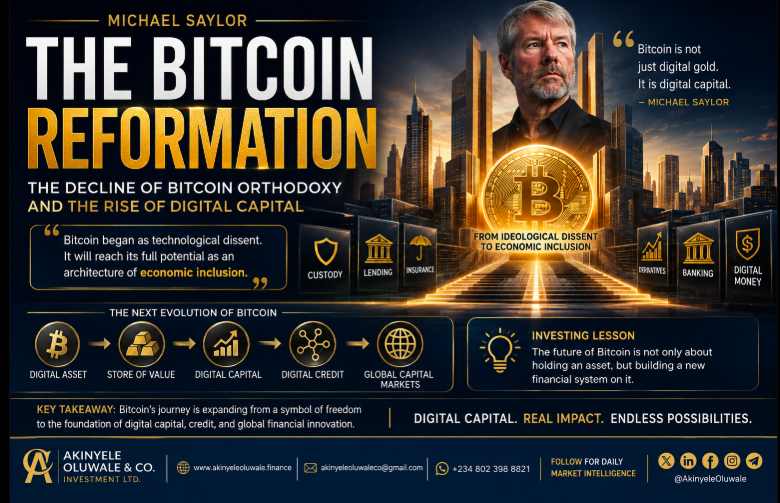
The Bitcoin Reformation: Michael Saylor Says Bitcoin’s Next Chapter Is Bigger Than “Digital Gold”
Michael Saylor is pushing a broader vision for Bitcoin one that moves beyond ideological purity and treats BTC as the foundation for digital capital, credit and financial products. If that transition continues, Bitcoin’s next battle may be less about proving it can survive and more about proving what can be built on top of it.
Published: 24 August 2026
Category: Bitcoin • Digital Capital • Institutional Crypto • Market Intelligence
By: Akinyele Oluwale & Co. Investment Ltd.
Executive Summary
Michael Saylor has reignited an important debate around Bitcoin with “The Bitcoin Reformation: The Decline of Bitcoin Orthodoxy and the Rise of Digital Capital.”
The central idea is provocative:
Bitcoin may have started as technological dissent, but its full potential could emerge through economic inclusion.
That represents a shift from the traditional Bitcoin narrative of rejecting banks, corporations and governments toward a world where those institutions increasingly build financial products around Bitcoin.
Saylor has repeatedly described Bitcoin as “digital capital” and argued that digital credit, banking, insurance, derivatives and money could eventually develop around that base layer. (Strategy)
For investors, this is more than philosophy.
It raises a serious question:
What happens if Bitcoin evolves from an asset people hold into collateral that financial systems build upon?
What Happened?
Saylor shared “The Bitcoin Reformation” on X, framing Bitcoin’s evolution around the decline of rigid orthodoxy and the rise of digital capital.
The historical “Bitcoin Reformation” thesis itself has roots in a 2019 Adamant Research paper by Tuur Demeester, which compared Bitcoin’s emergence with the economic and institutional transformation surrounding the Protestant Reformation. That research anticipated Bitcoin expanding into savings, lending, underwriting, custody, bonds, loans and insurance. (btcdirect.eu)
Saylor's current thinking pushes the institutional argument further.
His vision is essentially:
Digital Capital → Digital Credit → Digital Money
Background
Bitcoin's early culture was built around independence.
No central bank.
No corporate issuer.
No government required to validate the network.
That philosophy was critical to Bitcoin's development.
But adoption creates a paradox.
If Bitcoin becomes genuinely global, banks, corporations, asset managers, governments and ordinary savers will inevitably interact with it differently.
Saylor's argument is that institutional participation doesn't necessarily destroy Bitcoin's original properties.
The base layer can remain decentralised while financial products develop around it.
Why It Matters
This distinction could define Bitcoin's next decade.
An asset worth holding is one thing.
An asset that can also support credit, collateral, treasury management, insurance and investment products potentially enters a much larger financial opportunity set.
Saylor has argued that Bitcoin-based digital capital could eventually connect with the enormous global credit markets rather than simply competing with gold or other stores of value. (PodScripts)
That would fundamentally broaden Bitcoin's addressable market.
Winners & Losers / Key Stakeholders
Potential winners include Bitcoin holders, institutional custodians, banks, asset managers and companies capable of creating credible Bitcoin-backed financial products.
Traditional financial institutions may therefore become participants rather than casualties of Bitcoin adoption.
But leverage introduces risk.
Poorly constructed Bitcoin-backed credit products could amplify losses during severe market declines.
A strong underlying asset does not automatically make every financial product built on it strong.
Short-Term Impact
Don't expect philosophy alone to move Bitcoin's price sustainably.
The near-term market will still respond to liquidity, ETF flows, interest rates, regulation and investor positioning.
But narratives matter because they influence how capital eventually views an asset.
Bitcoin moving from “speculative cryptocurrency” to “institutional digital capital” would represent a significant change in perception.
Long-Term Impact
The larger possibility is the financialisation of Bitcoin.
Imagine:
Bitcoin → Collateral → Credit → Yield Products → Banking → Insurance → Global Capital Markets
That would be a very different ecosystem from simply buying BTC and waiting for appreciation.
It could also bring Bitcoin closer to mainstream finance—along with greater regulation, leverage and systemic interconnectedness.
Editorial Perspective
There is a tension investors shouldn't ignore.
Bitcoin's institutional success could make it more economically important while simultaneously making the ecosystem surrounding it more financially complex.
That isn't necessarily bad.
But complexity creates new risks.
The network may remain decentralised while ownership, custody and financial products become increasingly concentrated among large institutions.
That distinction deserves scrutiny.
What to Watch Next
Watch institutional custody, Bitcoin-backed lending, corporate treasury adoption, ETF ownership and regulated digital-credit products.
Most importantly, watch whether Bitcoin becomes increasingly accepted as productive collateral, not merely an appreciating asset.
That would provide stronger evidence that the “digital capital” thesis is becoming economic reality.
Investing Lesson
Separate the asset from the products built around it.
Bitcoin may succeed while individual Bitcoin-linked companies, credit instruments or leveraged strategies fail.
Understanding that difference is fundamental risk management.
Key Takeaways
Bitcoin's narrative is evolving:
Digital Money → Digital Gold → Digital Capital → Digital Credit
The further that progression goes, the more deeply Bitcoin could integrate with traditional finance.
Editorial Bottom Line
Bitcoin began by challenging the financial establishment.
Its next chapter may be more surprising:
the establishment could increasingly build on Bitcoin.
If that happens, the real “Bitcoin Reformation” won't simply be about replacing the old financial system.
It will be about changing what the existing financial system considers capital.
Notes
Analysis based on Michael Saylor's latest published framing, his 2026 discussions of Bitcoin as digital capital and digital credit, and the original Bitcoin Reformation research from Adamant Research. (Strategy)
Akinyele Oluwale & Co. Investment Ltd.
Where Global Finance Meets Tomorrow's Technology.