

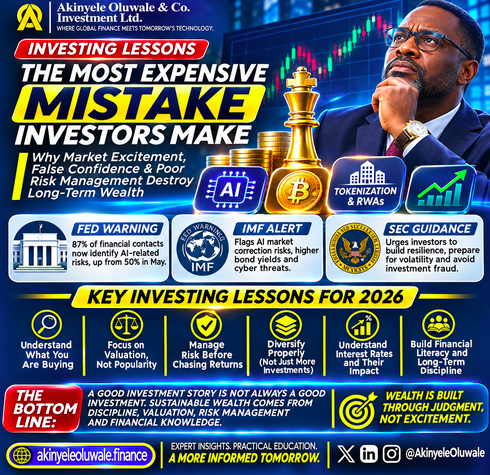
As Bitcoin, artificial intelligence, tokenization and digital finance dominate investment headlines, a fundamental lesson is becoming increasingly important: recognising a promising financial trend is not the same as making a sound investment decision.
Published: Saturday, 14 November 2026
Category: Investing Lessons | Financial Education | Wealth Management
By: Akinyele Oluwale & Co. Investment Ltd.
The financial markets are entering an era in which investors have unprecedented access to information, investment products and emerging technologies. A development in artificial intelligence can influence technology-company valuations. An announcement involving blockchain infrastructure can attract attention to digital assets. A central-bank decision can change bond yields, exchange rates and the cost of capital. Yet greater access to information does not automatically produce better investment decisions.
One of the most important investing lessons of 2026 is that being correct about a market trend does not necessarily mean being correct about an investment. An investor may correctly predict that artificial intelligence will transform business operations but still overpay for a technology company. Another investor may correctly recognise that institutional tokenization is expanding but purchase a cryptocurrency whose economic value has little connection to that adoption. A third may anticipate declining interest rates but invest in a security without understanding its credit risk, liquidity or maturity.
The common problem is the failure to distinguish a compelling narrative from an appropriate investment. This week's lesson examines the relationship between market developments, investment valuation, risk management and long-term financial discipline. The central argument is straightforward:
Sustainable wealth creation depends less on predicting every market movement and more on making decisions that remain financially manageable when expectations prove wrong.
The latest financial stability assessments provide a timely foundation for this week's investing lesson. On 13 November 2026, reporting on the U.S. Federal Reserve's latest Financial Stability Report highlighted growing concerns about artificial intelligence-related financial risks. According to the report, 87% of surveyed financial-system contacts identified AI-related risks, compared with 50% in May. The concerns included elevated valuations, complex financing arrangements, cybersecurity and the possibility that disappointing AI-related earnings could trigger a broader market correction. The International Monetary Fund's October 2026 Global Financial Stability Report identified three significant threats: an AI-related market correction, rising sovereign bond yields and increasingly sophisticated cyberattacks.
Meanwhile, the SEC and other U.S. financial regulators used World Investor Week in October to emphasise investor resilience, preparation for volatility and protection against financial fraud. These are not predictions that financial markets must collapse. They are warnings that investors should distinguish favourable market conditions from permanent financial security. The lesson is particularly relevant to anyone attracted by emerging technologies. Artificial intelligence may continue to generate economic value, but some investments linked to it may still be overpriced. Blockchain may improve financial infrastructure, but that does not establish the investment value of every cryptocurrency and government bonds may provide contractual interest payments, but their market prices can still decline when yields rise. Investment discipline begins with understanding what could go wrong, even when the overall economic story appears promising.
Why This Matters: A Good Investment Story Is Not Always a Good Investment
One of the most dangerous assumptions in investing is that a promising industry automatically produces attractive investment returns. History provides many examples of technologies that transformed economies while individual investors suffered losses because they purchased securities at excessive valuations. The problem is not necessarily that the technology failed. The problem may be that investors paid too much for the expected benefits. Consider a hypothetical technology company. The company earns ₦10 billion annually and has strong growth prospects.
Investors become excited about its future and push its market valuation to ₦500 billion. At that price, the company trades at 50 times its annual earnings. If earnings increase by 20%, the business may be performing well. However, if investors subsequently decide that a valuation of 30 times earnings is more reasonable, the share price could fall despite the company's improved profitability.
This illustrates a fundamental principle:
A company's business performance and its share-price performance are related, but they are not identical.
The same principle applies to digital assets. A blockchain network may attract new financial institutions but investors must still examine whether that activity creates economic demand for the network's associated token. Without that connection, institutional adoption may generate publicity without producing corresponding investment value. The lesson is not to reject innovation. It is to distinguish economic progress from investment valuation.
Investing Lesson One: Understand What You Are Buying
Before evaluating potential returns, an investor must understand the asset. Different investments create different rights, obligations and risks. A company share represents an ownership interest. A conventional bond generally represents a contractual debt obligation. A bank deposit represents a claim against the bank under the applicable deposit terms. A cryptocurrency token may provide access to a network, governance rights or another function, depending on its design. A tokenized security may represent a traditional financial instrument through a digital structure. These instruments should not be evaluated using the same assumptions.
For example, an investor purchasing a company's shares should examine its earnings, cash flows, competitive position and valuation. A bond investor should examine the issuer's creditworthiness, interest payments, maturity and sensitivity to changes in market yields. A person evaluating a cryptocurrency should understand its technical structure, economic function, supply arrangements, custody risks and applicable regulation.
The essential questions are:
What asset or claim do I actually hold?
What creates its economic value?
What risks could cause that value to decline?
What rights do I have if something goes wrong?
Can I explain the investment without relying on promotional language?
If an investment cannot be explained clearly, the investor may not yet understand it sufficiently.
Financial education should come before financial commitment.
Investing Lesson Two: Valuation Matters More Than Popularity
A popular investment is not necessarily attractively valued. Investors sometimes confuse widespread attention with evidence of value. A company may dominate financial headlines because it operates in artificial intelligence. A cryptocurrency may attract attention because a major institution announces a blockchain partnership. A property development may become popular because investors expect rapid price appreciation. However, popularity does not establish a reasonable purchase price.
Consider two hypothetical companies.
| Financial measure | Company A | Company B |
|---|---|---|
| Annual earnings | ₦5 billion | ₦5 billion |
| Market valuation | ₦100 billion | ₦200 billion |
| Price-to-earnings ratio | 20 times | 40 times |
Company B may deserve a higher valuation if its growth prospects, profitability or competitive advantages are substantially stronger but investors must establish whether those differences justify paying twice as much for the same current earnings. The important question is not simply which company has the most exciting prospects. It is whether those prospects are already reflected in the price.
A disciplined investor recognises that even an excellent business can become a poor investment when purchased at an unreasonable valuation.
Investing Lesson Three: Risk Management Comes Before Return Expectations
Investment discussions often begin with potential profits. A more responsible approach begins with financial resilience before committing money to an investment, a person should understand their financial obligations, liquidity requirements and ability to tolerate uncertainty. For example, money needed for essential expenses or near-term commitments generally should not depend on the uncertain performance of volatile financial assets. This principle becomes particularly important during periods of market enthusiasm. Investors may underestimate risk when prices have risen for an extended period. They may begin to assume that recent performance will continue indefinitely.
However, financial markets are influenced by economic growth, inflation, interest rates, company earnings, geopolitical developments and changes in investor expectations.
These factors can change rapidly. The IMF's October 2026 report emphasised that market resilience can coexist with elevated financial vulnerabilities. Its analysis identified concentrated exposures, leverage and liquidity mismatches as potential mechanisms through which market stress could spread. The implication is straightforward.
An investor should not judge financial safety solely by recent price performance. A market can appear stable while underlying vulnerabilities are increasing.
Risk management is not about predicting every loss. It is about ensuring that uncertainty does not undermine financial stability.
Investing Lesson Four: Diversification Reduces Concentration Risk
Diversification means spreading exposure across investments whose risks are not identical. The objective is to reduce dependence on the performance of one company, sector or asset class. However, diversification is often misunderstood. Owning several investments does not necessarily create a diversified portfolio. For example, holding five technology companies that depend heavily on the same AI spending cycle may still create substantial concentration risk. Likewise, owning multiple cryptocurrencies does not automatically provide meaningful diversification if their prices respond similarly to market liquidity and investor sentiment.
A useful distinction is between the number of investments and the sources of risk. A portfolio can contain many assets but remain heavily exposed to one economic development. The October 2026 IMF analysis specifically warned that concentrated AI-related exposures and increasing leverage could amplify a market correction. This reinforces the importance of understanding relationships between investments.
Diversification cannot eliminate all risk or guarantee positive returns. However, it can help investors avoid depending entirely on one uncertain outcome.
Investing Lesson Five: Understand the Relationship Between Interest Rates and Asset Prices
Interest rates influence nearly every major financial market. When interest rates change, they affect borrowing costs, corporate valuations, government financing and investor expectations. One important relationship concerns bonds. For a conventional fixed-rate bond, market price and yield generally move in opposite directions. When prevailing market yields rise, the price of an existing fixed-rate bond usually falls. When prevailing yields decline, the price of an existing fixed-rate bond usually rises.
The sensitivity depends on factors including maturity, coupon and duration. Consider a hypothetical investor holding a long-term bond. If market interest rates increase substantially, the bond's market value may decline even if the issuer continues making the required interest payments. The investor therefore faces interest-rate risk in addition to any credit risk. The same broader principle influences equity valuations. Higher discount rates can reduce the present value of expected future earnings. This may be particularly important for companies whose valuations depend heavily on profits expected many years into the future. The IMF's latest financial stability assessment warned that higher sovereign bond yields could affect valuations across financial markets.
The lesson is that interest rates are not merely central-bank statistics. They influence the price investors are willing to pay for future financial returns.
Investing Lesson Six: Beware of Leverage and Borrowed Confidence
Leverage involves using borrowed funds or financial arrangements that increase exposure to an asset. It can magnify gains when an investment performs favourably. It can also magnify losses when the investment performs poorly. This creates additional risk because financial obligations may remain even when asset values decline. For example, an investor may correctly believe that a particular industry has attractive long-term prospects. However, if the investment is financed through substantial borrowing, a temporary market decline could create financial pressure before the expected benefits materialise. The investment thesis might eventually prove correct but the financing arrangement could still produce an unfavourable outcome. This is why financial institutions pay close attention to leverage, collateral requirements and liquidity. The IMF has identified increasing leverage in certain financial-market segments as a potential amplifier of stress. The broader educational principle is that the quality of an investment decision cannot be separated from the financial obligations attached to it.
A promising asset does not make an unsuitable financing arrangement safe.
Investing Lesson Seven: Financial Literacy Is a Competitive Advantage
Financial markets are becoming more complex. Investors encounter products involving digital assets, tokenization, artificial intelligence, derivatives and alternative investment structures. The availability of these products does not guarantee that their risks are understood. In October 2026, the SEC and other investor-protection organisations published guidance for World Investor Week, emphasising financial resilience and awareness of fraudulent investment schemes. The guidance is particularly relevant in an environment where promotional claims can spread rapidly through social media. An investment opportunity may be presented as exclusive, urgent or guaranteed. Such language should encourage additional scrutiny rather than immediate confidence.
Financial literacy involves understanding fundamental concepts such as:
The purpose of financial education is not to guarantee profitable decisions. It is to improve the quality of judgment. An informed investor is better equipped to ask relevant questions, identify unsupported claims and recognise when additional professional advice is necessary.
The Nigerian Perspective: Investing Requires an Understanding of Inflation and Currency Risk
For Nigerian investors, financial decisions involve additional considerations. Inflation affects the purchasing power of money. Exchange-rate movements influence the naira value of foreign-currency assets and obligations. Interest rates affect the cost of borrowing and the returns available on certain financial instruments.
These factors interact. For example, an investment may generate a positive nominal return while failing to preserve purchasing power after inflation. Consider a hypothetical investment producing a 12% annual return while consumer prices rise by 15%.
The approximate inflation-adjusted return is negative. Using the standard real-return relationship:
Real return = (1 + nominal return) ÷ (1 + inflation rate) − 1
The result is approximately −2.6%.
This demonstrates why nominal returns should not be considered in isolation. Currency exposure also matters. A foreign-currency asset may appreciate in naira terms because the naira depreciates, even if the asset's foreign-currency price remains unchanged. Conversely, currency movements can reduce naira-denominated returns. Neither outcome should be confused automatically with the investment manager's skill.
The relevant measure of financial progress is not simply the amount of money accumulated, but the purchasing power and financial security that money provides.
Editorial Perspective: Discipline Is More Valuable Than Market Excitement
At Akinyele Oluwale & Co. Investment Ltd., we believe one of the greatest challenges facing modern investors is the growing distance between access to financial information and the ability to interpret it responsibly. Investors can follow global markets continuously. They can observe central-bank announcements, institutional blockchain developments and emerging technology trends almost immediately but receiving information is not the same as understanding its financial implications.
A major bank may announce a digital-asset initiative. That does not automatically establish the investment value of an associated cryptocurrency. An AI company may announce a major infrastructure project. That does not automatically justify any valuation investors are willing to pay. A government may issue securities offering attractive nominal yields. That does not eliminate inflation, credit or liquidity risk. We believe five principles should guide responsible investment education.
First, understand the asset before evaluating its potential return. Second, distinguish a promising economic trend from an attractive investment price. Third, evaluate risk in relation to financial obligations and liquidity needs. Fourth, avoid confusing market popularity with investment quality. Fifth, measure financial progress through long-term resilience rather than short-term excitement.
These principles are relevant across traditional securities, property, investment funds and digital assets. The objective is not to avoid every investment risk. It is to understand the risks being considered and recognise the consequences if expectations are not realised.
Our editorial assessment is that disciplined investors are distinguished not by their ability to predict every market movement, but by the quality of their financial decisions under uncertainty.
Several developments deserve attention in the weeks ahead. AI valuations: Monitor whether earnings and commercial performance justify market expectations. Federal Reserve financial stability assessments: Watch developments involving leverage, corporate financing and concentrated exposures. Government bond yields: Examine how inflation and fiscal pressures affect borrowing costs and asset valuations. Institutional cryptocurrency: Distinguish actual commercial activity from partnership announcements and technical demonstrations. Tokenization: Assess whether new infrastructure delivers measurable financial benefits. Liquidity conditions: Watch for signs of stress in markets where assets may be difficult to sell. Financial regulation: Monitor developments affecting investor protection, disclosures and market transparency.
Nigeria's macroeconomic environment: Follow inflation, interest rates, exchange-rate developments and their implications for purchasing power. These indicators help investors interpret financial conditions without relying on short-term speculation.
Akinyele Oluwale & Co. Investment Ltd. is an institutional financial intelligence platform focused on global financial markets, macroeconomics, central banking, institutional cryptocurrency, stablecoins, digital payments, tokenization, real-world assets, artificial intelligence and blockchain technology. Our mission is to explain consequential financial developments through evidence-based analysis, practical financial education and an institutional perspective. We believe financial knowledge should help readers understand not only emerging opportunities but also the economic risks, valuation considerations and financial responsibilities associated with investment decisions.
Final Editorial Verdict: Wealth Is Built Through Judgment, Not Excitement
The latest financial stability warnings reinforce a lesson that remains relevant across every investment cycle. Markets can rise while risks accumulate. Businesses can grow while their shares become overvalued. Technology can advance while individual investment products fail to deliver attractive returns and investors can correctly identify major economic trends while making poor financial decisions. This is why investing requires more than optimism. It requires understanding, patience, valuation discipline and awareness of financial risk.
The growth of artificial intelligence, blockchain and institutional digital finance will continue to create important economic developments but those developments should be examined through the same principles that apply to conventional financial assets. What is the underlying economic value? What financial rights does the investment provide? What assumptions support its valuation? What risks could undermine the expected outcome? And what happens if those assumptions prove incorrect? These are the questions that separate financial analysis from market excitement.
The greatest investing advantage is not knowing which asset will rise tomorrow. It is developing the judgment to recognise value, understand risk and make financially responsible decisions over time.
Observe the change. Understand the implications. Position with discipline.
Akinyele Oluwale & Co. Investment Ltd.
Where Global Finance Meets Tomorrow's Technology.
Website: akinyeleoluwale.finance
Editorial disclaimer: This article is intended for general financial education and market analysis. It does not constitute personalised investment advice or a recommendation to buy or sell any financial instrument.