

Published: 29 August 2026
Category: RWAs • Tokenization • Institutional Finance • Blockchain
By: Akinyele Oluwale & Co. Investment Ltd.
Real-world assets are beginning to demonstrate something institutional investors have been waiting for: utility after tokenization.
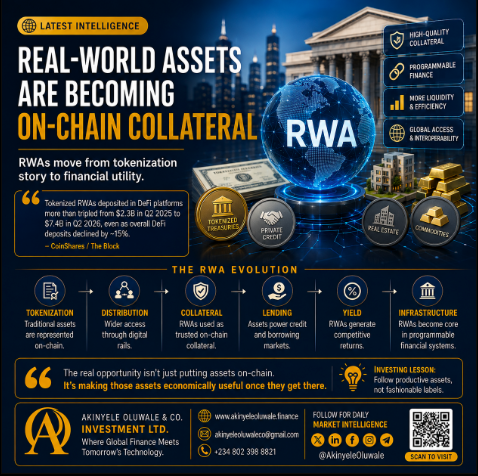
Deposits of tokenized RWAs into decentralized lending platforms and exchanges more than tripled from $2.3 billion in Q2 2025 to $7.4 billion in Q2 2026, even as overall DeFi deposits declined by roughly 15%. Tokenized Treasuries, private credit and other conventional financial products drove much of that expansion. (The Block)
That divergence matters.
RWAs are progressing from:
Asset Tokenization → On-Chain Distribution → Collateral → Lending → Yield → Financial Infrastructure
The story is no longer simply about representing assets digitally.
It is about putting productive assets to work.
Tokenized traditional assets are increasingly entering blockchain-based financial applications.
According to research reported by The Block, RWAs are now being integrated across four major functions: lending, margin, reserves and yield.
Meanwhile, institutional participation continues to deepen.
BlackRock introduced tokenized share classes for selected European money-market funds in August, using Ethereum and JPMorgan's Kinexys infrastructure. The underlying funds represented a combined $311 billion in assets under management, although this figure should not be confused with the amount actually tokenized.
That distinction is critical.
RWAs connect conventional financial assets with programmable digital infrastructure.
Examples include:
Government Bonds • Money-Market Funds • Private Credit • Commodities • Real Estate • Equities
Initially, the industry focused on proving these assets could be represented on-chain. Now institutional finance is asking a more demanding question:
What can we actually do with them?
A tokenized Treasury security that can provide yield, serve as collateral and move efficiently between financial platforms has considerably greater utility than a digital representation sitting idle in a wallet.
Collateral is fundamental to modern finance.
Banks, investment funds and financial institutions constantly pledge assets to obtain financing, manage liquidity and support transactions. Bringing high-quality RWAs into programmable markets could improve how collateral moves and is used.
Imagine:
Treasury Asset → Tokenized Ownership → Collateral → Credit → Settlement
Potentially with fewer disconnected systems between each stage.
That is where RWA tokenization begins becoming infrastructure rather than simply innovation.
Asset managers, banks, custodians, tokenization platforms, oracle providers and blockchain infrastructure companies could benefit as RWAs expand. Asset owners may gain broader distribution and potentially more efficient access to liquidity. But investors should not assume every so-called RWA token benefits.
The underlying asset can generate genuine economic value while a governance or utility token associated with the platform captures very little of it.
RWA growth and token appreciation are not synonymous.
Tokenized Treasuries and money-market products currently have a natural advantage. They are relatively standardized, familiar to institutions and capable of generating yield.
That helps explain why traditional financial products have become important collateral within the emerging RWA ecosystem.
Real estate, private markets and other less-liquid assets present greater challenges involving valuation, ownership rights and secondary-market liquidity.
Expect adoption to remain uneven.
The long-term opportunity is considerably larger than token issuance. RWAs could eventually connect traditional capital markets with continuously operating programmable financial networks.
Assets could potentially become:
Investable + Transferable + Collateralized + Programmable + Globally Accessible
But technology alone cannot create liquidity.
Legal ownership, custody, pricing, redemption and regulatory enforceability remain essential.
The RWA industry is reaching its credibility test. Putting a property, Treasury bill or private-credit instrument on blockchain is technically interesting. But investors should ask:
Does tokenization improve the economics of the asset?
Does it reduce settlement friction?
Does it improve collateral efficiency?
Does it broaden legitimate distribution?
Does it create measurable transaction activity?
If not, tokenization may simply be a new wrapper around an old asset.
Watch RWA collateral volumes, tokenized Treasury adoption, institutional money-market funds, private credit, settlement activity and interoperability.
Also watch the relationship between asset growth and blockchain value capture.
That will increasingly separate serious infrastructure from speculative narratives.
Follow productive assets, not fashionable labels.
An RWA investment thesis should answer four questions:
What backs the token? Who legally owns the asset? How does it generate value? Who ultimately captures that value?
RWAs are evolving:
Representation → Distribution → Collateral → Lending → Yield → Financial Infrastructure
The move toward collateral may be one of the most important stages yet.
The real RWA revolution isn't simply bringing the physical and financial world onto blockchain. It is making traditional assets more usable once they arrive there.
When tokenized Treasuries, funds and credit instruments begin functioning as collateral and liquidity across digital markets, blockchain stops merely representing finance.
It starts participating in how finance actually works.
Akinyele Oluwale & Co. Investment Ltd.
Where Global Finance Meets Tomorrow’s Technology.