

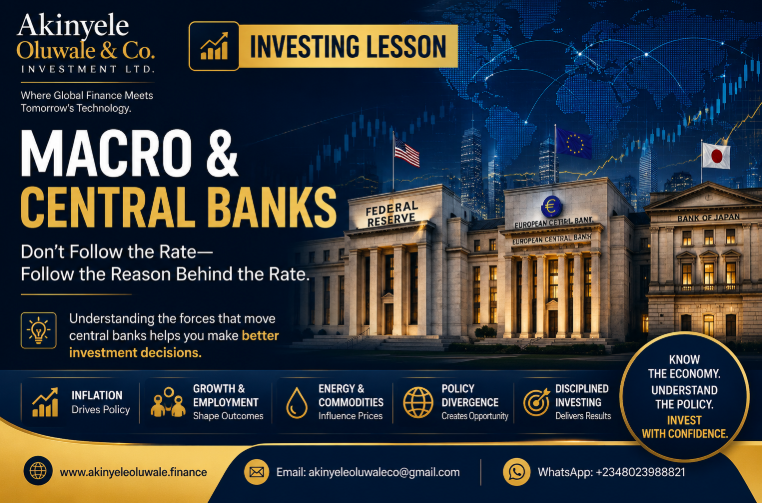
Investing Lesson: Don’t Follow the Rate; Follow the Reason Behind the Rate
Central banks are no longer moving neatly in the same direction. The Federal Reserve is balancing growth, inflation and financial conditions; the ECB remains alert to energy-driven inflation; while the Bank of Japan is signalling further normalisation if its outlook holds. For investors, the lesson is simple: knowing whether rates rise or fall is not enough. You must understand why.
Published: 22 August 2026
Category: Investing Lessons • Macro & Central Banks • Market Intelligence
By: Akinyele Oluwale & Co. Investment Ltd.
Executive Summary
Investors spend enormous energy predicting the next interest rate decision.
Cut? Hold? Hike?
However the decision itself is only half the story.
The ECB held rates in July after raising them by 25 basis points in June as the Middle East energy shock increased inflation risks. Japan, meanwhile, says it will continue adjusting monetary accommodation if economic and inflation conditions develop as projected. (European Central Bank)
The Federal Reserve's July meeting minutes were released on August 19, keeping markets focused on the balance between inflation, growth and financial conditions. (Federal Reserve)
For investors, this creates an important lesson:
Don't invest based only on what central banks do. Understand what is forcing them to do it.
What Happened?
Global monetary policy is becoming increasingly divergent.
The ECB kept its key rates unchanged in July, with its deposit facility at 2.25%, after June's rate increase. Euro area inflation had eased to 2.8% in June, but policymakers remained concerned about the delayed effects of higher energy costs. (European Central Bank)
Japan faces almost the opposite challenge. The BOJ expects inflation to move toward and potentially above 2%, influenced by oil prices, yen depreciation and AI-related demand for semiconductors. It says further rate increases remain possible if its economic scenario materialises. (Bank of Japan)
This is not one global monetary cycle anymore.
It is multiple economies responding to different pressures.
Background
Interest rates influence almost every asset investors own.
Rates → Bonds → Currencies → Equities → Property → Credit → Crypto
But the relationship isn't mechanical.
A rate cut caused by falling inflation and healthy growth can be positive.
A rate cut triggered by recession or financial stress can tell a very different story.
Likewise, a rate increase caused by strong economic activity differs dramatically from one required because inflation is becoming uncontrolled.
That is why simply hearing “the Fed is cutting” or “the BOJ is hiking” tells an investor surprisingly little.
Why It Matters
Think about two scenarios.
Scenario A: Inflation falls, growth remains resilient and a central bank gradually cuts rates.
Scenario B: Unemployment rises sharply, credit deteriorates and a central bank cuts aggressively.
Same action: rate cuts.
Completely different economic message.
The intelligent investor therefore asks:
What problem is monetary policy trying to solve?
That question helps explain what may happen next to earnings, currencies, bond yields, liquidity and risk assets.
Winners & Losers / Key Stakeholders
When inflation cools without recession, equities, bonds and other risk assets can benefit from easier financial conditions.
Persistent inflation creates a different environment. Higher-for-longer rates can favour cash and certain short-duration assets while placing pressure on highly valued companies whose expected profits sit far into the future.
Currency investors must pay particular attention to policy divergence.
If one central bank is easing while another is tightening, capital can move between currencies and bond markets as investors search for better risk-adjusted returns.
Short-Term Impact
Markets will remain extremely sensitive to inflation, employment, energy prices and central bank communication.
A single data release can rapidly change expectations.
But investors should avoid rebuilding portfolios around every headline.
Markets don't only trade today's rate.
They trade expectations about tomorrow's rate.
By the time a central bank officially changes policy, financial markets may have priced much of it already.
Long-Term Impact
One of the biggest macro changes ahead may be the end of synchronised monetary policy.
Energy security, demographics, fiscal deficits, AI investment, productivity and domestic inflation dynamics differ dramatically between countries.
That could create more opportunities in:
Currencies + Global Bonds + Equities + Commodities + Digital Assets
But it will also demand more disciplined asset allocation.
Editorial Perspective
Investors often ask:
“When will rates fall?”
A stronger question is:
“What economic conditions would make rates fall—and what would those conditions mean for my investments?”
That small change moves thinking from prediction to analysis.
Central banks don't control markets in isolation.
They respond to economies.
Understand the economy and central-bank decisions become much easier to interpret.
What to Watch Next
Watch inflation trends, labour markets, oil and energy prices, bond yields and currency movements.
In Europe, the duration of the energy shock remains critical. In Japan, watch wages, inflation and the yen. In the United States, watch how incoming inflation and activity data reshape expectations for the next FOMC meetings. (European Central Bank)
Investing Lesson
Don't follow the rate. Follow the reason behind the rate.
The direction of monetary policy tells you what the central bank is doing.
The economic reason tells you why and often where the investment risks and opportunities really are.
Key Takeaways
Never analyse interest rates alone.
Study:
Inflation → Growth → Employment → Liquidity → Policy → Asset Prices
That sequence provides far more insight than trying to predict one central-bank meeting.
Editorial Bottom Line
Successful macro investing isn't about guessing every rate decision correctly.
It is about understanding the forces shaping those decisions.
Don't ask only: “What will the central bank do next?”
Ask:
“Why will it do it and what does that reason mean for my portfolio?”
That is where monetary-policy watching becomes investment intelligence.
Notes
Primary references: Federal Reserve July FOMC materials, European Central Bank July monetary-policy decision and the Bank of Japan's July 2026 economic and inflation outlook. (Federal Reserve)
Akinyele Oluwale & Co. Investment Ltd.
Where Global Finance Meets Tomorrow’s Technology.