

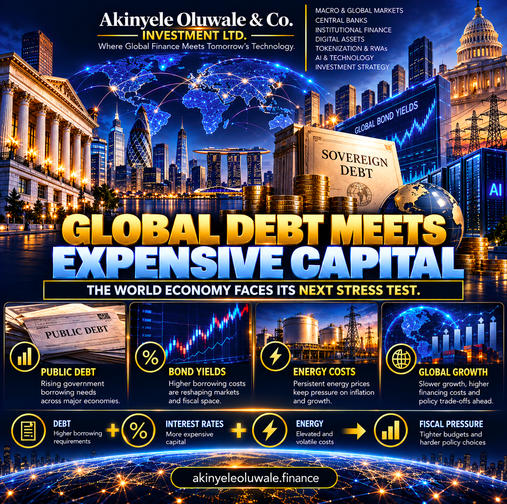
GLOBAL DEBT MEETS EXPENSIVE CAPITAL
Why Rising Government Borrowing, Elevated Bond Yields and Energy Costs Could Define the Next Phase of the Global Economy
Published: 10 October 2026
Category: Macro & Global Markets
By: Akinyele Oluwale
The global economy is entering a period in which the cost of financing economic activity is becoming increasingly important.
Governments need capital.
Businesses need capital.
Artificial intelligence requires enormous infrastructure investment.
Energy systems require modernisation.
Emerging economies need financing for development.
But capital is becoming more expensive.
This creates an uncomfortable economic reality.
At precisely the moment when the world needs substantial investment, borrowing costs remain elevated.
The International Monetary Fund has warned that rising public debt, energy pressures and risks associated with AI investment could create significant challenges for global economic stability. AP News
Meanwhile, government bond markets have experienced substantial volatility.
The United States and several European economies have faced pressure from elevated sovereign borrowing costs and concerns about fiscal sustainability. Reuters
The emerging question is no longer simply:
How much capital does the global economy need?
It is:
How much will that capital cost, and who will ultimately pay for it?
The global financial system is confronting several interconnected challenges.
First, government borrowing requirements remain substantial.
Countries must finance public expenditure, infrastructure and existing debt obligations.
Second, bond yields remain elevated.
Higher yields increase the cost of new borrowing and refinancing.
Third, energy prices remain an inflation risk.
Persistent energy costs can place pressure on consumers, businesses and central banks.
Fourth, AI infrastructure is creating additional demand for capital.
Technology companies require substantial financing to construct data centres, purchase advanced chips and secure electricity.
Fifth, emerging economies face difficult financing conditions.
Higher global borrowing costs can increase debt-servicing pressures and discourage investment.
These developments create a powerful economic relationship:
Understanding this relationship is essential for investors, policymakers and financial institutions.
Debt is not automatically harmful.
Governments can borrow to finance productive infrastructure, education, healthcare and economic development.
Businesses can borrow to expand operations and generate additional revenue.
The problem arises when borrowing costs become difficult to sustain.
Consider a simplified example.
A government borrows ₦1 trillion.
At an annual interest rate of 5%, its interest expense is:
₦1 trillion × 5% = ₦50 billion.
If refinancing costs rise to 10%, annual interest expense becomes:
₦1 trillion × 10% = ₦100 billion.
The government now pays an additional ₦50 billion annually in interest.
That additional expense could otherwise have supported infrastructure, education or healthcare.
This demonstrates a fundamental economic principle:
The sustainability of debt depends not only on how much is borrowed, but also on the cost of borrowing and the capacity to repay.
The same principle applies to corporations.
A business can have strong revenue growth but still experience financial difficulties if debt-servicing costs rise faster than its operating cash flows.
Ahead of the IMF–World Bank meetings, IMF Managing Director Kristalina Georgieva warned that countries must address rising debt and broader economic vulnerabilities.
She also highlighted the potential consequences of energy pressures and AI-related investment risks. AP News
The message is important.
Governments cannot assume that favourable financing conditions will return automatically.
They must increasingly consider how public expenditure, taxation, borrowing and economic growth interact.
Fiscal discipline is therefore becoming more important.
Bond markets have experienced significant volatility as investors reassess inflation, government borrowing and interest-rate expectations.
During the past week, U.S. and French government bond yields attracted considerable attention.
Although U.S. Treasury yields retreated from recent highs toward the end of the week, borrowing costs remained elevated. The Wall Street Journal
The underlying issue is straightforward.
When governments issue substantial debt, investors must be willing to purchase that debt.
If investors demand higher returns, governments face higher financing costs.
This can create a difficult cycle:
Higher Debt → Higher Interest Costs → Greater Fiscal Pressure → Additional Borrowing Needs
However, the cycle is not inevitable. Economic growth, fiscal adjustments and changes in interest rates can alter the outcome.
Energy is a fundamental input into economic activity.
Higher oil and electricity costs can affect:
On 9 October, Brent crude remained near $104 per barrel, according to Reuters market reporting. Reuters
Sustained energy costs can complicate central-bank efforts to control inflation.
That can also make it more difficult for borrowing costs to decline.
Artificial intelligence is creating enormous demand for infrastructure financing.
Companies are investing in semiconductors, data centres, electricity and computing capacity.
Reuters reported that AI infrastructure could require approximately $1.5 trillion in external financing by 2028, citing Morgan Stanley estimates. Reuters
This introduces another important question.
If governments and corporations are simultaneously seeking enormous amounts of financing, how will financial markets allocate available capital?
The answer depends on expected returns, risk, liquidity and financing conditions.
The world is experiencing several investment cycles simultaneously.
Countries require roads, ports, electricity, healthcare and public services.
Technology companies require data centres, computing equipment and energy infrastructure.
Energy systems require investment in generation, transmission, storage and reliability.
Developing economies need capital for industrialisation, education, digital infrastructure and economic diversification.
Each of these areas competes for financing.
This creates an increasingly important global equation:
When financing conditions tighten, capital allocation becomes more selective.
Projects with credible cash flows, manageable risks and strong economic fundamentals may be better positioned to attract funding.
Projects dependent on unrealistic assumptions may face greater difficulties.
This is why investment discipline matters across both the public and private sectors.
Higher government borrowing requirements can increase pressure on sovereign bond markets.
Investors may demand higher yields when inflation, fiscal uncertainty or refinancing risks increase.
However, yields can also decline when economic growth weakens or demand for safe assets strengthens.
Therefore, government bond markets must be evaluated within the broader economic environment.
Higher interest rates can affect equity valuations.
When investors can earn higher returns on relatively low-risk government securities, they may become less willing to pay expensive valuations for uncertain future corporate earnings.
This is especially relevant for capital-intensive businesses.
Banks can benefit from higher lending rates, but they also face risks.
Higher borrowing costs may weaken customers' repayment capacity.
Government bond volatility can affect securities portfolios.
And slower economic growth can increase credit risk.
AI companies face the challenge of generating sufficient future cash flows to justify their capital expenditure.
Higher financing costs increase the importance of disciplined investment decisions.
Emerging economies can face additional pressure when global interest rates remain elevated.
Foreign-currency borrowing may become more expensive.
Exchange rates may experience volatility.
And international investors may become more selective.
For Nigeria, the broader implication is clear:
Fiscal sustainability, productive investment and efficient capital allocation are essential to long-term economic resilience.
At Akinyele Oluwale & Co. Investment Ltd., we believe one of the most important questions confronting the global economy is:
This question connects several major developments.
It connects government debt with central-bank policy.
It connects AI infrastructure with corporate financing.
It connects energy prices with inflation.
And it connects emerging-market development with global capital flows.
Investors should therefore avoid examining these developments in isolation.
A rising bond yield is not merely a bond-market event.
It can influence:
Government budgets.
Corporate investment.
Bank lending.
Equity valuations.
Currency markets.
Digital assets.
Economic growth.
The central lesson is:
Capital availability creates opportunity. Capital costs determine whether that opportunity is economically sustainable.
For governments, the challenge is to ensure borrowed funds support productive economic outcomes.
For corporations, the challenge is to generate returns above the cost of capital.
For investors, the challenge is to distinguish between economic opportunity and investment value.
As the new week approaches, investors should monitor eight developments.
1. IMF–World Bank Meetings: Watch updated assessments of global growth, debt and financial stability.
2. U.S. Inflation: The upcoming September CPI report could influence Federal Reserve expectations. The Wall Street Journal
3. Government Bond Yields: Monitor whether sovereign borrowing costs stabilise or rise again.
4. Energy Prices: Oil remains important for inflation and global growth.
5. Corporate Earnings: Major U.S. banks begin reporting quarterly results next week. Reuters
6. AI Financing: Watch whether investors continue demanding greater financial discipline from AI infrastructure projects.
7. Emerging-Market Capital Flows: Monitor currency pressures, borrowing costs and international investment.
8. Fiscal Policy: Governments' responses to higher debt-servicing costs will become increasingly important.
The global economy requires substantial investment.
But elevated borrowing costs are making capital allocation more difficult.
Government debt is becoming a central financial-market concern.
Energy prices remain an important inflation risk.
AI infrastructure is increasing demand for financing.
Emerging economies face additional challenges when global capital becomes expensive.
The most important investment framework is:
And today's central principle is:
The next global financial challenge may not be finding opportunities. It may be financing them sustainably.
Akinyele Oluwale & Co. Investment Ltd. is a global finance and digital-economy intelligence platform dedicated to helping investors, professionals and decision-makers understand developments reshaping modern financial markets.
Our coverage includes:
Artificial Intelligence, Blockchain & Technology, Crypto & Digital Assets, Institutional Finance, Stablecoins & Payments, Tokenization & RWAs, Central Banks, and Macro & Global Markets.
Our editorial approach focuses on three questions:
What changed?
Why does it matter?
What should investors watch next?
We connect macroeconomic developments with financial markets, institutional capital and emerging technologies.
Our objective is to support informed analysis, disciplined investment thinking and a deeper understanding of global financial transformation.