

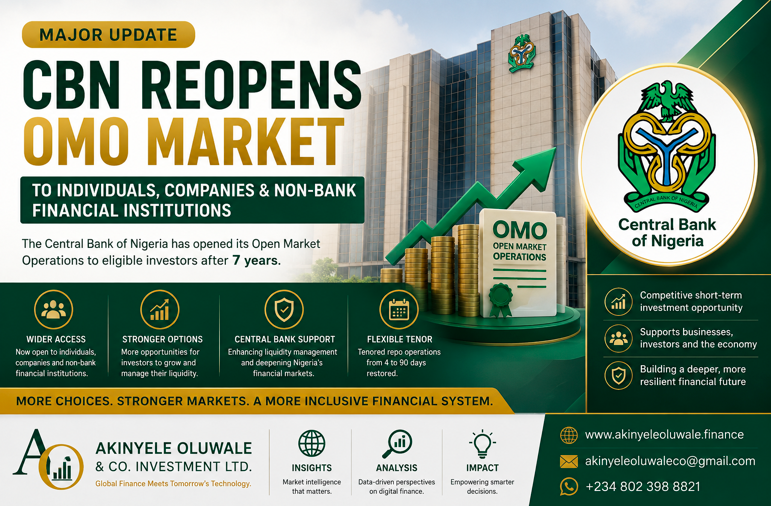
CBN Reopens OMO Market to Nigerians: Individuals and Companies Gain Access After Seven-Year Restriction
Nigeria's central bank has widened access to its Open Market Operations securities, allowing individuals, companies and non-bank financial institutions back into a market from which domestic investors had been restricted since 2019. The change could reshape short-term investment choices while strengthening the CBN's liquidity-management toolkit.
Published: 13 August 2026
Category: Macro & Central Banks • Nigeria • Fixed Income • Investing
By: Akinyele Oluwale & Co. Investment Ltd.
Executive Summary
The Central Bank of Nigeria has reversed a major restriction on participation in its Open Market Operations (OMO)market, opening eligible OMO securities to individual investors, corporates and non-bank financial institutions. (Vanguard News)
This reverses the policy introduced in 2019 that excluded domestic individuals and corporates from OMO participation while largely preserving access for banks and foreign portfolio investors. (cbn.gov.ng)
The CBN has also restored tenored repurchase transactions of four to 90 days and removed restrictions that prevented institutions participating in the Nigerian Foreign Exchange Market and government-securities auctions from accessing its Discount Window. (Punch Newspapers)
For Nigerian investors, the headline is straightforward:
Another short-term fixed-income investment channel has reopened.
But OMO bills are monetary-policy instruments not ordinary savings products and investors should understand yields, access arrangements, maturity and reinvestment risk before committing capital.
What Happened?
The CBN has broadened participation in its OMO market to include:
The move effectively reverses the restriction imposed approximately seven years ago. (Vanguard News)
OMO is one of the tools the CBN uses to manage liquidity.
When the central bank sells OMO bills, money is absorbed from the financial system. When securities mature or the CBN buys instruments, liquidity can return.
This makes OMO fundamentally different from a conventional corporate investment product.
Its primary purpose is monetary policy.
Context / Background
Why were Nigerian individuals removed in the first place?
In 2019, the CBN restricted domestic corporates and individuals from primary and secondary OMO activity. The objective included reducing arbitrage, lowering the cost of liquidity management and redirecting domestic capital toward other parts of the economy. (cbn.gov.ng)
That produced an unusual market structure in which attractive OMO yields were not generally available directly to ordinary domestic investors.
Now the door is reopening.
And it is happening while the CBN continues to use OMO aggressively to manage liquidity and monetary conditions.
Why It Matters
For investors, this expands the menu of naira-denominated fixed-income instruments.
OMO bills have historically offered competitive short-term yields. For context, CBN data show that during Q2 2025, OMO bills had average bid rates of 23.32% and average stop rates of 23.68%, although current and future auction yields can differ materially. (cbn.gov.ng)
That does not mean every Nigerian can simply open a CBN account and buy an OMO bill tomorrow.
Operational access, auction terms, minimum denominations, participating intermediaries and settlement procedures still matter.
But strategically, domestic capital can once again compete for an instrument that has played a major role in Nigeria's money market.
Winners and Losers
Potential Winners
Individual investors: More options for managing short-term naira liquidity.
Corporates: Companies with surplus cash gain another potential treasury-management instrument.
Non-bank financial institutions: Asset managers and other institutions receive broader portfolio-management flexibility.
The CBN: A larger investor base could potentially improve the transmission and effectiveness of liquidity-management operations.
Potential Pressure
Bank deposits: Attractive OMO yields could encourage some investors to reconsider low-yielding deposits.
Treasury bills and money-market products: Competition for investor capital could increase depending on relative yields.
Banks: Deposit competition could become more intense if sophisticated clients gain attractive alternatives.
Short-Term Impact
The immediate effect is likely to be felt first among high-net-worth investors, corporate treasuries and professional money managers.
The actual investment impact will depend heavily on the yields offered at future auctions.
If OMO yields materially exceed comparable short-term alternatives, demand could be strong.
But investors shouldn't chase yield blindly.
A 20% nominal return in a high-inflation environment is not the same as a 20% real increase in purchasing power.
Nominal yield is only the beginning of the calculation.
Long-Term Impact
This change could help deepen Nigeria's domestic money market.
It may also broaden the investor base supporting the CBN's liquidity operations.
But there is an important macroeconomic tension.
The IMF noted earlier this year that the CBN aims over time to reduce reliance on costly short-term portfolio flows through OMO instruments and encourage more capital toward longer-dated government securities and equities. (IMF)
So reopening OMO access shouldn't be interpreted as evidence that Nigeria wants every investor permanently concentrated in short-term paper.
The wider objective remains a deeper and more efficient financial market.
Editorial Perspective
This is more important than it initially looks.
For years, Nigerian investors have faced a difficult equation:
High inflation + currency depreciation + limited access to certain high-yield institutional instruments.
Reopening OMO participation improves choice.
And choice matters.
But it also creates responsibility.
Investors should not automatically move money simply because an instrument carries a higher headline yield.
Compare:
OMO bills.
Treasury bills.
FGN bonds.
Money-market funds.
Commercial paper.
Equities.
Foreign-currency assets.
Each solves a different portfolio problem.
An investor building emergency liquidity should think differently from a pension fund managing liabilities or a young professional building wealth over 20 years.
The best investment isn't necessarily the instrument paying the highest rate today.
It is the instrument that fits the investor's objective.
What to Watch Next
The most important things to monitor are the next OMO auction yields, practical access arrangements for individuals, minimum investment requirements, taxation, secondary-market liquidity and whether banks or investment platforms begin offering easier retail access.
Also watch whether broader domestic participation affects demand for Nigerian Treasury bills and other short-duration investments.
Investing Lesson
Yield should never be considered without inflation, liquidity and opportunity cost.
Suppose an investment earns 20%.
That sounds excellent.
But ask:
What is inflation?
How quickly can I access the money?
What happens when the instrument matures?
Can I reinvest at the same rate?
What alternative investment did I give up?
And what is my real return after taxes and costs?
Professional investing begins when we stop asking:
“What is the interest rate?”
and start asking:
“What role does this investment play in my portfolio?”
Key Takeaways
Editorial Bottom Line
Nigeria has reopened a door that had been closed to domestic investors for nearly seven years.
For individuals, this creates another opportunity.
For the CBN, it creates another channel through which monetary policy can reach the financial system.
The opportunity is worth watching but the smartest investor won't simply chase the highest OMO yield.
They will decide where OMO fits within a properly diversified investment plan.
Akinyele Oluwale & Co. Investment Ltd.
Global Finance Meets Tomorrow's Technology.