

Published: 29 August 2026
Category: Investing Lesson • AI & Blockchain • Stablecoins & Payments
By: Akinyele Oluwale & Co. Investment Ltd.
AI agents are moving beyond answering questions and toward completing economic tasks. At the same time, payment companies and blockchain firms are building infrastructure that allows software agents to transact programmatically.
Visa's research with Artemis says agents are already purchasing compute, data and other services, while Mastercard launched infrastructure specifically designed for machine-speed payments in June. Circle has separately introduced agent wallets and nanopayment infrastructure using USDC. (Visa)
The investing lesson is bigger than AI or stablecoins individually:
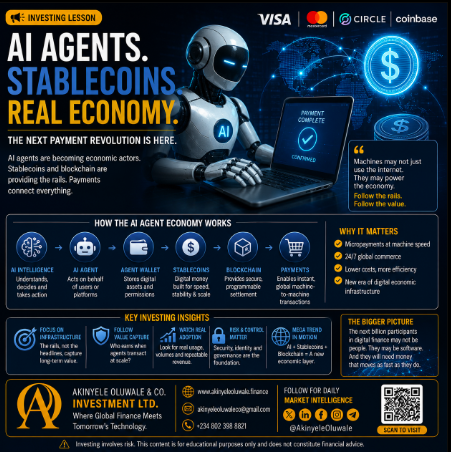
AI creates economic intent. Blockchain provides programmable infrastructure. Stablecoins provide digital money. Payments connect everything.
Several developments are converging.
Visa and South Korea's Dunamu have announced cooperation around stablecoin payments and AI-driven financial services, including cross-border payments and agentic commerce. (Blockhead)
Meanwhile, Circle's USDC reached $73.3 billion in circulation at the end of Q2 2026, while quarterly on-chain transaction volume increased 151% year-on-year to $14.8 trillion. Circle is also preparing Arc, a blockchain designed around financial markets, payments and agentic economic activity. (Circle)
These aren't isolated announcements.
They point toward a new payment participant:
The AI agent.
Traditional internet commerce was built around humans.
We search.
We compare.
We click.
We authorize payment.
Agentic commerce changes that sequence. A properly authorized software agent could potentially:
Search → Compare → Negotiate → Purchase → Pay → Settle
This creates an unusual payments problem.
Machines may need to conduct huge numbers of transactions continuously, including payments too small or too frequent for conventional human-oriented checkout experiences.
Stablecoins and blockchain networks offer characteristics well suited to this environment: programmability, global availability and continuous settlement.
The crucial point is that intelligence alone doesn't create an economy.
Economic actors need money and settlement.
If millions and eventually potentially far more AI agents begin purchasing data, compute, software services and other resources, payment infrastructure will need to operate at machine speed.
Mastercard explicitly describes AI agents potentially executing continuous chains of transactions and micropayments. (Mastercard)
That potentially gives stablecoins a use case extending far beyond crypto trading.
They could become part of the transaction layer of the machine economy.
Potential beneficiaries extend across several layers:
AI platforms → Agent wallets → Stablecoins → Blockchains → Payment networks → Settlement infrastructure
The important investment question is not simply which stablecoin becomes largest.
It is:
Who captures economic value when an AI agent makes a payment?
Traditional card networks aren't necessarily being displaced. Visa and Mastercard are actively integrating themselves into agentic and stablecoin infrastructure. (Visa Corporate)
The future may therefore be hybrid rather than purely blockchain-based.
Expect considerable experimentation.
Agents may increasingly pay for APIs, cloud computing, digital content and machine-to-machine services but today's infrastructure remains early. Security, authorization, identity, fraud prevention, consumer protection and transaction accountability still require substantial development.
The ability of a machine to spend money creates an obvious requirement:
Programmability must be matched by control.
The larger possibility is an entirely new economic layer. Imagine autonomous software paying other software for:
Compute • Data • Storage • APIs • Digital Services • Content
without requiring a person to manually approve every small transaction. That could transform stablecoins from primarily human-controlled digital dollars into machine-readable money.
Investors should resist reducing this development to:
“AI + Crypto = Bullish.”
That isn't analysis. The better framework is to identify the economic stack. If agents transact billions of times, somebody provides the intelligence, somebody provides the wallet, somebody provides the currency, somebody processes the transaction and somebody settles it.
Follow who gets paid.
That is where the investment thesis begins.
Watch agent transaction volumes, stablecoin payment activity, AI wallets, micropayment protocols, merchant adoption and integration by Visa, Mastercard, Circle and other financial institutions.
Most importantly, watch whether agentic payments progress from demonstrations into repeatable economic activity.
Don't invest merely because two powerful narratives AI and blockchain intersect.
Ask:
What does the agent need? Who supplies it? How often is it used? Who captures the economics?
Narratives attract capital.
Recurring transactions create businesses.
The emerging architecture looks increasingly like:
AI Intelligence → Agent → Wallet → Stablecoin/Payment Method → Blockchain/Network → Settlement
If that architecture scales, payments could become one of the most important bridges between AI and blockchain.
The next billion participants in digital finance may not all be people. Some could be software and if machines become economic actors, they will require money designed for an environment where transactions happen continuously, programmatically and globally.
AI may create the demand. Stablecoins may provide the money. Blockchain may provide the rails. Payments may become the bridge connecting them all.
Akinyele Oluwale & Co. Investment Ltd.
Where Global Finance Meets Tomorrow's Technology.