

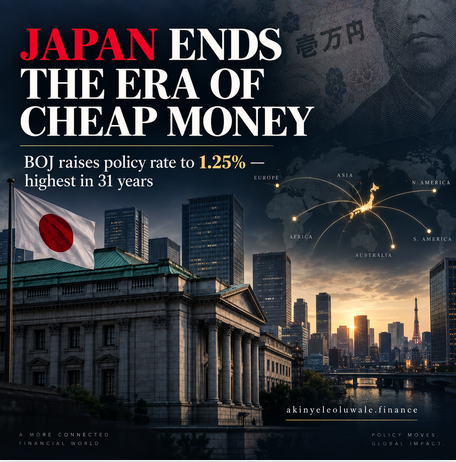
Japan Ends the Era of Cheap Money: Why the BOJ’s 1.25% Rate Matters Globally
Published: September 19, 2026
Category: Central Banks / Macro & Global Markets
By: Akinyele Oluwale
Executive Summary
The Bank of Japan has increased its benchmark policy rate from 1.00% to 1.25%, taking Japanese interest rates to their highest level in 31 years. The decision, approved by a 7–2 vote, represents another significant step in Japan’s gradual departure from the ultra-low and negative interest-rate policies that defined its economy for decades.
Viewed in isolation, a 1.25% interest rate may appear modest particularly when compared with rates in the United States, United Kingdom and other major economies. However, Japan occupies a unique position within the global financial system. Its exceptionally low borrowing costs have long made the Japanese yen an important funding currency for international investors.
This means the Bank of Japan’s decision is not merely a domestic monetary-policy adjustment. It could influence the yen carry trade, Japanese investment in foreign bonds, global liquidity conditions, equity valuations and speculative markets, including cryptocurrency.
The immediate market reaction has been mixed. The yen weakened despite the rate increase, partly because the decision had already been anticipated and investors remain uncertain about how rapidly the Bank of Japan will tighten policy further. Nevertheless, the structural direction is becoming clearer: the era in which investors could assume that Japanese money would remain exceptionally cheap indefinitely is coming to an end.
Background
Japan spent decades fighting deflation, weak wage growth and subdued domestic demand. In response, the Bank of Japan introduced increasingly unconventional monetary policies, including near-zero interest rates, negative rates, extensive government-bond purchases and yield-curve control.
These policies helped keep borrowing costs low across the Japanese economy. They also affected international markets because Japanese banks, insurers, pension funds and asset managers frequently looked overseas for higher returns.
At the same time, international investors could borrow yen at extremely low rates and use the funds to purchase higher-yielding assets elsewhere. This approach became known as the yen carry trade.
The strategy is attractive when Japanese rates are low, the yen is stable or weakening and risk assets are rising. Its vulnerability emerges when Japanese rates rise, the yen appreciates or market volatility forces investors to reduce leverage.
The Bank of Japan began moving away from negative interest rates in 2024. Subsequent increases demonstrated that the policy shift was not a one-off adjustment. The latest move to 1.25% strengthens the argument that Japan is entering a more conventional but still cautious interest-rate environment.
Governor Kazuo Ueda and the Bank of Japan must now balance competing risks. Tightening too slowly could allow inflation to remain above target and further weaken household purchasing power. Tightening too quickly could damage growth, place pressure on Japan’s highly indebted public finances and cause disorderly movements in domestic and global markets.
Why it matters
Japan is one of the world’s largest economies, creditors and sources of investment capital. Consequently, changes in Japanese interest rates can affect financial conditions far beyond the country’s borders.
First, higher Japanese yields may encourage domestic institutions to retain more capital at home. If Japanese government bonds offer more attractive returns, insurers and pension funds may have less incentive to accept currency risk by investing heavily in foreign bonds.
Any sustained repatriation of Japanese capital could reduce demand for US Treasuries, European sovereign debt and other international fixed-income securities. This would not automatically cause a global bond-market crisis, but it could contribute to higher yields and tighter financial conditions.
Second, higher Japanese rates can alter the economics of the yen carry trade. Investors who borrowed cheaply in yen to acquire equities, bonds, commodities or digital assets may face higher financing costs. If the yen strengthens sharply, the currency loss can compound the pressure, potentially forcing leveraged positions to be unwound.
Third, the decision introduces another variable into global liquidity. Financial markets have become accustomed to evaluating policy primarily through the actions of the US Federal Reserve and European Central Bank. Japan’s normalisation means the Bank of Japan must now be considered more seriously in global asset-allocation and risk-management decisions.
Stakeholders: Winners and Losers
Potential winners include Japanese banks and other financial institutions whose lending margins may improve as rates rise. Japanese savers could also benefit from better returns on bank deposits and low-risk domestic investments after years of negligible income.
The yen could become a beneficiary if investors conclude that additional rate increases are likely. A stronger and more stable currency would reduce the domestic cost of imported food, fuel and raw materials, offering some relief to Japanese households and businesses.
Japanese investors seeking income at home may also gain from the emergence of more attractive domestic fixed-income opportunities.
The potential losers include highly leveraged companies, property borrowers and other entities that became dependent on exceptionally cheap financing. Japan’s government must also manage higher debt-servicing costs because the country carries one of the largest public-debt burdens in the developed world.
International investors using yen-funded leverage could face reduced returns or losses if borrowing costs rise and the currency appreciates. Foreign governments and companies may also encounter higher financing costs if Japanese investors reduce their allocation to overseas bonds.
Speculative assets, including highly leveraged cryptocurrency positions, could experience volatility if tighter Japanese policy contributes to a broader reduction in global liquidity.
Short-Term Impact
The short-term reaction may remain inconsistent. Although a rate increase would normally support a currency, the yen weakened after the announcement because markets had largely anticipated the decision and remained uncertain about the pace of future tightening.
This illustrates an important market principle: prices react not only to what a central bank does, but also to what investors believe it will do next.
If the Bank of Japan communicates a slow and conditional tightening path, carry trades may remain attractive for some time. If inflation persists and policymakers indicate that further increases are likely, investors could begin reducing yen-funded positions more aggressively.
Japanese bank shares may initially benefit from expectations of improved margins. Export-oriented companies, however, could be affected if the yen eventually appreciates. Bond markets may experience further upward pressure on yields as investors adjust to the reduced level of central-bank support.
Bitcoin and other digital assets are not directly tied to Japanese policy, but leveraged crypto markets are sensitive to global liquidity, currency volatility and sudden changes in risk appetite. Traders should therefore monitor developments without assuming that a single rate increase guarantees either a market crash or an immediate rally.
Long-Term Impact
The long-term significance lies in the cumulative normalisation of Japanese monetary policy.
If domestic Japanese yields continue rising, the global allocation of capital could gradually change. Japanese institutions may direct a larger portion of their portfolios toward domestic bonds, reducing one longstanding source of demand for overseas debt.
The change could also make the yen a less attractive funding currency. The carry trade will not necessarily disappear, especially while rate differentials remain substantial, but its risk-and-return profile is changing.
For Japan, successful normalisation could signal that the economy has finally moved beyond entrenched deflation. Sustainable wage growth, stable inflation and more productive capital allocation would be positive outcomes.
The risks are equally serious. Higher rates could reveal vulnerabilities among indebted companies, weaken interest-sensitive sectors and increase fiscal pressure on the Japanese government. If policy normalisation coincides with weaker global growth, the Bank of Japan could face a difficult choice between controlling inflation and protecting economic activity.
Globally, the end of permanently cheap Japanese money could contribute to a financial environment in which leverage is more expensive, bond yields remain structurally higher and investors demand stronger fundamentals before allocating capital.
Editorial Perspective
The Bank of Japan’s decision should not be interpreted as proof that an immediate global market collapse is underway. Neither should it be dismissed because 1.25% appears low by international standards.
The importance of this development is structural.
For decades, Japan provided the global financial system with an unusually stable source of low-cost capital. Many investment strategies were built directly or indirectly around the assumption that Japanese interest rates would remain close to zero.
That assumption is becoming less dependable.
The greatest risk is not necessarily the current interest rate. It is the possibility that multiple leveraged positions are adjusted simultaneously when investors realise that Japan’s monetary-policy regime has permanently changed.
Institutional investors should review currency exposure, funding sources and the sensitivity of their portfolios to higher global bond yields. Retail investors should avoid excessive leverage and resist the temptation to treat every central-bank decision as a guaranteed directional trading signal.
Policy moves often begin gradually. Their consequences can become nonlinear when positioning, currency movements and market psychology interact.
What to Watch Next
Investors should monitor Governor Kazuo Ueda’s guidance and any indication of when the next rate adjustment could occur.
The yen’s direction against the US dollar will be critical. A rapid appreciation could place greater pressure on carry trades, while continued weakness may give the Bank of Japan more reason to consider additional tightening.
Japanese government-bond yields also deserve attention. A sustained increase particularly at the longer end of the yield curve could influence Japanese institutional demand for foreign bonds.
Other important indicators include Japanese wage growth, services inflation, household consumption and energy prices. Stronger wages and persistent inflation would support further normalisation, while weak consumption or slowing growth could encourage caution.
Internationally, investors should compare the Bank of Japan’s direction with the policies of the Federal Reserve, European Central Bank and other major central banks. Interest-rate differentials will influence capital flows and exchange rates.
For cryptocurrency markets, the most useful indicators will be leverage, funding rates, stablecoin liquidity, exchange inflows and signs of forced liquidation. The relevant question is not whether Japan directly controls Bitcoin, but whether the changing cost of global capital reduces demand for leveraged risk.
Notes
The Bank of Japan increased its policy rate from 1.00% to 1.25% on September 18, 2026. The decision was approved by a 7–2 majority and took the policy rate to its highest level since 1995.
Sources: [Reuters](https://www.reuters.com/world/asia-pacific/boj-raises-interest-rates-31-year-high-widely-expected-move-2026-09-18/), [Associated Press](https://apnews.com/article/67e71246d3af41bcfc61aa788f9959c7) and [Financial Times](https://www.ft.com/content/97a0bed5-0580-4ccc-bd3c-fe9a714259e2).
This publication is provided for information and education. It does not constitute investment, legal or financial advice. Investors should conduct independent research and assess their personal circumstances before making financial decisions.
Akinyele Oluwale & Co. Investment Ltd.
Where Global Finance Meets Tomorrow’s Technology.