

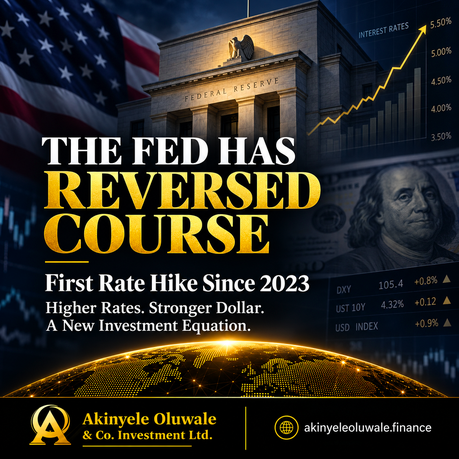
The Fed Has Reversed Course: What Its First Rate Hike Since 2023 Means for Investors
Published: September 17, 2026
Category: Macro & Global Markets / Central Banks
By: Akinyele Oluwale
The United States Federal Reserve has raised its benchmark interest rate by 25 basis points to a target range of 3.75%–4.00%, marking its first increase since 2023.
Although the size of the increase was widely anticipated, the broader message is more important: the period of expected monetary easing has been interrupted. Persistent inflation, elevated energy prices and resilient economic activity have forced the Federal Reserve to tighten financial conditions again.
For investors, this changes the global investment equation.
Why the Federal Reserve Raised Rates
Central banks increase interest rates when inflation remains too high or when demand is growing faster than the economy can sustainably accommodate.
Higher rates make borrowing more expensive. This can reduce household spending, discourage excessive corporate borrowing and slow investment. The objective is to weaken inflationary pressure without causing an unnecessary recession.
The present challenge is complicated by elevated oil prices. Energy affects transportation, manufacturing, food distribution and household expenses. When oil remains expensive, inflation can persist even as economic growth slows.
The Federal Reserve must therefore balance two risks: allowing inflation to become entrenched or tightening monetary policy so aggressively that it damages economic activity.
The Global Cost of Capital Is Rising
The federal funds rate influences financing conditions far beyond the United States.
When US interest rates rise, Treasury securities become more attractive to global investors. Other investments must then offer stronger potential returns to justify their additional risk.
This affects:
* Corporate borrowing costs
* Government debt-servicing expenses
* Mortgage and consumer-credit rates
* Equity-market valuations
* Venture-capital funding
* Cryptocurrency liquidity
* Emerging-market capital flows
Companies dependent on inexpensive financing will face greater pressure than businesses supported by strong cash flow, manageable debt and sustainable earnings.
What It Means for Equities and Bonds
Higher interest rates reduce the present value of future corporate earnings. This is particularly important for highly valued growth companies whose expected profits lie several years ahead.
Investors may become less willing to pay excessive prices for uncertain future growth when government securities provide increasingly competitive yields.
Bonds also require careful analysis. Newly issued securities may offer higher yields, but existing long-duration bonds can lose value when market interest rates rise.
This environment rewards disciplined valuation and careful management of portfolio duration.
What It Means for Cryptocurrency
Digital assets generally perform best when liquidity is abundant, interest rates are low and investors are willing to accept greater risk.
Higher rates and a stronger dollar can reduce speculative demand across the cryptocurrency market. This does not mean that every digital asset must decline. It means that investors are likely to become more selective.
Assets supported primarily by hype may struggle, while networks with credible utility, liquidity, institutional participation and sustainable development may prove more resilient.
The distinction between technological value and speculative momentum becomes increasingly important when money is no longer cheap.
Implications for Nigeria and Other Emerging Markets
Higher US yields can attract international capital toward dollar-denominated assets. This may reduce investment flows into emerging economies and place additional pressure on their currencies.
For Nigeria, the principal risks include:
* Greater pressure on the naira
* Higher costs of servicing dollar-denominated debt
* More expensive imported goods
* Possible capital outflows
* Increased financing costs for Nigerian businesses
* Renewed inflationary pressure through exchange rates and energy prices
Nigeria’s domestic conditions remain important, but US monetary policy influences the external environment in which the country must operate.
How Investors Should Respond
A single rate increase should not automatically trigger indiscriminate selling. The disciplined response is to review portfolio assumptions.
Investors should examine:
1. Leverage: Can existing debts remain affordable if rates stay elevated?
2. Liquidity: Is sufficient cash available for emergencies and opportunities?
3. Valuation: Are current asset prices supported by realistic earnings and cash flows?
4. Currency exposure: How would a stronger dollar affect assets and obligations?
5. Concentration: Is too much capital exposed to one company, sector or speculative theme?
6. Investment horizon: Can short-term volatility be tolerated without abandoning long-term objectives?
What to Watch Next
The direction of markets will depend on more than this single decision.
Investors should monitor:
* US inflation data
* Crude-oil prices
* Treasury yields
* Dollar strength
* Federal Reserve communication
* The Bank of Japan’s policy direction
* Capital flows into emerging markets
* Corporate earnings and debt refinancing
The central question is whether the Federal Reserve stops after one additional increase or begins a longer tightening cycle.
Final Perspective
The return of higher interest rates does not eliminate investment opportunities. It changes the conditions under which those opportunities must be evaluated.
Cheap capital can conceal weak businesses, excessive leverage and unrealistic valuations. Tighter financial conditions expose those weaknesses.
The next phase will favour investors who understand cash flow, valuation, liquidity and risk not those who depend entirely on market momentum.
Akinyele Oluwale
Founder & Chief Investment Strategist
Akinyele Oluwale & Co. Investment Ltd.
akinyeleoluwale.finance
This publication is for educational and informational purposes and does not constitute personalised investment advice.