

THE GLOBAL MONETARY POLICY DILEMMA: WHY INFLATION, RISING DEBT AND FINANCIAL MARKET VOLATILITY ARE TESTING CENTRAL BANKS
As the global economy approaches 2027, central banks face increasingly difficult decisions involving price stability, economic growth, government borrowing, financial-market valuations and the preservation of household purchasing power.
Published: Wednesday, 25 November 2026
Category: Macro & Central Banks
By: Akinyele Oluwale & Co. Investment Ltd.
Editorial Focus: Monetary Policy | Inflation | Interest Rates | Sovereign Debt | Global Liquidity | Financial Stability
The global economy is approaching a critical period in which monetary policy decisions could have significant consequences for businesses, households, governments and financial markets. Central banks face a fundamental economic dilemma. Reducing interest rates prematurely could undermine progress towards price stability, while maintaining restrictive monetary conditions for too long could weaken economic activity, increase debt-servicing costs and place additional pressure on financially vulnerable businesses. Meanwhile, governments must manage substantial borrowing requirements, financial institutions must navigate changing liquidity conditions, and investors must reassess valuations across traditional and digital asset markets.
The situation is particularly complex because inflation is not always driven by excessive consumer demand. Energy prices, international trade restrictions, geopolitical tensions, currency depreciation and supply-chain disruptions can also contribute to rising prices. Interest-rate adjustments alone cannot resolve all these problems. For emerging economies such as Nigeria, the challenge is even more demanding. Monetary authorities must consider domestic inflation, exchange-rate stability, foreign capital flows and the affordability of credit.
Our central assessment is that the next phase of global monetary policy will require a delicate balance between controlling inflation, maintaining financial stability and supporting sustainable economic activity.
Central bank decisions are not abstract economic events that affect only financial institutions and professional investors. They influence the cost of borrowing, mortgage repayments, business expansion, employment opportunities, exchange rates and the purchasing power of ordinary households. When interest rates increase, businesses generally face higher financing costs. Companies may postpone expansion, reduce expenditure or reconsider recruitment decisions. When interest rates decline, borrowing may become more affordable, although the actual benefits depend on commercial lending conditions, inflation expectations and the financial health of borrowers. For households, the consequences can be equally significant. A person earning the same monthly salary while food, transportation, electricity and housing costs increase is experiencing a decline in real purchasing power. This explains why controlling inflation remains one of the most important responsibilities of monetary authorities. However, price stability must be pursued without ignoring the broader economic consequences of restrictive financial conditions. The challenge is not simply to determine whether interest rates should rise or fall. It is to determine which policy decisions are appropriate for the prevailing economic circumstances.
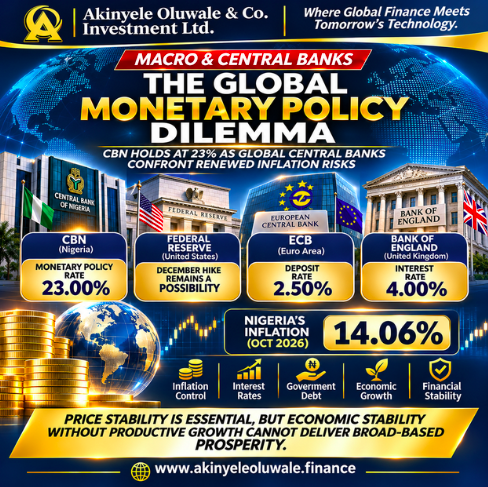
The most significant domestic economic development this week came from the Central Bank of Nigeria (CBN). At its 308th Monetary Policy Committee meeting, held on 23 and 24 November 2026, the CBN decided to retain the Monetary Policy Rate (MPR) at 23.00%. The Committee also retained the Cash Reserve Requirement at 45% for deposit money banks, 16% for merchant banks and 75% for public-sector deposits held outside the Treasury Single Account. The Standing Facilities Corridor remained unchanged at +50 and −300 basis points around the MPR. According to the CBN, the decision was necessary to consolidate recent progress in reducing inflation while addressing potential price pressures arising from global energy disruptions, festive-season expenditure and election-related spending. The decision follows September's 350-basis-point reduction in the benchmark rate from 26.5% to 23%. However, maintaining the MPR at 23% indicates that the monetary authorities are not yet sufficiently confident that inflationary pressures have been sustainably contained. For Nigerian businesses, borrowing costs could therefore remain elevated, particularly for enterprises dependent on bank financing.
The economic lesson: A reduction in inflation does not automatically justify an immediate reduction in interest rates.
Nigeria's headline inflation declined from 14.63% in September 2026 to 14.06% in October 2026. Core inflation also moderated from 12.95% to 10.78%, while food inflation declined from 19.59% to 19.13%. The CBN identified exchange-rate stability, monetary policy transmission and improving food supply as factors supporting the disinflationary process. Nevertheless, there is an important distinction that every Nigerian should understand.
Falling inflation does not necessarily mean falling prices.
When inflation declines from 14.63% to 14.06%, the general price level is still increasing compared with the corresponding period of the previous year, but at a slower annual rate. For example, if a representative basket of goods cost ₦100,000 one year earlier, an annual inflation rate of 14.06% would imply an increase to approximately ₦114,060. The rate of increase may have moderated, but the household still requires more money to purchase the same representative basket of goods. This explains why improvements in official inflation statistics may not immediately translate into noticeable improvements in household living standards. Sustainable economic recovery requires not only lower inflation but also employment opportunities, productivity growth and improvements in real household income.
The minutes of the United States Federal Reserve's 27–28 October 2026 monetary policy meeting, released on 18 November, revealed growing concerns about persistent inflation. According to Associated Press reporting, nearly all Federal Reserve policymakers anticipated that a quarter-percentage-point increase in interest rates could be appropriate in December. Some participants expressed support for stronger monetary tightening. The Federal Reserve's concerns include persistent underlying inflation and the possibility that inflationary pressures could remain above its long-term 2% objective. This development has important consequences beyond the United States. The US dollar occupies a central position in international trade, government borrowing, commodity pricing and global financial markets. When American interest rates remain elevated, dollar-denominated financing can become more expensive, while international capital flows may change in response to higher US yields. Emerging economies with substantial foreign-currency obligations may consequently experience additional financial pressure. Higher American interest rates can also affect equity valuations, cryptocurrency markets and international investment sentiment. However, Federal Reserve meeting minutes represent policymakers' discussions and expectations, not a confirmed future interest-rate decision.
A December rate increase remains a possibility rather than an established outcome.
The European Central Bank (ECB) continues to confront uncertainty surrounding energy prices, economic activity and inflation. The ECB maintained its key deposit facility rate at 2.50% at its late-October policy meeting. Speaking on 5 November 2026, ECB President Christine Lagarde indicated that incoming economic indicators would help determine whether additional monetary tightening would be necessary in December. The central bank faces a particularly difficult challenge because higher energy costs can simultaneously increase inflation and weaken economic growth. This creates what economists describe as an adverse supply shock. Unlike inflation driven primarily by excessive consumer demand, supply-driven inflation may arise when the cost of producing and distributing goods increases. Raising interest rates can help moderate demand and prevent inflation expectations from becoming entrenched. However, it cannot directly produce additional energy, resolve geopolitical disputes or eliminate international supply-chain disruptions. Europe's monetary policy challenge therefore demonstrates the limitations of central banking. Monetary policy remains essential, but sustainable economic stability also requires appropriate fiscal, industrial and energy policies.
The Bank of England's November 2026 monetary policy report confirmed that its Monetary Policy Committee voted by an 8–1 majority to increase Bank Rate by 25 basis points to 4.00%. The decision reflected concerns about elevated energy prices and future inflationary pressures. UK consumer price inflation reached 3.5% in September, while the Bank projected that inflation could rise to approximately 5% by the middle of 2027 before subsequently moderating. That projection remains conditional on future economic developments. The decision illustrates how renewed inflationary pressures can interrupt expectations of lower borrowing costs.
Businesses operating with variable-rate loans may encounter higher financing expenses, while households could experience additional pressure on mortgage affordability. The broader concern is that prolonged monetary tightening may weaken consumption and business investment. Central banks must therefore continually assess whether their actions are achieving price stability without creating unnecessary economic damage.
For much of the period following the 2008 global financial crisis, major economies benefited from relatively low interest rates and considerable monetary accommodation. These conditions supported borrowing, encouraged investment and contributed to rising valuations across several asset classes. However, the economic environment has become increasingly complicated. Geopolitical tensions, energy disruptions, international trade fragmentation and substantial government borrowing requirements have created additional challenges for monetary authorities. Reuters reported on 4 November 2026 that central banks overseeing the ten most heavily traded currencies had collectively delivered 350 basis points of monetary tightening through 14 interest-rate increases during the year up to that point, without recording a rate cut. This suggests that the international monetary environment remains sensitive to renewed inflationary pressures. The consequences extend across several areas of economic activity.
When interest rates remain elevated, governments may face higher costs when issuing new debt or refinancing existing obligations. This can reduce the fiscal resources available for infrastructure, healthcare, education and other public services. Countries with substantial debt-servicing obligations may find it increasingly difficult to balance economic development with fiscal sustainability.
Companies that rely heavily on borrowed capital may experience pressure on profit margins when financing costs increase. Businesses must generate sufficient operating cash flows to meet interest payments, maintain operations and support future investment. Revenue growth alone does not necessarily establish financial sustainability when borrowing costs are rising.
Interest rates influence the present value of expected future cash flows. All else being equal, higher discount rates reduce the present value of future earnings. This relationship is particularly relevant to technology companies whose market valuations depend substantially on profits expected many years into the future. Artificial intelligence may remain commercially transformative while individual AI-related investments experience significant valuation adjustments. Technological innovation does not suspend the fundamental economic principles of valuation.
Restrictive monetary conditions can place pressure on corporate earnings, consumer demand and asset valuations. Highly indebted businesses and companies dependent on distant future earnings may be particularly sensitive to elevated financing costs. However, the impact varies according to individual business models, industries and economic conditions.
Cryptocurrency markets remain sensitive to global liquidity, financial-market sentiment and institutional risk appetite. Even as regulated custody, tokenization and blockchain payment infrastructure continue developing, restrictive monetary conditions can influence digital asset valuations. Institutional adoption and short-term cryptocurrency performance should therefore be analysed separately. A financial institution can remain committed to blockchain infrastructure while reducing its exposure to volatile assets.
Higher interest rates generally influence yields on newly issued government securities. However, rising market yields can reduce the market value of existing fixed-rate bonds. Government securities must also be evaluated within the context of inflation, maturity, sovereign creditworthiness and currency exposure. A positive nominal return does not necessarily translate into an improvement in purchasing power.
Gold is frequently examined in the context of geopolitical uncertainty, monetary instability and inflation expectations. Nevertheless, its price can also respond to real interest rates, currency movements and changes in market liquidity. No asset provides guaranteed protection against every economic development.
Interest-rate differences between economies can influence international capital flows and currency valuations. For emerging markets, exchange-rate stability also depends on export earnings, foreign reserves, investor confidence, trade balances and the credibility of domestic economic policy. Interest rates represent only one component of this broader economic relationship.
Nigeria's latest monetary policy decision presents an opportunity to examine the relationship between macroeconomic stability and everyday economic realities. According to the November MPC communiqué, Nigeria's gross external reserves stood at $54.02 billion as of 17 November 2026, while the composite Purchasing Managers' Index increased to 53.2 points in October. The Committee also welcomed a memorandum of understanding between the CBN and the Nigerian National Petroleum Company Limited aimed at improving foreign-exchange inflows and supporting energy-sector financing. These developments deserve attention.
However, improvements in macroeconomic indicators must eventually translate into measurable improvements in the productive economy. Nigeria cannot achieve sustainable prosperity through restrictive monetary policy alone. Several structural challenges require continued attention.
Electricity and energy infrastructure: Businesses operating with unreliable electricity supplies incur additional production and operating costs. These costs can ultimately contribute to higher consumer prices.
Agricultural productivity: Improved agricultural output, transportation and storage infrastructure could help address persistent food-price pressures.
Exchange-rate stability: A more predictable foreign-exchange environment can support business planning, import management and investment decisions.
Affordable business financing: Small and medium-sized enterprises require financing arrangements that allow commercially viable businesses to expand without unsustainable debt obligations.
Fiscal discipline: Government spending and borrowing decisions must complement rather than undermine monetary policy objectives.
Nigeria's 23% MPR and October inflation rate of 14.06% produce a simple difference of 8.94 percentage points.
However, this difference is not an actual inflation-adjusted investment return or the interest rate paid to commercial bank depositors. The MPR is a policy benchmark, not a guaranteed investment yield. The broader implication is that Nigeria remains within a relatively restrictive monetary environment despite recent progress in reducing inflation.
The ultimate measurement of economic reform should not be limited to statistical improvements. It should include employment creation, business sustainability, household purchasing power and improved living standards.
At Akinyele Oluwale & Co. Investment Ltd., our institutional assessment is that the global economy requires greater coordination between monetary policy, fiscal responsibility and structural economic development. Central banks have important responsibilities.They can influence liquidity, manage policy interest rates, supervise selected financial activities and attempt to anchor inflation expectations but they cannot independently resolve every economic problem. The CBN cannot solve Nigeria's electricity challenges through interest-rate adjustments. The Federal Reserve cannot eliminate international trade disruptions through monetary tightening. The European Central Bank cannot independently resolve Europe's energy supply challenges and the Bank of England cannot directly reverse geopolitical developments affecting international commodity prices. These limitations demonstrate why monetary policy should not be treated as a universal solution to structural economic weaknesses.
There is also a significant danger associated with maintaining high interest rates for prolonged periods. Although restrictive monetary policies may help contain inflation, they can increase financing costs, discourage productive investment and weaken financially vulnerable businesses. Conversely, reducing rates prematurely may weaken confidence in monetary policy and allow inflationary pressures to return. The challenge therefore requires institutional judgment rather than rigid adherence to a predetermined interest-rate direction. For Nigeria, the CBN's decision to maintain the MPR at 23% is understandable within the context of lingering inflationary risks. Nevertheless, prolonged monetary restriction must be accompanied by meaningful improvements in domestic production, infrastructure, fiscal management and business financing.
Price stability is essential, but economic stability without productive growth cannot deliver broad-based prosperity.
The real objective of economic policy should be creating conditions under which businesses can operate sustainably, households can preserve purchasing power and governments can finance development responsibly.
As the global economy approaches December 2026 and the beginning of 2027, the following developments deserve close attention.
Federal Reserve's December decision: Whether American policymakers proceed with additional monetary tightening in response to persistent inflation.
European Central Bank's December meeting: Whether incoming economic data justify maintaining or increasing interest rates.
Global energy prices: Whether geopolitical developments and supply disruptions continue placing upward pressure on production costs.
Nigeria's November inflation report: Whether the country's disinflationary momentum continues despite seasonal spending pressures.
Nigeria's external reserves: Whether foreign-exchange inflows and reserve accumulation remain sustainable.
Election-related expenditure: Whether increased public and private spending creates additional inflationary pressure in Nigeria.
Global sovereign debt markets: Whether elevated borrowing costs create additional fiscal and financial stability concerns.
Artificial intelligence valuations: Whether corporate earnings justify technology-related infrastructure expenditure under restrictive financial conditions.
Global cryptocurrency liquidity: How digital asset markets respond to monetary policy developments and institutional risk management.
CBN's next MPC meeting: The Committee has scheduled its next meeting for 22–23 February 2027. Incoming inflation, exchange-rate and economic growth data will be important considerations ahead of that meeting. These developments represent areas for continued economic observation rather than guaranteed predictions.
The CBN retained Nigeria's Monetary Policy Rate at 23% on 24 November 2026.
Nigeria's headline inflation declined to 14.06% in October.
Food inflation remains elevated at 19.13%, despite recent moderation.
Nigeria's external reserves stood at $54.02 billion on 17 November.
Federal Reserve meeting minutes indicate the possibility of additional monetary tightening in December.
The European Central Bank is assessing whether further interest-rate increases are necessary.
The Bank of England increased its benchmark interest rate to 4% in November.
Falling inflation does not necessarily mean falling consumer prices.
Restrictive monetary conditions can influence global liquidity, corporate profitability and financial-market valuations.
Sustainable economic prosperity requires coordination between monetary policy, fiscal discipline and structural economic reforms.
Akinyele Oluwale & Co. Investment Ltd. is an independent financial intelligence and research platform covering global macroeconomics, central banking, institutional cryptocurrency, stablecoins, digital payments, tokenization, real-world assets, artificial intelligence and blockchain technology.
Our editorial mission is to provide research-driven financial intelligence that connects monetary policy, economic fundamentals, institutional developments and emerging financial technologies.
We believe responsible financial journalism must distinguish verified economic developments from speculative expectations, nominal financial growth from genuine purchasing-power improvements, and technological innovation from sustainable economic value.
Our analytical approach emphasises factual accuracy, financial education, institutional accountability and independent economic reasoning.
The latest monetary policy developments in Nigeria, the United States, Europe and the United Kingdom reveal a common economic challenge. Central banks are attempting to contain inflation without unnecessarily weakening economic activity. Governments are managing borrowing requirements. Businesses are confronting financing costs. Households are struggling to preserve purchasing power and financial markets are adjusting to a less accommodating monetary environment.
Nigeria's decision to retain the MPR at 23% demonstrates that improving inflation statistics have not eliminated the risks confronting the domestic economy. The Federal Reserve's December discussions and Europe's renewed inflation concerns reinforce the possibility that restrictive monetary conditions could persist into 2027. However, higher interest rates alone cannot deliver sustainable economic prosperity. Productivity must improve. Infrastructure must become more reliable. Government finances must remain sustainable. Businesses must generate genuine economic value and household incomes must improve relative to the cost of living.
The true success of monetary policy should ultimately be measured not merely by lower inflation statistics, but by its contribution to a stable, productive and sustainable economy.
The global economy does not simply need cheaper money or more expensive money. It needs credible institutions, responsible capital allocation, productive investment and sustainable economic growth.
Observe the change. Understand the implications. Position with discipline.
Akinyele Oluwale & Co. Investment Ltd.
Where Global Finance Meets Tomorrow's Technology.
www.akinyeleoluwale.finance
Editorial disclaimer: This publication is intended for general financial education, macroeconomic research and institutional analysis. It does not constitute personalised investment advice or a guarantee of future economic or financial performance.