

Published: October 26, 2026 | Category: Institutional Finance | By: Akinyele Oluwale
The institutional crypto market is undergoing an important structural transition. Large financial institutions are increasingly moving beyond providing clients with simple exposure to Bitcoin and Ether.
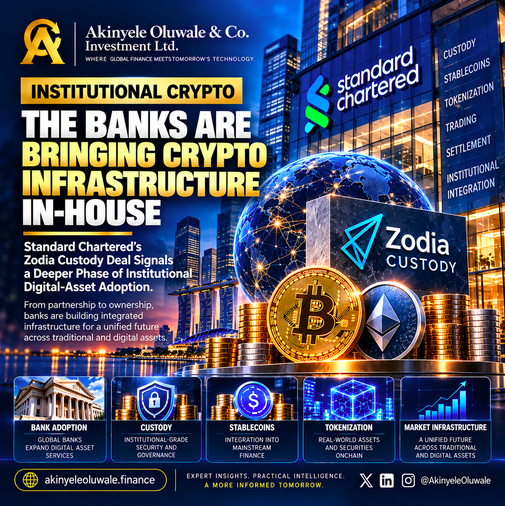
They are building or acquiring the infrastructure required to service digital assets. Standard Chartered's Zodia transaction is a powerful example.
The bank says Zodia's regulated custody operations across Singapore, Hong Kong, Australia, the United Arab Emirates and Luxembourg will ultimately be integrated with its existing digital-asset custody activities.
Its stated objective is particularly revealing:
to build a unified institutional offering combining traditional and digital-asset securities services.
That is the real story. The institutional digital-asset market is moving from:
“How can clients access crypto?”
toward:
“How can digital assets become part of normal institutional financial operations?”
Those are fundamentally different questions. The first is about investment access. The second is about infrastructure and infrastructure is where institutional adoption becomes durable.
Imagine a large pension fund, asset manager, hedge fund or corporation considering digital assets. Buying the asset is only the beginning. The institution must also answer:
Who holds the asset? How are private keys protected? Who has authority to move it? How are transactions approved?
How is ownership recorded? How does the institution satisfy regulators? How are assets separated from those belonging to other clients? How are transactions reconciled?
How does digital-asset custody interact with the institution's existing portfolio systems?
How are risks monitored? These questions explain why custody is so important. For an individual, custody can mean protecting a wallet. For a financial institution, custody is an entire operating system of:
SECURITY → GOVERNANCE → AUTHORIZATION → RECORDKEEPING → COMPLIANCE → REPORTING → SETTLEMENT
Institutional investors cannot simply behave like individual cryptocurrency users.
They operate under mandates, internal controls, regulatory obligations and fiduciary responsibilities.
That creates demand for infrastructure capable of bringing digital assets into familiar institutional frameworks.
Standard Chartered's strategy should be understood in that context.
On October 21, Standard Chartered announced that it had signed definitive agreements to acquire Zodia Custody. The development followed acceptance in May of the bank's earlier non-binding acquisition offer. The transaction remains subject to regulatory approvals and customary closing conditions.
Upon completion, Standard Chartered plans to integrate Zodia's regulated custody operation into its existing digital-asset custody activities within Securities Services.
Zodia's software and professional-services activities will take a different route. Those assets are expected to move into a separate entity called Zodia Solutions, established under SC Ventures.
This creates an interesting structure.
One side becomes:
BANK-OWNED REGULATED CUSTODY
The other remains:
DIGITAL-ASSET INFRASTRUCTURE TECHNOLOGY
That separation is strategically important. It recognizes that custody and technology infrastructure perform different roles. The custodian safeguards assets and operates within regulated financial structures.
The technology provider supplies the systems institutions need to develop and scale digital-asset capabilities.
Institutional crypto is becoming specialized and specialization is often a sign of market maturation.
The acquisition should not be viewed in isolation. Standard Chartered has been steadily assembling different pieces of an institutional digital-asset ecosystem. Earlier this month, the bank announced plans to extend custody services in Singapore for selected cryptoassets, stablecoins and tokenized real-world assets, subject to regulatory requirements.
Its custody footprint already extends across important international financial centres. The bank has also launched institutional support for Ripple's RLUSD stablecoin through its DIFC branch in Dubai.
Separately, it has been working toward connecting RLUSD with institutional collateral infrastructure and it has introduced cryptocurrency trading for eligible affluent clients in the UAE through an integrated banking model.
Taken together, these developments reveal something much larger than a collection of crypto announcements. They show the construction of an ecosystem.
Think about the progression:
CUSTODY
↓
TRADING
↓
LIQUIDITY
↓
COLLATERAL
↓
STABLECOINS
↓
TOKENIZED ASSETS
↓
SETTLEMENT
↓
INSTITUTIONAL SECURITIES SERVICES
That begins to resemble a digital version of traditional capital-market infrastructure and that is precisely why this development matters.
Investors should resist the temptation to interpret this transaction as a short-term Bitcoin price signal. It is not.
Standard Chartered acquiring digital-asset custody infrastructure does not mean Bitcoin must rise tomorrow. The significance is structural.
A bank investing capital, management attention and regulatory resources into digital-asset infrastructure is making a different kind of decision from an investor purchasing cryptocurrency.
One is an asset-allocation decision. The other is an infrastructure investment decision. Infrastructure decisions are generally based on longer-term expectations about client demand and future financial activity.
That distinction gives us an important framework:
All three matter but they tell us different things.
Bitcoin's price can fall while institutional infrastructure improves.
ETF outflows can occur while banks expand custody.
Crypto-market sentiment can weaken while tokenization infrastructure advances. This is why institutional crypto should never be analysed solely through price charts.
At Akinyele Oluwale & Co. Investment Ltd., we believe the Zodia development illustrates one of the most important transitions occurring in digital finance:
Institutional crypto is moving from partnership dependency toward infrastructure ownership.
That is a major distinction.
During the early stages of financial innovation, established institutions frequently rely on specialist technology companies.
This allows them to experiment without rebuilding their entire operating infrastructure but as an activity becomes strategically important, institutions may decide that critical capabilities should sit closer to the core business.
That appears to be what we should watch now.
The strategic progression can be expressed as:
Not every bank will follow this route. Some may continue partnering with specialist custodians. Others may build internally.
Some may acquire. There is no single correct architecture but the strategic question is changing. Banks are increasingly asking:
Which parts of the digital-asset value chain do we need to control ourselves?
Custody is an obvious candidate.
Why?
Because custody sits at the centre of trust If an institution cannot safeguard the asset, everything else becomes secondary.
The acquisition is not yet completed.
It remains subject to regulatory approvals and closing conditions.
That qualification is essential.
A definitive agreement is considerably more advanced than a proposal, but it is not the same as a completed transaction.
This may be the most important indicator.
Watch whether digital assets become increasingly embedded alongside traditional securities services rather than remaining a separate crypto division.
If that happens, the distinction between “traditional assets” and “digital assets” may gradually become less important operationally.
Standard Chartered plans to expand digital-asset custody in Singapore.
The proposed offering includes selected cryptoassets, stablecoins and tokenized real-world assets.
That combination is important.
It suggests custody is moving beyond Bitcoin and Ether toward a broader digital-asset universe.
The bank's RLUSD custody initiative deserves attention.
Institutional markets require efficient collateral.
If regulated stablecoins increasingly become usable within institutional trading and collateral systems, they could develop an economic role far beyond crypto exchange settlement.
This may be the biggest strategic question.
Will competitors respond by:
building internally,
partnering,
or
acquiring specialist digital-asset infrastructure?
If acquisitions increase, institutional crypto could enter a consolidation phase.
That would represent another important stage of maturation.
The eventual objective may not be separate systems for crypto and traditional finance.
It may be a unified institutional platform capable of servicing:
Bitcoin
Ether
Stablecoins
Tokenized deposits
Tokenized bonds
Tokenized funds
Traditional securities
and potentially other real-world assets.
That is a much bigger opportunity than cryptocurrency custody alone.
The Standard Chartered–Zodia transaction provides seven important lessons.
The story is moving beyond asset prices toward the systems supporting digital finance.
Partnerships are increasingly being complemented by direct ownership and internal integration.
Institutional capital requires security, governance, compliance and operational controls.
This may eventually matter more than maintaining standalone “crypto divisions.”
Their potential role increasingly includes settlement, collateral and payments.
Institutional custody may ultimately cover much more than cryptocurrencies.
The institutional framework is increasingly:
Surrounding the entire architecture:
Akinyele Oluwale & Co. Investment Ltd. provides financial intelligence and investment education focused on global finance, institutional capital, markets and emerging technology.
Our Institutional Crypto coverage is built around a simple principle:
Follow the infrastructure, not only the price.
Cryptocurrency prices can change dramatically within hours. Infrastructure evolves much more slowly but infrastructure can ultimately determine which financial technologies survive.
That is why developments such as Standard Chartered's Zodia transaction deserve attention. The significance is not that another bank has suddenly “become bullish on crypto.”
That would oversimplify the story.
The deeper significance is that a major international financial institution sees enough potential institutional demand to continue investing in the systems required to safeguard and service digital assets.
The distinction matters.
Institutional adoption should increasingly be measured through questions such as:
Are banks offering custody?
Are institutional trading systems developing?
Can digital assets function as collateral?
Can stablecoins integrate with regulated finance?
Can tokenized assets operate inside institutional portfolios?
Can digital securities interact with traditional settlement infrastructure?
Can institutions manage digital assets under the same governance standards applied to conventional securities and increasingly:
Are financial institutions willing to own the infrastructure themselves?
That final question may define the next stage.
The first institutional crypto era was about access.
The second was about infrastructure.
The next may increasingly be about ownership, integration and scale.
Standard Chartered's proposed acquisition of Zodia Custody gives us a clear example of that transition.
Crypto infrastructure is no longer necessarily something sitting outside the banking system. Parts of it are gradually moving inside and when infrastructure moves inside institutions, digital assets move one step closer to becoming part of ordinary financial architecture.
That does not guarantee universal adoption.
It does not eliminate regulatory risk.
It does not guarantee that every digital asset will survive and it certainly does not mean price speculation should replace disciplined analysis.
It means something more important:
the institutional digital-asset market is becoming structurally deeper.
The future may therefore be less about:
Traditional Finance versus Crypto
and increasingly about:
The institutions capable of combining both worlds securely, efficiently and within credible regulatory frameworks may ultimately shape the next architecture of global finance.
Observe the change. Understand the implications. Position with discipline.
Akinyele Oluwale & Co. Investment Ltd.
Where Global Finance Meets Tomorrow's Technology.
akinyeleoluwale.finance
This publication is for educational and informational purposes and does not constitute individualized investment, financial, legal or tax advice.