

As artificial intelligence becomes increasingly capable of producing content, making decisions and executing digital tasks, the financial industry faces a fundamental question: how can institutions verify what AI systems create, authorise and deliver? Blockchain offers potential solutions but its usefulness depends on more than technological promises.
Published: November 3, 2026
Category: AI & Blockchain
By: Akinyele Oluwale
Artificial intelligence is transforming how information is produced, analysed and used. Blockchain technology, meanwhile, is being explored as a way to maintain verifiable records, coordinate digital transactions and establish rules for exchanging value.
The emerging opportunity lies in bringing these capabilities together.
An AI system may generate a financial recommendation, identify a transaction or prepare an instruction. But how does a bank establish that the instruction was authorised, the underlying data was reliable and the resulting action can be independently examined?
These questions are becoming increasingly important as businesses move from AI tools that simply provide answers toward systems capable of carrying out tasks.
The real issue is no longer just how intelligent AI can become. It is how accountable AI-driven activity can be made.
For investors, banks, regulators and business leaders, this creates a potentially important area of financial infrastructure—provided the technology can deliver practical benefits without introducing unnecessary complexity.
A significant development is emerging at the intersection of artificial intelligence and blockchain technology.
As AI systems become capable of completing increasingly complex tasks, financial institutions and technology companies are confronting a new challenge: how to establish the identity, authority and accountability of software agents acting on behalf of individuals and businesses.
Recent developments demonstrate that this challenge is moving beyond theoretical discussion.
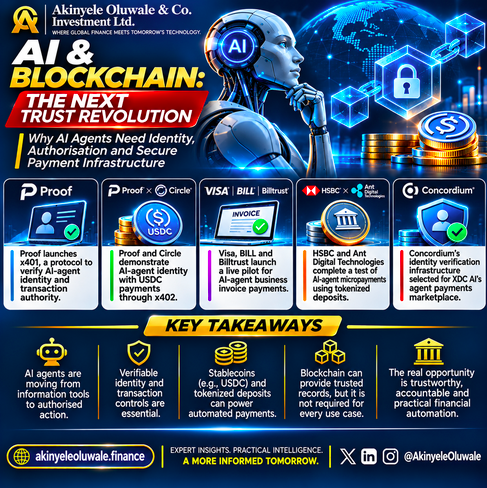
On October 15, 2026, Proof announced the launch of x401, a protocol designed to allow AI agents to present evidence of the identity and authorisation of the people they represent.
On October 19, Proof and Circle announced a demonstration combining verifiable agent identity with USDC payments through the x402 payment protocol.
On October 20, Visa, BILL and Billtrust announced a live pilot enabling trusted AI agents to initiate and complete approved business invoice payments.
Earlier, on October 9, Ant Digital Technologies and HSBC announced a successful technical verification test involving AI agents, tokenized deposits and micropayment settlement.
Meanwhile, blockchain-based identity infrastructure is attracting attention as developers explore ways to associate AI agents with verifiable human or business identities.
These developments suggest that AI is moving from assisting financial decisions toward participating in authorised financial workflows.
However, the technologies involved must be distinguished carefully.
Not every AI payment system requires a blockchain.
Not every digital identity credential is recorded on-chain.
And the ability to verify an AI agent's authority does not establish that its underlying decision is financially sound.
The emerging opportunity is therefore not simply to combine AI with cryptocurrency.
It is to create infrastructure through which automated systems can interact with financial services while preserving security, accountability and human oversight.
Our central assessment is that the next major development in AI and blockchain may be less about creating intelligent machines and more about building trustworthy systems around what those machines are permitted to do.
Consider a simple business example.
A company receives hundreds of supplier invoices every month.
Traditionally, employees review invoices, verify payment details, obtain approvals and instruct the bank to make payments.
Artificial intelligence may automate parts of this process.
An AI agent could compare invoices against purchase orders, identify discrepancies and prepare approved payment instructions.
But a critical question remains.
Who authorised the AI agent to act, and how can the bank or supplier verify that authority?
Imagine that the company authorises an AI agent to process a supplier invoice of ₦500,000.
The system must ensure that the agent cannot independently change the payment to ₦5 million or redirect the funds to another recipient without appropriate authorisation.
This is where digital identity, cryptographic signatures, payment controls and verifiable records become important.
A properly designed system can associate a transaction with an approved instruction and detect unauthorised changes to signed transaction details.
Blockchain technology may support parts of this infrastructure by providing shared records, programmable settlement or verifiable credentials.
However, blockchain is not always necessary.
Conventional databases, cryptographic signatures and regulated payment networks can also provide important controls.
The correct technology depends on the problem being solved.
For banks and businesses, the objective should be straightforward: improve efficiency while maintaining financial accountability.
On October 15, 2026, Proof announced the launch of x401.
The company described the protocol as a mechanism allowing websites and services to request evidence of the identity and transaction authority associated with an AI agent.
The system is designed around an agent identity wallet.
A person can approve specified transaction terms, while the receiving service can examine cryptographic evidence of that approval.
The importance of this approach lies in the distinction between an AI agent's capabilities and its authority.
An agent may be technically capable of initiating a transaction.
That does not necessarily mean the person or organisation it represents has authorised the transaction.
For example, an AI assistant might be able to prepare a purchase order.
But a supplier needs assurance that the purchase was approved by an authorised representative of the company.
Proof's announcement illustrates an emerging attempt to address this problem through verifiable credentials and signed authorisations.
Nevertheless, a provider's launch announcement should not be interpreted as evidence that its protocol has achieved universal acceptance or compatibility across every financial platform.
The effectiveness of such systems will depend on implementation quality, adoption, security and interoperability.
The lesson: AI agents need verifiable authority, not merely technical access.
On October 19, Proof and Circle announced a collaboration involving AI-agent identity and digital payments.
The companies described a demonstration in which an AI agent presents a verified credential through x401 and completes a payment in USDC using x402 and a Circle Agent Wallet.
This development is significant because it combines two functions that are often discussed separately.
The first is identity verification.
The second is payment execution.
An automated financial transaction may require both.
A merchant needs to establish that an AI agent is authorised to act.
The payment infrastructure must then transfer the agreed amount under the appropriate conditions.
Blockchain-based stablecoins may provide one settlement mechanism for such transactions.
However, a successful demonstration does not establish that the approach is already operating at substantial commercial scale.
It also does not eliminate questions concerning stablecoin redemption, custody, transaction disputes and regulatory compliance.
The lesson: The emerging AI economy requires both trustworthy identity systems and dependable payment infrastructure.
On October 20, Visa, BILL and Billtrust announced a live pilot enabling trusted AI agents to complete approved business invoice payments through supplier portals.
The pilot addresses a practical business problem.
Many payment systems require employees to enter credentials, navigate supplier websites and complete transactions manually.
The companies are testing whether authorised AI agents can perform selected activities while maintaining appropriate payment controls.
The announced system incorporates agent authentication, tokenized payment credentials and transaction visibility.
Importantly, tokenized payment credentials are not necessarily blockchain-based tokens.
In conventional payment systems, tokenization can involve substituting sensitive payment information with protected digital identifiers.
This distinction is essential because the word tokenization describes several different technologies.
The Visa pilot demonstrates progress in AI-enabled payment automation.
It does not, by itself, establish blockchain adoption.
Its relevance to the broader AI and blockchain discussion is that it highlights the same fundamental requirements: identity, authorisation, secure execution and accountability.
The lesson: AI-driven financial automation is advancing through multiple technological approaches, not blockchain alone.
On October 9, Ant Digital Technologies and HSBC announced a successful technical verification test involving AI agents and tokenized deposit infrastructure.
The test combined HSBC's Tokenised Deposit Service with Ant Digital Technologies' technology to demonstrate an automated process.
An AI agent could discover a digital service, use that service and complete an associated micropayment.
The demonstration involved a blockchain test environment and tokenized deposit settlement capabilities.
This is a particularly interesting development for financial institutions.
An AI agent may need to purchase access to information, computing services or digital resources.
Traditional payment arrangements can be inefficient for very small transactions, particularly where manual intervention or significant processing costs are involved.
Automated micropayments may offer a way to support certain machine-to-machine commercial activities.
However, a technical verification test is not equivalent to a fully deployed commercial banking product.
The economics must still be assessed.
A payment system handling small transactions must control processing costs, security risks and operational complexity.
The lesson: Tokenized bank deposits may become one of several mechanisms supporting automated financial transactions.
On October 15, Concordium announced that its identity verification infrastructure had been selected for XDC AI's agent payments marketplace.
The integration is intended to associate AI agents with verified individuals or businesses while limiting unnecessary disclosure of personal information.
This reflects a broader area of technological development known as verifiable digital identity.
An AI agent may be associated with credentials establishing who operates it, which organisation it represents or what permissions it has received.
Blockchain systems can sometimes support credential registries and verification arrangements.
However, it is important to distinguish identity verification from behavioural reliability.
A verified agent can still make mistakes.
An authorised system can still produce inaccurate analysis.
And a technically valid transaction can still be commercially unwise.
Identity infrastructure addresses only part of the trust problem.
The lesson: Establishing who is responsible for an AI agent is important, but it does not guarantee that the agent's decisions are correct.
The most important shift is from AI as an information tool to AI as an operational participant.
Traditional AI applications often generate reports, summaries or recommendations.
More advanced agentic systems may interact with software, retrieve information and perform approved tasks.
This creates opportunities for efficiency.
It also creates new responsibilities.
When an AI system only recommends an action, a human may review the recommendation before anything happens.
When an AI agent is permitted to execute a transaction, the consequences can occur immediately.
Financial institutions therefore need clear boundaries around automated authority.
These boundaries may include transaction limits, approval requirements, verified identities, activity records and mechanisms for suspending unauthorised operations.
Blockchain may contribute to these arrangements where multiple organisations require a shared or independently verifiable record.
For example, a bank, merchant and service provider may benefit from consistent evidence of a transaction's authorisation.
But not every record needs to be stored on a public blockchain.
Confidentiality, privacy, performance and regulatory requirements may favour other arrangements.
The most effective systems will likely combine several technologies.
AI can analyse information and perform tasks.
Cryptographic credentials can establish authority.
Payment networks can transfer value.
Blockchain infrastructure may support shared verification or settlement.
Human governance remains responsible for defining acceptable behaviour.
The key is not technological complexity.
It is reliable coordination.
AI agents may reduce manual work in selected financial processes, including invoice processing, reconciliation and transaction monitoring.
However, banks must ensure that automated systems operate within approved authority and comply with relevant financial regulations.
Payment providers may develop services that authenticate AI agents and support approved automated transactions.
The commercial opportunity will depend on transaction demand, security and sustainable processing economics.
Networks supporting digital identity, credentials or programmable payments may attract interest.
However, increased attention to AI agents does not automatically translate into higher demand or market prices for a blockchain's native token.
Stablecoins may provide settlement infrastructure for certain automated digital transactions.
Their usefulness will depend on reserve quality, redemption arrangements, legal compliance and operational reliability.
Companies may benefit from faster invoice processing, reduced repetitive work and improved transaction records.
However, automation can also introduce new forms of error, fraud exposure and dependence on technology providers.
The convergence of AI and blockchain may create business opportunities, but technological potential should not be confused with investment profitability.
Investors should distinguish commercial revenue, genuine usage and sustainable business models from speculative market narratives.
At Akinyele Oluwale & Co. Investment Ltd., we believe the convergence of AI and blockchain deserves attention because it raises fundamental questions about financial accountability.
The industry's discussion has often focused on what artificial intelligence can do.
But financial institutions must ask a more demanding question:
What should an AI system be permitted to do, and how can that permission be independently verified?
This distinction is essential.
An AI agent capable of executing payments may improve efficiency.
But an AI agent operating without clear limits could expose a business to significant financial and operational risks.
Similarly, blockchain technology may provide verifiable records.
But recording inaccurate information on a blockchain does not make that information accurate.
The value of the technology depends on the integrity of the entire process.
Consider an AI system that processes supplier invoices.
The business must verify that the supplier exists, the invoice is genuine, the goods or services were received and the payment was approved.
A blockchain record of the payment cannot replace those underlying controls.
The appropriate approach is therefore to combine innovation with financial discipline.
Businesses should begin by identifying genuine operational problems.
They should then evaluate whether AI, blockchain or conventional technologies offer the most reliable and economical solution.
The objective is not to deploy the most fashionable system.
It is to improve financial outcomes while preserving accountability.
Our editorial assessment is that the next stage of AI and blockchain adoption will be determined by trust, authorisation and practical economic usefulness not by claims of unlimited automation.
Several developments deserve attention during November and beyond.
AI-agent identity standards: Monitor whether emerging protocols gain wider acceptance among financial institutions, merchants and technology providers.
Commercial payment deployment: Watch whether announced pilots progress into reliable commercial services with measurable transaction activity.
Stablecoin integration: Assess whether stablecoins provide practical advantages for authorised automated payments.
Tokenized bank deposits: Follow developments involving regulated financial institutions testing tokenized deposit settlement.
Cybersecurity: Examine how companies protect agent credentials, prevent unauthorised transactions and respond to compromised systems.
Regulatory oversight: Monitor how financial authorities address accountability when automated systems initiate transactions.
Interoperability: Assess whether different identity and payment systems can work together without creating excessive operational complexity.
Economic value: Look for evidence of reduced costs, improved processing times, reliable controls and sustainable commercial demand.
These measures will provide a more meaningful assessment of progress than announcements alone.
AI agents are moving beyond generating information toward performing authorised digital tasks.
Proof launched x401 in October 2026 to support verification of AI-agent identity and transaction authority.
Proof and Circle demonstrated how verified credentials can be combined with USDC payments.
Visa, BILL and Billtrust launched a live pilot for AI-agent business invoice payments.
HSBC and Ant Digital Technologies completed a technical test involving AI agents and tokenized deposit micropayments.
Blockchain-based identity infrastructure is being explored as one way to establish accountability for AI agents.
Not every AI payment system requires blockchain technology.
Verifying an AI agent's identity does not guarantee the accuracy or financial wisdom of its decisions.
Banks and businesses must retain strong controls over authorisation, security, privacy and operational risk.
Sustainable adoption will depend on measurable commercial benefits and dependable governance.
Akinyele Oluwale & Co. Investment Ltd. is an institutional financial intelligence platform focused on artificial intelligence, blockchain technology, cryptocurrency, stablecoins, tokenization, central banking and global financial markets.
Our mission is to provide evidence-based analysis that helps investors, financial professionals, business executives and policymakers understand important technological and economic developments.
We believe financial innovation should be evaluated through practical usefulness, financial discipline, operational resilience and responsible governance.
The latest developments in AI and blockchain reveal an important transformation.
Artificial intelligence is increasingly being developed to perform tasks rather than merely provide information.
At the same time, financial and technology companies are building systems to establish who authorises those tasks, how payments are completed and how transactions can be verified.
This creates opportunities for more efficient financial services.
But the transition also raises serious questions about accountability.
An intelligent system must not be mistaken for an authorised system.
A verified transaction must not be mistaken for a commercially sound decision.
And technological automation must not replace appropriate financial oversight.
The next major breakthrough in AI and blockchain may not be a more powerful algorithm or a faster network. It may be the infrastructure that allows institutions to trust, control and verify automated financial activity.
That is where the next phase of digital-finance competition is beginning.
Observe the change. Understand the implications. Position with discipline.
Akinyele Oluwale & Co. Investment Ltd.
Where Global Finance Meets Tomorrow's Technology.
Website: akinyeleoluwale.finance