

Published: October 2026
Category: Institutional Finance
By: Akinyele Oluwale
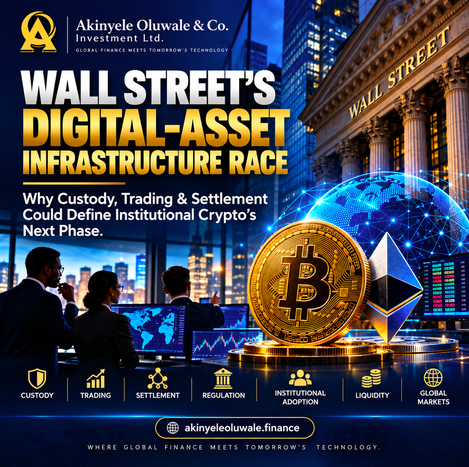
The next phase of institutional crypto may be defined less by which digital asset rises fastest and more by who builds the trusted infrastructure through which institutional capital can safely participate.
For much of crypto’s history, attention has centred on price.
Bitcoin rises. Bitcoin falls. Another cryptocurrency rallies. A new market cycle begins. Investors debate whether the next milestone will be $100,000, $150,000 or considerably higher.
Those movements matter to market participants, but they can distract from a quieter development that may ultimately prove more important to the long-term relationship between digital assets and traditional finance.
Large financial institutions are increasingly asking a different question.
Not simply:
Which crypto asset should we own?
But:
What infrastructure do we need if digital assets become a permanent part of global finance?
That question takes us beyond price and into custody, execution, regulation, settlement, risk management and institutional-grade market infrastructure.
Recent developments suggest that this transition is accelerating.
Deutsche Bank is preparing to launch its first digital-asset custody service, initially supporting major cryptocurrencies including Bitcoin and Ether. According to Reuters, the bank plans eventually to expand into stablecoin transactions, tokenized deposits and blockchain-based securities issuance. Importantly, Deutsche Bank describes these services as complementary to traditional banking rather than replacements for it.
At the same time, regulators are adapting.
The U.S. Securities and Exchange Commission proposed a new framework in October intended to provide investment advisers and regulated funds with clearer pathways for holding crypto assets.
Taken together, these developments point toward an important shift:
Institutional crypto is increasingly becoming an infrastructure story.
The institutional digital-asset market appears to be entering a different stage of development. The first stage was largely about observation. Traditional financial institutions watched Bitcoin and the wider crypto market develop outside the established banking system.
The second stage involved exposure.
Institutional investors began examining ways of gaining access to digital assets through investment products, funds and other regulated structures.
The emerging stage is different.
Financial institutions increasingly need the operational infrastructure required to hold, transfer, trade, settle and manage digital assets within regulated environments.
That means the institutional conversation is broadening from:
“Should we have crypto exposure?”
to:
“How do we build digital assets into financial infrastructure safely?”
This distinction matters.
An institutional market cannot depend solely on rising prices.
It needs custody.
It needs compliance.
It needs liquidity.
It needs execution.
It needs reliable settlement.
It needs operational resilience.
And, perhaps above everything else, it needs trust.
The institutional crypto opportunity therefore increasingly follows a chain:
Regulatory Clarity → Institutional Trust → Custody → Trading Infrastructure → Liquidity → Adoption → Scale
The institutions that successfully build these layers may occupy strategically important positions if digital assets continue moving deeper into mainstream finance.
Consider what happens when an individual decides to own a digital asset. The individual can create a wallet, purchase the asset and take responsibility for holding it.
A large financial institution operates very differently.
Imagine an asset manager responsible for billions of dollars belonging to pension funds, corporations, institutions and individual investors.
It cannot simply write down a recovery phrase and place it somewhere safe.
Questions immediately emerge.
Who legally controls the asset?
Where is it held?
How are private keys protected?
Who is authorised to approve transactions?
What happens if an employee leaves?
How are client assets segregated?
How are transactions recorded?
What happens if technology fails?
How are regulators satisfied that assets actually exist?
How are operational risks monitored?
How does the institution demonstrate compliance to auditors?
This is why custody is not merely a technical problem.
It is an institutional problem.
The SEC’s current custody initiative reflects this reality. Its October proposal seeks to modernise rules governing how registered investment advisers and regulated funds can safeguard crypto assets, including circumstances involving self-custody and state trust companies.
One SEC commissioner summarised the underlying principle particularly well: safeguarding client assets remains fundamental even though the mechanics of safeguarding assets recorded on distributed ledgers may differ from protecting traditional paper certificates.
The technology changes.
The responsibility does not.
Several developments are beginning to converge. First, major banks are moving closer to direct digital-asset services. Deutsche Bank’s planned custody launch is particularly significant because the strategy extends beyond simply storing Bitcoin.
The bank plans a phased expansion involving major cryptocurrencies, stablecoins, tokenized deposits and potentially blockchain-based securities issuance. That tells us something important about how major financial institutions may increasingly view the digital-asset opportunity. They may not see Bitcoin, stablecoins, tokenized deposits and digital securities as completely separate businesses. They can increasingly become different parts of a broader digital-finance infrastructure.
Second, U.S. regulators are creating clearer pathways for institutional participation. The SEC’s proposed crypto-custody rules are intended to address uncertainty facing investment advisers and regulated funds whose clients seek digital-asset exposure.
The Office of the Comptroller of the Currency had already clarified that national banks and federal savings associations may engage in crypto-asset custody and certain execution services, subject to appropriate risk management and legal requirements.
More recently, the OCC issued its final rule implementing major elements of the GENIUS Act for payment stablecoins, including standards covering reserve backing, redemption and risk management.
The direction is becoming clearer.
Digital assets are moving into an environment where traditional questions of regulation, custody, governance and risk management increasingly matter.
The most interesting part of institutional crypto may no longer be crypto itself. It may be the gradual convergence of traditional and digital financial infrastructure. For years, the dominant narrative presented the relationship as a competition:
Crypto versus banks.
Blockchain versus traditional finance.
Decentralisation versus institutions.
Reality is becoming more complicated.
Banks can provide digital-asset custody.
Traditional financial institutions can operate blockchain infrastructure.
Regulated entities can provide crypto execution.
Commercial banks can experiment with tokenized deposits.
Capital markets can explore tokenized securities.
Central banks can provide settlement infrastructure for tokenized markets.
The Bank for International Settlements recently highlighted how tokenization can potentially bring issuance, trading, clearing, settlement, custody and asset servicing into shared digital environments. But it also emphasised that these markets require safe and scalable settlement assets.
This suggests that the future may not be:
Traditional Finance OR Digital Finance
but increasingly:
That is a fundamentally different investment and institutional thesis.
If institutional crypto continues developing in this direction, investors should pay attention to more than cryptocurrency prices. The infrastructure surrounding digital assets may become increasingly important. Consider the institutional value chain:
Asset Creation
↓
Custody
↓
Trading & Execution
↓
Liquidity
↓
Settlement
↓
Reporting & Compliance
↓
Risk Management
↓
Institutional Adoption
Every layer solves a different problem and each layer must work reliably if large pools of capital are going to participate. This is why custody deserves more attention than it often receives.
Custody is where ownership meets trust.
Without credible custody arrangements, institutions may hesitate to allocate meaningful capital regardless of how attractive an underlying asset appears but custody alone is not enough.
Institutional markets also need deep liquidity, efficient execution, clear legal ownership, reliable settlement and strong risk controls. The real institutional opportunity therefore extends well beyond simply buying cryptocurrency.
It involves building the financial machinery around digital assets.
For Akinyele Oluwale & Co. Investment Ltd., the most important signal is not that traditional finance has suddenly embraced everything associated with crypto.
It has not.
Nor should every institutional announcement automatically be interpreted as evidence that mass adoption is inevitable.
The more disciplined interpretation is that the relationship between regulated finance and digital assets is becoming more structured.
Regulators are defining rules.
Banks are developing custody capabilities.
Financial institutions are experimenting with tokenized money and assets. Market infrastructure is evolving and risk management is moving closer to the centre of the conversation.
That is how financial systems usually mature.
Not through excitement alone.
Through infrastructure.
Through standards.
Through regulation.
Through liquidity.
Through operational resilience.
And ultimately through trust.
Our institutional framework therefore becomes:
The sequence matters because institutional capital rarely moves sustainably on enthusiasm alone. It moves when the infrastructure surrounding an opportunity becomes sufficiently reliable.
That leads to our central editorial principle:
Institutions cannot allocate capital at scale to infrastructure they cannot trust.
And another:
The institutional crypto era may ultimately be defined less by crypto replacing traditional finance—and more by digital assets becoming integrated into it.
Several developments deserve close attention.
Watch whether more globally significant banks launch direct custody services rather than relying entirely on specialist crypto companies.
The greater the participation of regulated financial institutions, the more competitive the custody market could become.
The SEC’s proposed custody framework remains important because institutional participation depends heavily on clear rules governing how client assets may be held and protected.
The Basel Committee is reviewing elements of its prudential standard governing banks’ exposures to cryptoassets and expects to provide an update by the end of 2026.
This deserves attention because institutional adoption is affected not only by whether banks are legally permitted to participate, but also by the capital and risk-management treatment attached to that participation.
The lines between crypto infrastructure and payment infrastructure may continue to blur.
Banks experimenting with tokenized deposits and institutions exploring regulated stablecoins could create new connections between traditional money and blockchain-based markets.
This could become one of the most important areas.
Institutional markets need certainty that the transfer of an asset and the transfer of payment can occur reliably and finally.
A financial system containing hundreds of isolated digital networks could simply recreate fragmentation in a new technological form.
Institutional-scale digital finance therefore requires networks capable of communicating safely and efficiently.
BIS-related work has repeatedly highlighted interoperability and trusted settlement as important foundations for scaling tokenized markets.
1. Institutional crypto is moving beyond simple exposure.
The conversation increasingly includes custody, execution, settlement, compliance and infrastructure.
2. Major banks are becoming more directly involved.
Deutsche Bank’s planned digital-asset custody launch is another example of regulated financial institutions developing their own capabilities.
3. Regulation is becoming part of the infrastructure.
Clear custody and risk-management rules can help determine how institutional capital participates.
4. Custody is fundamental.
Institutional adoption cannot scale sustainably without credible systems for safeguarding assets and demonstrating control.
5. Digital assets and traditional finance are increasingly converging.
The emerging model may involve integration rather than replacement.
6. Price is only one part of the story.
Bitcoin’s market value may attract attention, but the infrastructure being constructed around digital assets may tell us more about their long-term institutional relevance.
7. Trust remains the foundation.
Technology can create new financial rails.
Institutions will use those rails at scale only when governance, security, regulation and operational resilience are strong enough to support them.
Akinyele Oluwale & Co. Investment Ltd. provides financial intelligence focused on the intersection of global finance, institutional capital and emerging technology.
Our coverage spans:
Artificial Intelligence
Blockchain & Technology
Crypto & Digital Assets
Institutional Finance
Stablecoins & Payments
Tokenization & Real-World Assets
Central Banks
Macro & Global Markets
Our objective is not simply to report financial headlines. We seek to understand the forces underneath them.
Where is capital moving?
What infrastructure is being built?
Which technologies are moving from experimentation toward institutional adoption?
What risks remain?
And what developments could ultimately create sustainable economic value?
The evolution of institutional crypto illustrates why these questions matter.
The headline may be Bitcoin.
But underneath Bitcoin sits an expanding network of custody providers, banks, regulators, exchanges, payment systems, settlement infrastructure and institutional investors.
That infrastructure may ultimately determine whether digital assets remain a specialised financial market or become a lasting component of the global financial system.
For investors and institutions, therefore, the question is becoming larger than:
What will Bitcoin trade at next?
The more important long-term question may be:
Observe the change. Understand the implications. Position with discipline.
Akinyele Oluwale & Co. Investment Ltd.
Where Global Finance Meets Tomorrow’s Technology.
akinyeleoluwale.finance
This publication is provided for educational and informational purposes and does not constitute individualized investment, financial, legal or tax advice.