

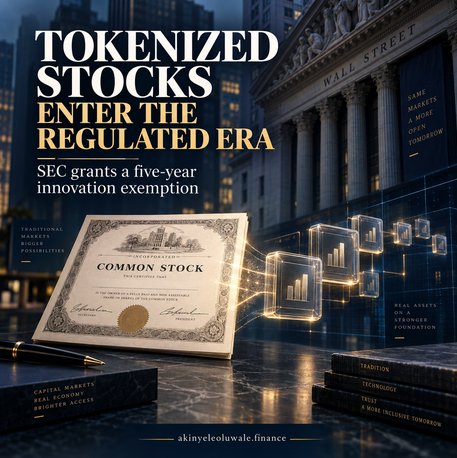
Tokenized Stocks Enter the Regulated Era: Why the SEC’s Five-Year Exemption Matters
Published: September 18, 2026
Category: Tokenization & RWAs / Institutional Finance
By: Akinyele Oluwale
Executive Summary
The United States Securities and Exchange Commission has introduced a five-year regulatory exemption for eligible platforms and liquidity providers involved in tokenized-stock trading. The development represents a significant step towards integrating blockchain-based securities into the regulated American capital market.
The most important feature of the framework is not simply the possibility of round-the-clock stock trading. It is the requirement that eligible tokenized stocks preserve the legal and economic rights associated with conventional share ownership.
Qualifying instruments must provide rights such as dividends and shareholder voting. Synthetic tokens that merely reproduce the market price of a company’s shares without granting actual ownership are excluded. Platforms must also notify companies before listing tokenized versions of their shares, while issuers retain the right to object.
The exemption could accelerate the development of blockchain-based trading, settlement, custody and collateral infrastructure. However, it also raises important questions concerning liquidity, cybersecurity, investor protection, corporate actions and legal ownership.
The five-year period should be understood as a controlled regulatory experiment. It will test whether tokenization can improve capital-market infrastructure without weakening the protections attached to securities ownership.
Background
Tokenization is the process of representing ownership or economic rights in an asset through a digital token recorded on a blockchain or distributed ledger.
In capital markets, tokenization can be applied to shares, bonds, money-market instruments, real estate, investment funds and other financial assets. The objective is generally to make these assets easier to issue, transfer, settle, divide and use as collateral.
However, the term “tokenized stock” has frequently been applied to products with very different legal structures.
Some tokenized-stock products represent an enforceable ownership interest in an underlying share. Others are synthetic instruments that merely follow the price of a listed company without granting the investor ownership, voting rights or a direct claim on the company.
This difference is fundamental.
An investor holding a synthetic token linked to a company’s share price may benefit when that price rises. However, that investor may not legally be a shareholder. The investor may have no right to vote, receive dividends directly or participate in a corporate action.
The SEC’s reported framework attempts to address this distinction by creating a temporary regulatory pathway for tokenized stocks that preserve traditional shareholder rights.
Eligible platforms and liquidity providers may receive relief from certain requirements, including aspects of dealer registration, for five years. The framework excludes synthetic tokens that merely replicate stock prices without conveying ownership.
Platforms are also expected to notify the relevant company before listing a tokenized version of its shares. If the company objects, the listing cannot proceed.
Why It Matters
The development matters because it moves tokenized equities closer to the centre of regulated finance.
Until now, much of the tokenized-stock market has operated outside the United States or through products whose legal connection to the underlying shares was unclear. This has limited institutional participation and created uncertainty for investors.
The SEC’s framework establishes an important principle: technology may change how an asset is issued, traded and settled, but it should not remove the legal protections attached to ownership.
This could provide regulated financial institutions with greater confidence to develop blockchain-based securities services.
Tokenized stocks could potentially support faster settlement, lower reconciliation costs and more efficient collateral management. They may also enable programmable corporate actions, including automated dividend distributions and shareholder voting.
Another important benefit is extended market access. Conventional stock markets operate during defined trading hours, while blockchain networks can operate continuously. Subject to appropriate liquidity and risk controls, tokenized equities could allow investors to transfer or trade eligible securities outside traditional exchange hours.
However, continuous trading does not automatically produce better markets. Liquidity may be weaker outside normal trading periods, increasing volatility and transaction costs. Regulators and platforms must therefore balance accessibility with market stability.
Stakeholders: Winners and Losers
Potential winners
Regulated digital-asset platforms: Exchanges that can satisfy securities, custody and compliance requirements may gain access to a new category of regulated financial products.
Traditional brokerages: Brokerages that adopt blockchain infrastructure could expand trading hours, improve settlement efficiency and offer new services to clients.
Institutional custodians: Tokenized securities will require secure custody arrangements that connect blockchain records with legally recognised ownership.
Tokenization companies: Providers specialising in digital issuance, transfer-agent services, smart contracts and asset administration could experience increased institutional demand.
Blockchain networks: Networks capable of delivering security, reliability, privacy and regulatory controls may become important infrastructure for tokenized capital markets.
Stablecoin and tokenized-deposit providers: Blockchain-based securities markets will require reliable settlement assets. Regulated stablecoins and tokenized bank deposits may therefore benefit from increased institutional usage.
Investors: Properly designed tokenized stocks could eventually provide investors with faster settlement, broader access and improved asset portability.
Potential losers
Legacy market intermediaries: Businesses that depend heavily on slow settlement processes, fragmented record-keeping or manual reconciliation may face pressure on their existing revenue models.
Synthetic-token operators: Platforms offering stock-price exposure without genuine ownership rights could struggle to compete with regulated tokenized equities.
Unprepared exchanges and brokers: Institutions that fail to modernise their infrastructure may lose market share to more technologically capable competitors.
Weak blockchain networks: Networks unable to meet institutional standards for security, compliance, reliability and transaction finality may be excluded from serious tokenization activity.
Short-Term Impact
In the short term, the announcement is likely to increase investment and strategic activity across the tokenization sector.
Crypto exchanges, brokerages, custodians and financial-technology firms will examine whether they qualify for the exemption and what changes are required to participate. Companies that already possess securities-market licences, institutional custody capabilities and compliance infrastructure will hold an advantage.
The market may also experience speculative interest in tokens associated with real-world assets and blockchain infrastructure. Investors should treat such movements cautiously. A regulatory development supporting tokenized securities does not automatically create value for every project using the RWA label.
Traditional listed companies may initially respond conservatively. Some issuers may welcome tokenization as a way to broaden access to their shares, while others may object because of concerns about fragmented liquidity, market manipulation, brand control or shareholder administration.
The first approved platforms and participating issuers will therefore be important indicators of the programme’s credibility.
Long-Term Impact
Over the longer term, the exemption could contribute to a restructuring of capital-market infrastructure.
Blockchain-based systems may gradually reduce the separation between trading, clearing, settlement, custody and asset servicing. A security could potentially be issued, transferred, settled and used as collateral through interoperable digital infrastructure.
This could reduce settlement risk and operational duplication. Financial institutions currently maintain separate records across brokers, exchanges, custodians, clearing houses and transfer agents. Shared digital records could reduce some of this reconciliation burden.
Tokenized equities may also become programmable. Dividends, voting rights, ownership restrictions and compliance requirements could be incorporated into the infrastructure governing the asset.
However, tokenization will not eliminate the need for trusted institutions. Regulated custodians, legal registries, compliance providers and market supervisors will remain essential.
The likely future is therefore not complete decentralisation. It is the gradual adoption of blockchain technology within regulated financial markets.
International competition will also intensify. The United States, European Union, United Kingdom, Singapore, Hong Kong and the United Arab Emirates are all developing different approaches to digital assets and tokenized finance. Jurisdictions that combine regulatory clarity with credible market infrastructure may attract more issuers, investors and technology providers.
Editorial Perspective
The SEC’s decision should be viewed as an important institutional development, but not as evidence that every tokenized asset has become legitimate or investable.
The central question is not whether an asset appears on a blockchain. The central question is what legally enforceable right the token represents.
A digital token that follows the price of a share is not necessarily a share. Technology cannot substitute for ownership rights, credible custody or investor protection.
The SEC’s distinction between genuine tokenized equity and synthetic price exposure is therefore necessary. Tokenization should improve the infrastructure of ownership rather than create weaker imitations of established financial assets.
The five-year exemption is also a sensible regulatory approach because it provides room for innovation without immediately making the framework permanent. Regulators can observe how tokenized-stock markets perform under real conditions and adjust the rules where necessary.
For African economies, including Nigeria, the development offers valuable lessons. Tokenization could eventually expand access to investment products, improve capital formation and reduce administrative costs. However, governments and regulators must first clarify ownership, custody, settlement, disclosure and investor-protection rules.
Without these foundations, tokenization may increase speculation without improving financial inclusion or productive investment.
What to Watch Next
Investors and institutions should monitor:
1. The first platforms admitted under the exemption;
2. Which listed companies consent to tokenization;
3. Whether major issuers formally object;
4. The blockchains selected for issuance and settlement;
5. How custody and beneficial ownership are structured;
6. The treatment of dividends, voting and corporate actions;
7. The level of institutional liquidity available;
8. Whether tokenized shares can be used as collateral;
9. Access rules for international investors;
10. The response of traditional exchanges and brokerages;
11. Any cybersecurity or smart-contract incidents; and
12. Whether the exemption becomes a permanent regulatory framework after five years.
The quality of the first tokenized-stock products will matter more than the number of products launched. Strong legal rights, credible custody and reliable settlement will determine whether the market gains institutional trust.
Notes
* The five-year exemption applies to eligible platforms and liquidity providers participating in compliant tokenized-stock trading.
* Qualifying tokenized stocks are expected to preserve conventional shareholder rights, including dividends and voting privileges.
* Synthetic tokens that merely track stock prices without granting ownership are excluded.
* Platforms must notify issuers before listing tokenized versions of their shares.
* An issuer’s objection may prevent the proposed tokenized listing.
* The exemption should not be interpreted as unrestricted approval for all tokenized-stock products.
* Market participants must continue to evaluate custody, liquidity, cybersecurity, smart-contract and legal-ownership risks.
* This publication is for educational and informational purposes and does not constitute investment, legal or financial advice.
Akinyele Oluwale & Co. Investment Ltd.
Where Global Finance Meets Tomorrow’s Technology.