

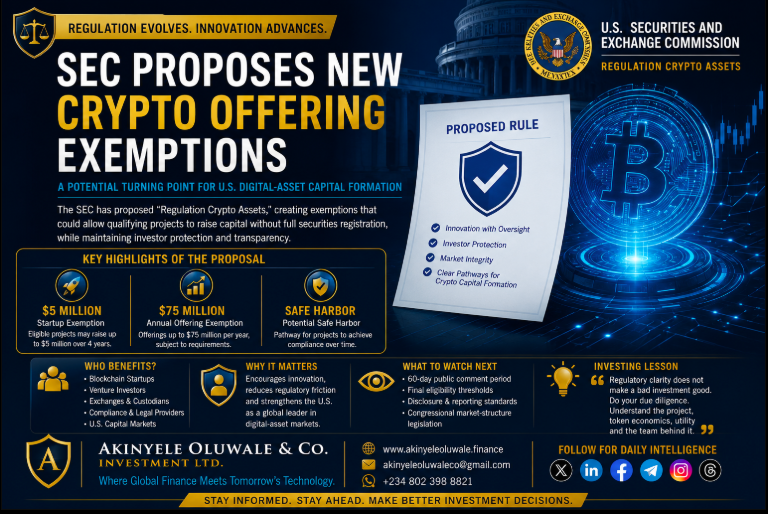
SEC Proposes New Crypto Offering Exemptions: A Potential Turning Point for U.S. Digital-Asset Capital Formation
The U.S. Securities and Exchange Commission has proposed a dedicated framework that could allow qualifying crypto projects to raise capital without navigating the full traditional securities-registration process. It is potentially significant—but this is a proposal, not yet final law, and investor protections remain central to the debate.
Published: 19 August 2026
Category: Crypto & Digital Assets • Regulation • Market Intelligence
By: Akinyele Oluwale & Co. Investment Ltd.
Executive Summary
The SEC has taken one of its clearest steps yet toward building a regulatory framework specifically designed for crypto.
On August 18, the Commission proposed “Regulation Crypto Assets,” creating exemptions for certain offerings involving crypto assets that are investment contracts. SEC Chairman Paul Atkins described the approach as an attempt to develop “fit-for-purpose” rules for crypto markets. (SEC)
Among the headline provisions are a startup exemption permitting qualifying projects to raise up to $5 million over four years, and a broader fundraising exemption allowing offerings of up to $75 million annually, subject to disclosure and other requirements. The proposal also includes a potential safe-harbor pathway. (Reuters)
This could represent an important shift:
from forcing crypto into old regulatory structures toward designing rules around how digital assets actually work.
What Happened?
The SEC formally proposed a crypto-specific offering regime covering certain “covered investment contracts” associated with crypto assets. Commissioner Mark Uyeda said the objective is to provide rules that entrepreneurs and market participants can rely upon. (SEC)
The proposal does not simply declare crypto offerings unregulated.
Instead, it creates alternative pathways under which qualifying issuers could avoid full securities registration while still meeting disclosure, reporting and eligibility requirements. (SEC)
That distinction matters.
Exemption does not mean absence of regulation.
It means potentially replacing a traditional framework with one more closely tailored to blockchain-based capital formation.
Background
For years, one of America's biggest crypto problems has been regulatory uncertainty.
Projects have struggled with fundamental questions:
Is the token itself a security?
Does an investment contract surrounding its initial distribution permanently determine the token's legal status?
How can a blockchain project raise capital legally while progressing toward decentralisation?
Earlier this year, the SEC issued an interpretation distinguishing among categories of crypto assets and explaining how federal securities laws apply to certain transactions. The new proposal goes further by addressing how qualifying projects could actually raise capital. (SEC)
Meanwhile, broader market-structure legislation remains unresolved in Congress, increasing the importance of agency-level action. (Reuters)
Why It Matters
Capital formation is one of the foundations of innovation.
If legitimate blockchain startups cannot clearly understand how to raise money compliantly, founders may relocate, investors may remain cautious and innovation can migrate to friendlier jurisdictions.
A workable exemption could reduce that friction.
But easier fundraising also creates risk.
Crypto history contains enough failed projects, misleading token sales and outright fraud to demonstrate why disclosure and accountability cannot simply disappear.
The challenge is therefore not choosing between innovation and investor protection.
Good regulation must deliver both.
Winners & Losers / Key Stakeholders
Early-stage blockchain companies could become major beneficiaries if the final framework reduces legal uncertainty and compliance costs.
Crypto venture investors may gain clearer routes for financing emerging networks.
Law firms, regulated exchanges, custodians and compliance providers could also benefit as a more formal issuance ecosystem develops.
The pressure would fall on projects that depend on opacity.
If exemptions require meaningful financial, tokenomic and project disclosures, serious builders could gain credibility while weaker offerings face greater scrutiny.
Short-Term Impact
The immediate market impact should not be overstated.
This is a proposed rule, not a completed regulatory regime.
The proposal is expected to undergo a 60-day public-comment period following publication, during which industry participants, investors and other stakeholders can challenge or recommend changes. (Reuters)
Crypto companies will now examine the eligibility requirements, disclosure obligations and safe-harbor provisions closely.
Long-Term Impact
However, adopted effectively, Regulation Crypto Assets could help rebuild the United States as a more competitive jurisdiction for blockchain capital formation.
More importantly, it could begin separating two questions that crypto regulation has often blurred:
How should a project raise capital?
and
What does the resulting crypto asset become once the network is functional?
That distinction could prove fundamental to mature digital-asset markets.
There is one limitation, however: agency rules may not provide the permanence of legislation passed by Congress. A future administration could change regulatory direction more easily than it could repeal federal law. (Reuters)
Editorial Perspective
This is bigger than being “pro-crypto” or “anti-crypto.”
The real issue is whether regulation can recognise technological differences without abandoning financial discipline.
Trying to regulate every blockchain project exactly like a conventional corporation can create unnecessary friction.
But removing accountability entirely would recreate the worst excesses of earlier token markets.
The stronger path lies between those extremes:
Clear rules. Proportionate disclosure. Investor protection. Room to innovate.
What to Watch Next
Watch the SEC's final eligibility thresholds, disclosure requirements and safe-harbor conditions.
Also watch Congress.
The unresolved market-structure debate remains critical because SEC rulemaking alone cannot provide the same long-term certainty as legislation defining the respective roles of the SEC and CFTC. (Reuters)
Investing Lesson
Regulatory clarity does not make a bad investment good.
A compliant token can still fail.
Investors must still examine the project, token economics, governance, liquidity, utility and people behind it.
Regulation can improve the road. It cannot guarantee the destination.
Key Takeaways
The SEC is proposing tailored exemptions that could significantly change how qualifying U.S. crypto projects raise capital.
The framework potentially lowers regulatory friction while retaining disclosure requirements. (SEC)
Editorial Bottom Line
For years, America's crypto debate centred on enforcement.
The conversation is increasingly moving toward architecture.
If the SEC can create workable rules that protect investors without suffocating innovation, this proposal could become an important bridge between crypto entrepreneurship and regulated U.S. capital markets.
Notes
Primary sources: SEC — Proposed Regulation Crypto Assets; SEC Chairman Paul Atkins' statement; Reuters reporting on the proposal and the wider U.S. crypto regulatory environment. (Reuters)
Akinyele Oluwale & Co. Investment Ltd.
Where Global Finance Meets Tomorrow's Technology.