

For decades, the country has faced substantial infrastructure requirements, financing constraints and difficulties translating economic potential into broad-based prosperity.
Electricity remains essential to industrial development.
Digital connectivity is increasingly important for productivity.
Agriculture requires investment in processing, logistics and market access.
Small businesses need affordable financing.
And a growing population requires productive employment opportunities.
Addressing these challenges will require substantial investment.
But the critical question is not simply how much financing Nigeria can attract.
It is whether that financing can be converted into measurable economic value.
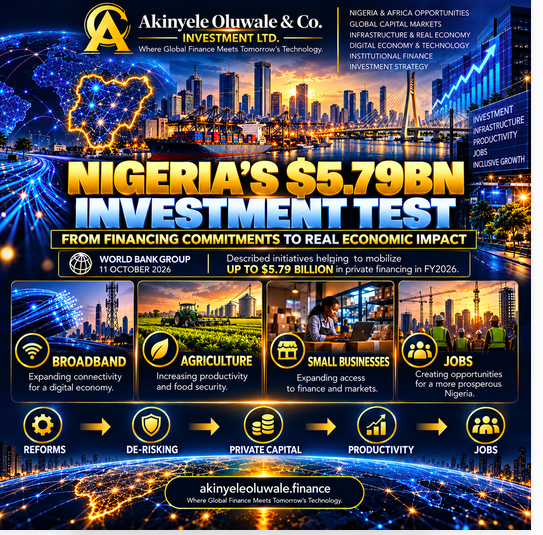
On 11 October, the World Bank Group highlighted initiatives helping mobilise up to $5.79 billion in private financing in fiscal year 2026.
The institution identified broadband connectivity, agricultural value chains, access to finance and economic opportunities as important areas of potential impact. World Bank
This development deserves attention.
However, investors and policymakers must distinguish between financing mobilisation and completed economic outcomes.
Mobilising capital is an achievement. Deploying it productively is the real test.
Nigeria's investment outlook is receiving renewed attention as international development institutions seek to attract greater private-sector participation.
The World Bank Group's latest update highlights a financing approach combining:
The objective is to reduce barriers that discourage private investment while directing capital toward productive economic activities.
The World Bank Group identifies its different institutions as complementary participants in this process.
The International Finance Corporation supports private-sector investment and financing structures.
The Multilateral Investment Guarantee Agency provides instruments designed to mitigate certain investment risks.
Other World Bank Group operations support reforms and development programmes that can improve investment conditions. World Bank
The emerging development framework is:
The effectiveness of this approach will depend on implementation, actual financing flows and measurable development outcomes.
Nigeria requires substantial investment to expand its productive capacity.
Government financing alone cannot sustainably meet every infrastructure and development requirement.
Public resources must support education, healthcare, security, infrastructure and other essential services.
At the same time, government borrowing creates future repayment obligations.
This makes private capital an important component of economic development.
Private investment can help finance projects, introduce technology, improve management practices and expand employment.
However, attracting private capital requires credible investment conditions.
Investors generally evaluate several factors:
Political and regulatory stability.
Currency and inflation risks.
Infrastructure availability.
Expected cash flows.
Legal and contractual protections.
Financing costs.
Long-term investment returns.
If these conditions are uncertain, investors may demand higher returns or avoid projects entirely.
This is where development-finance institutions can play an important role.
By supporting reforms, providing financing and mitigating certain risks, they can help make otherwise difficult investments more commercially viable.
But an important distinction remains:
Private capital mobilisation is not equivalent to immediate economic development.
Economic development occurs when financing is translated into functioning infrastructure, productive businesses and improved economic opportunities.
In its 11 October update, the World Bank Group described initiatives helping mobilise up to $5.79 billion in private financing in Nigeria during fiscal year 2026.
The institution emphasised how reforms, financing platforms and risk-mitigation instruments can encourage private investment. World Bank
The figure is significant.
However, it should not be interpreted as confirmation that $5.79 billion has already been paid into Nigeria or fully invested in completed projects.
Financing mobilisation, commitments, disbursements and realised development outcomes are different measures.
Understanding those differences is essential for credible financial analysis.
Digital connectivity is increasingly central to economic productivity.
Reliable broadband can support:
Digital payments.
Online education.
Business communication.
Financial technology.
Electronic commerce.
Remote professional services.
And wider participation in the digital economy.
Improved connectivity can reduce transaction costs and help businesses access larger markets.
However, infrastructure must be affordable and accessible to produce widespread economic benefits.
Agriculture remains an important component of Nigeria's economy.
But agricultural productivity depends on more than production volumes.
Farmers and agribusinesses need access to storage, processing, transportation, financing and reliable markets.
Investment across agricultural value chains can reduce inefficiencies and improve commercial opportunities.
The World Bank Group identifies stronger agricultural value chains as one of the potential benefits of its financing initiatives. World Bank
Micro, small and medium-sized enterprises play an important role in economic activity.
Yet many businesses face financing constraints.
Limited access to affordable credit can restrict inventory purchases, equipment investment and expansion.
Improving access to finance can support business productivity.
But credit expansion must be accompanied by responsible lending, financial management and appropriate risk assessment.
The development comes as global financial leaders gather in Bangkok for the IMF–World Bank Annual Meetings.
The meetings are taking place amid concerns about high public debt, energy-price pressures and expensive international financing.
The World Bank has also disclosed discussions with dozens of countries about potential support to manage economic shocks. Reuters
For Nigeria, the meetings provide an opportunity to examine how international financing can support sustainable economic development.
Nigeria's development-financing challenge is part of a wider global problem.
Many developing economies need substantial infrastructure investment.
Yet borrowing costs remain elevated.
Government budgets face competing demands.
And private investors remain sensitive to economic and political risks.
The result is a financing gap.
Closing that gap requires more than additional borrowing.
It requires mechanisms that can attract capital toward economically productive projects.
Three concepts are particularly important.
This involves attracting private investment toward projects or businesses, sometimes with support from development institutions.
The objective is to expand financing beyond available public resources.
Investors may avoid commercially promising projects because of currency, political, regulatory or implementation risks.
Appropriate guarantees, insurance and project structures can reduce certain risks.
However, these instruments cannot eliminate every risk.
Financing should ultimately support projects capable of delivering sustainable economic benefits.
Consider two hypothetical projects.
Project A attracts $500 million but experiences persistent delays and produces limited economic benefits.
Project B attracts $250 million, becomes operational and improves transportation efficiency for thousands of businesses.
The larger project is not automatically the better development outcome.
The quality of investment matters as much as its size.
Greater private investment could expand demand for banking services, project finance and corporate lending.
Banks may participate in financing infrastructure, agriculture and small-business development.
However, institutions must maintain appropriate credit standards.
Financing growth should not come at the expense of asset quality.
Infrastructure development could benefit from increased private-sector participation.
Priority areas include electricity, transportation, telecommunications and logistics.
Commercial viability and effective project execution remain essential.
Investment in agricultural processing, storage and distribution could improve productivity and market access.
The economic benefits will depend on implementation and the ability of businesses to operate profitably.
Expanded broadband infrastructure could support greater adoption of digital financial services.
Better connectivity can improve access to payments, banking and business technology.
However, digital inclusion also requires affordability, consumer protection and financial literacy.
Improved financing availability could support business expansion.
But the impact should be assessed through measurable outcomes, including business survival, productivity and employment.
Development-finance participation may improve the attractiveness of certain projects by reducing specific risks.
Nevertheless, international investors will continue evaluating currency stability, inflation, legal protections and expected returns.
A stronger pipeline of commercially viable projects could create opportunities for institutional financing.
However, the eventual impact on equity and debt markets will depend on actual project structures, investor participation and market conditions.
At Akinyele Oluwale & Co. Investment Ltd., we believe Nigeria's investment conversation must evolve beyond financing announcements.
The country needs capital.
But capital alone does not guarantee economic transformation.
What matters is the relationship between financing and productive outcomes.
This requires asking five questions.
First: How much financing has actually been committed?
Second: How much has been disbursed?
Third: Which projects and businesses have received the funds?
Fourth: What measurable economic outcomes have been achieved?
Fifth: Are those outcomes financially and economically sustainable?
These questions are particularly important when evaluating large development-finance announcements.
An investment programme should not be judged solely by its headline value.
It should also be assessed through:
Infrastructure delivered.
Businesses financed.
Employment supported.
Productivity improvements.
Economic sustainability.
And long-term development impact.
Our editorial framework is therefore:
The central lesson is straightforward.
Nigeria's development success will not be measured simply by how much capital it attracts, but by how productively that capital is deployed.
Eight indicators deserve particular attention.
1. Actual Financing Commitments
What proportion of the announced mobilisation translates into binding commitments?
2. Disbursement Progress
How much financing reaches eligible projects and businesses?
3. Infrastructure Delivery
Are financed infrastructure projects completed on schedule?
4. Private-Sector Participation
Are domestic and international investors increasing their participation?
5. MSME Financing
Are smaller businesses gaining meaningful access to appropriate financing?
6. Agricultural Productivity
Are investments improving processing, storage, market access and production efficiency?
7. Employment Outcomes
Are projects supporting productive and sustainable jobs?
8. Development-Finance Announcements
What additional financing initiatives or policy commitments emerge from the IMF–World Bank meetings?
These indicators will help determine whether Nigeria's investment momentum produces measurable economic benefits.
The World Bank Group has highlighted initiatives helping mobilise up to $5.79 billion in private financing for Nigeria in fiscal year 2026.
The financing approach connects reforms, investment opportunities and risk mitigation.
Broadband, agriculture and small-business financing are among the potential areas of impact.
However, financing mobilisation should not be confused with actual disbursement or completed development outcomes.
Private capital can support economic transformation when it finances productive projects.
The central framework is:
And the most important conclusion is:
Attracting capital is progress. Turning capital into productive economic value is development.
Akinyele Oluwale & Co. Investment Ltd. is a global finance and digital-economy intelligence platform focused on developments reshaping investment, financial markets and emerging technologies.
Our coverage includes:
Artificial Intelligence, Blockchain & Technology, Crypto & Digital Assets, Institutional Finance, Stablecoins & Payments, Tokenization & RWAs, Central Banks, and Macro & Global Markets.
We examine the relationship between global financial developments and their implications for investors, businesses and policymakers.
Our editorial framework is built around three questions:
What changed?
Why does it matter?
What should investors watch next?
Our objective is to promote informed analysis, financial understanding and disciplined investment thinking.
Akinyele Oluwale & Co. Investment Ltd.
Where Global Finance Meets Tomorrow's Technology.