

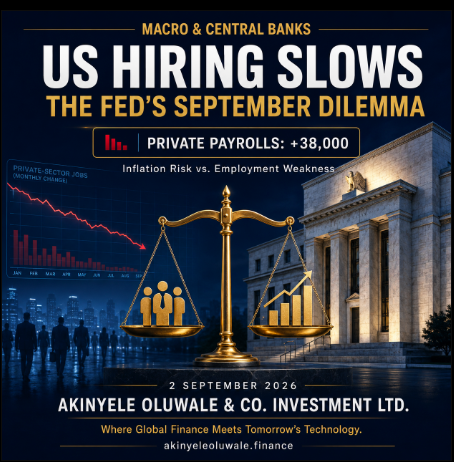
US Hiring Slows, Complicating the Federal Reserve’s September Decision
Published: 2 September 2026
Category: Macro & Global Markets • Central Banks
By: Akinyele Oluwale & Co. Investment Ltd.
Executive Summary
The US private sector added just 38,000 jobs in August, according to ADP below market expectations and weaker than July’s revised 46,000 increase.
The report points to a labour market that is still expanding, but with fading momentum. For the Federal Reserve, this creates an uncomfortable policy conflict: employment is weakening while inflation remains above target and energy prices are threatening another round of price pressure.
The Fed must now decide which risk requires greater attention persistent inflation or a deeper employment slowdown.
Background
August’s employment gains were heavily concentrated in a few areas. Education and health services added 45,000 jobs, while leisure and hospitality gained 16,000.
Those increases were partly offset by losses in manufacturing, professional and business services, information, trade and other sectors. Manufacturing alone reportedly shed 17,000 positions.
This uneven pattern suggests that headline employment growth may be masking weakness beneath the surface. Businesses are not conducting widespread layoffs, but many are becoming more cautious about hiring. Economists increasingly describe the environment as a “slow-hire, slow-fire” labour market.
However, the ADP report should not be treated as the final verdict. Its figures do not always move in line with the US Bureau of Labor Statistics’ official nonfarm-payroll report.
Why It Matters
The Federal Reserve has two principal responsibilities: maintaining price stability and supporting maximum employment.
When inflation is high and employment is strong, raising rates is easier to justify. When inflation falls and employment weakens, cutting rates becomes more straightforward.
The current environment offers neither comfort.
US inflation remains above the Fed’s 2% objective, while geopolitical and energy-market risks could keep prices elevated. At the same time, weaker hiring suggests that restrictive monetary policy may already be weighing on businesses.
An unnecessary rate increase could deepen the slowdown. But easing too early could allow inflation to regain momentum.
Stakeholders: Winners and Losers
Bond investors may benefit if weaker employment reduces expectations of further rate increases and pushes yields lower.
Rate-sensitive sectors including housing, technology and smaller companies could also receive temporary support if markets anticipate a more cautious Fed.
Workers, jobseekers and recruitment-dependent businesses face greater uncertainty. Manufacturing companies are particularly exposed to high financing, input and energy costs.
Banks may experience weaker loan demand if businesses delay expansion, while the US dollar could lose support if expectations shift towards easier monetary policy.
Short-Term Impact
Markets are likely to focus heavily on the official nonfarm-payroll report, unemployment rate, wage growth and revisions to earlier employment figures.
A further downside surprise could weaken the dollar, support government bonds and reduce the probability of a September rate increase.
Conversely, stronger official payrolls or renewed wage pressure could reverse that reaction quickly. The ADP report is an important warning, but not enough on its own to determine monetary policy.
Long-Term Impact
If subdued hiring continues, household income growth and consumer spending could weaken. That would eventually reduce inflation, but at the cost of slower economic activity.
A prolonged slowdown could also expose fragile corporate balance sheets, particularly among smaller businesses carrying expensive debt.
The central question is whether the labour market is gradually normalising or approaching a more serious contraction. The difference will shape US monetary policy well beyond September.
Editorial Perspective
Investors should resist the temptation to interpret every weak employment report as an automatic signal for rate cuts.
The Fed does not respond to a single number. It examines the combined direction of employment, inflation, wages, consumption and financial conditions.
The intelligent conclusion is not that a policy reversal is guaranteed. It is that the cost of another rate increase has risen.
In this environment, conviction should follow evidence not headlines.
What to Watch Next
Watch the official US employment report, unemployment claims, wage growth and payroll revisions.
Also monitor oil prices, core inflation and comments from Federal Reserve officials. If hiring continues to weaken while inflation remains persistent, the Fed may favour holding rates steady rather than committing to either tightening or easing.
Notes
This analysis draws on the [August ADP employment report and sector breakdown](https://www.reuters.com/business/us-private-payrolls-growth-slows-august-adp-says-2026-09-02/), the [Federal Reserve’s latest policy debate](https://www.reuters.com/commentary/reuters-open-interest/fed-minutes-show-september-rate-hike-still-table-2026-08-20/) and the Fed’s stated responsibility to monitor [risks on both sides of its dual mandate](https://www.federalreserve.gov/monetarypolicy/fomcminutes20260318.htm).
Akinyele Oluwale & Co. Investment Ltd.
Where Global Finance Meets Tomorrow’s Technology.