

The Next Economy Won't Wait for Humans: Why AI Agents and Blockchain Could Redefine Money
Published: August 2026
By: Akinyele Oluwale & Co. Investment Ltd.
Executive Summary
When people hear the word crypto, many still think about volatile token prices, speculative trading, and overnight gains. But according to macro investor Raoul Pal, that view is becoming increasingly outdated.
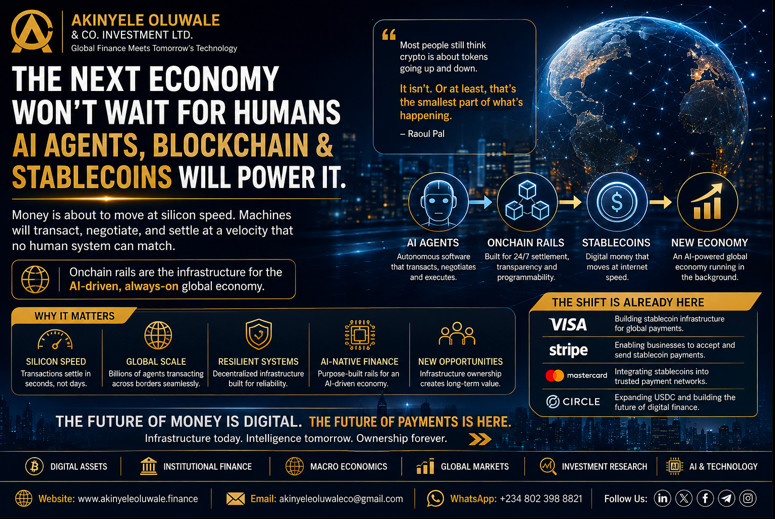
His argument is that the real transformation isn't about digital assets rising or falling in price. It's about creating a financial system capable of supporting an economy where artificial intelligence agents transact, negotiate, settle payments, and execute business operations autonomously. In that world, blockchain networks and stablecoins become the infrastructure that enables machines to exchange value at internet speed.
Whether or not one agrees with every aspect of that vision, it highlights an important shift in the conversation: the future of crypto may be defined less by speculation and more by infrastructure.
The Crypto Narrative Is Changing
For much of the past decade, cryptocurrencies have been judged largely by their market prices.
When Bitcoin rallied, interest surged.
When markets declined, many concluded the industry had failed.
That perspective is understandable.
Prices are visible.
Infrastructure is not.
Yet the technology powering digital assets has continued to evolve in the background.
Today, some of the world's largest financial institutions are exploring tokenised assets, stablecoins, blockchain settlement, and programmable money. Increasingly, the discussion is moving beyond what a token is worth to what the underlying technology can do.
An Economy Built by Software
Raoul Pal's central idea is that the next phase of the digital economy may be driven by AI agents rather than people.
Imagine software that can:
These tasks already exist in businesses today.
The difference is that they are largely initiated by humans.
As AI systems become more capable, some routine commercial activities could increasingly be automated.
If software is making decisions and completing transactions, it also needs a way to exchange value.
That raises an important question:
What payment system is best suited for machines?
Why Traditional Payment Systems Have Limits
Traditional banking infrastructure was designed for a human economy.
Banks operate within business hours.
Cross-border transfers can take days.
Settlement often involves multiple intermediaries.
Compliance checks occur at several stages.
For consumers, these systems work reasonably well.
For autonomous software executing thousands or potentially millions of transactions, they may prove less efficient.
Machine driven commerce could require payment systems that operate continuously, settle quickly, and communicate through programmable interfaces.
Blockchain Was Built for Continuous Operation
One of blockchain's defining characteristics is that it operates around the clock.
Transactions can be verified and settled without waiting for traditional banking hours.
Smart contracts can automatically execute agreements once predefined conditions are met.
Stablecoins can transfer value digitally without relying on conventional payment rails.
These characteristics explain why many technology companies and financial institutions are exploring blockchain infrastructure for future payment systems.
That does not necessarily mean traditional banking disappears.
Instead, blockchain may increasingly complement existing financial infrastructure.
Stablecoins Could Become Machine Money
Stablecoins are emerging as one of blockchain's strongest practical use cases.
Unlike more volatile cryptocurrencies, stablecoins are designed to maintain a relatively stable value by being linked to fiat currencies such as the U.S. dollar.
That makes them particularly suitable for payments.
If AI agents eventually perform commercial activities on behalf of businesses and individuals, stablecoins could provide a practical method for settling transactions digitally.
This is one reason why companies such as Visa, Mastercard, Stripe, and Circle have been investing in stablecoin infrastructure.
Regulation Will Face New Challenges
Raoul Pal also argues that regulation may struggle to keep pace with technological innovation.
History offers some support for that observation.
The internet evolved faster than many legal systems.
Social media expanded before comprehensive regulatory frameworks existed.
Artificial intelligence is now raising similar questions.
Digital assets are no exception.
Governments around the world are introducing new rules, licensing frameworks, and compliance standards.
However, technology often develops more rapidly than legislation.
That does not mean regulation is unnecessary.
Rather, it highlights the importance of creating rules that protect consumers while allowing innovation to continue.
Finding that balance will remain one of the defining policy challenges of the coming decade.
Ownership May Shift From Applications to Infrastructure
One of the more thought-provoking ideas in Pal's comments concerns value creation.
If blockchain networks become the foundation for future digital commerce, the greatest value may not lie only in individual applications.
Instead, value could increasingly reside in the infrastructure itself.
History provides similar examples.
The internet created enormous value for application companies, but it also rewarded businesses that built the underlying infrastructure from cloud computing providers to semiconductor manufacturers.
Blockchain infrastructure may follow a similar path.
What This Means for Investors
For investors, the message is not to assume that every cryptocurrency will succeed.
Rather, it is to recognise that the digital asset industry is evolving.
Increasingly, institutional investors are paying attention to:
These areas represent practical applications rather than speculative narratives.
That distinction matters.
A Reality Check
It is important to separate long-term vision from present-day reality.
Fully autonomous AI economies do not yet exist.
Most commercial transactions still rely on traditional banking systems.
Regulation remains fragmented across jurisdictions.
Technical challenges around interoperability, privacy, cybersecurity, and governance are still being addressed.
The future described by Raoul Pal is therefore best understood as a potential direction rather than a certainty.
Whether it unfolds exactly as he predicts will depend on advances in AI, payments, regulation, and market adoption.
Final Thoughts
The biggest mistake investors can make is assuming that crypto is only about token prices.
Increasingly, the industry is becoming about infrastructure.
The conversation is shifting from speculation to utility.
From trading to settlement.
From digital coins to programmable money.
And from individual transactions to intelligent systems capable of interacting with one another.
Whether that transformation takes five years or fifteen, one thing is becoming clear:
The future of finance will likely be shaped by the technologies that enable value to move as efficiently as information.
Blockchain, stablecoins, and artificial intelligence are no longer developing in isolation.
They are beginning to converge and that convergence may define the next generation of the global economy.
Key Takeaways