

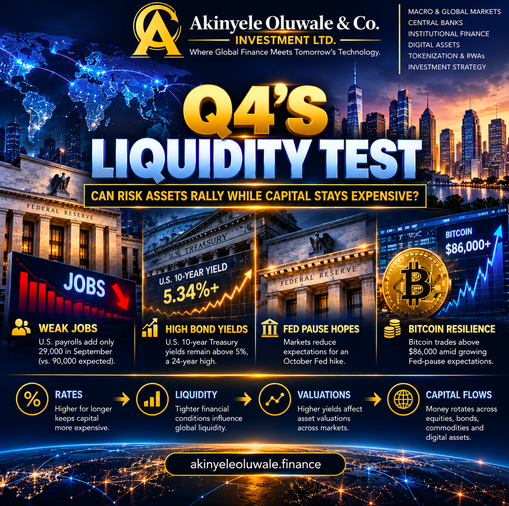
Q4's Liquidity Test: Can Risk Assets Rally While Capital Stays Expensive?
Published: October 5, 2026
Category: Home → Latest Intelligence → Macro & Global MarketsBy: By: Akinyele Oluwale
Q4 has opened with an unusual combination.
The U.S. labour market is weakening.
Expectations for an immediate Federal Reserve rate increase have fallen.
Yet government borrowing costs remain historically high.
At the same time, equities have remained remarkably resilient and Bitcoin recently traded above $86,000. Reuters
The resulting question is bigger than whether markets rise or fall this week:
Can risk assets continue appreciating if the cost of capital remains structurally expensive?
Understanding that tension requires following one of our core frameworks:
Global markets are entering Q4 with contradictory signals.
September U.S. nonfarm payrolls increased by only 29,000, substantially below the approximately 90,000 economists expected, while unemployment increased to 4.2%. That significantly reduced market expectations for another Federal Reserve rate increase at the October meeting. Reuters
But monetary relief is not guaranteed.
Inflation remains above target, energy prices remain elevated and government-bond yields are still historically high.
At the same time, risk assets are showing resilience.
Global equities weathered an extraordinary third quarter in which oil prices surged, sovereign borrowing costs increased and AI-related investment remained an important driver of markets. Reuters
Bitcoin has also participated in the risk rally, recently moving above $86,000 as expectations for an October Fed pause increased. Barron's
Investors therefore face an unusual environment:
Growth is weakening.
Inflation remains problematic.
Capital remains expensive.
But risk appetite has not disappeared.
That is Q4's liquidity test.
Asset prices don't operate independently of the financial system.
Capital has a price.
That price is influenced by interest rates and bond yields.
When safe government securities offer attractive yields, investors require stronger expected returns before accepting additional risk elsewhere.
The transmission mechanism looks like this:
This connects seemingly unrelated markets.
A change in Treasury yields can influence:
equities,
technology valuations,
corporate borrowing,
real estate,
currencies,
commodities,
Bitcoin,
and other digital assets.
The question for Q4 is therefore not simply whether the Federal Reserve pauses.
The more important question is:
A pause and an easing cycle are not the same thing.
That distinction matters enormously.
September U.S. employment growth slowed dramatically.
Payrolls increased by only 29,000, versus approximately 90,000 expected.
August's employment gain was also revised downward. Reuters
That weakened the case for another immediate Fed increase.
Reuters reported that markets moved toward roughly an 80% probability of no October rate increase following the employment report. Reuters
But that does not automatically mean rate cuts are coming.
Reuters' latest assessment suggests the Fed could skip October while retaining the possibility of another increase in December if inflation remains persistent. Reuters
That distinction is essential.
And:
The bond market remains under considerable pressure.
Government yields increased sharply during Q3 as investors confronted higher energy prices, inflation concerns and enormous capital requirements.
Reuters reported that U.S. 10-year Treasury yields moved above 5% during the quarter, reaching levels not seen since before the global financial crisis. Reuters
That means long-term financing conditions remain tight even while markets reduce expectations for another immediate Fed move.
This creates a crucial divergence:
Fed pause expectations
do not necessarily equal
cheap long-term capital.
Stocks have not responded to higher yields in the way some investors might have expected.
After the weak employment report, the Nasdaq rose about 1.2%, while broader U.S. equities also advanced as investors reduced expectations for an October Fed increase. Reuters
Bitcoin also recently crossed $86,000, supported partly by expectations that the Fed may delay further tightening. Barron's
So markets currently appear willing to look beyond expensive capital toward the possibility of improved future liquidity.
Whether that expectation proves correct is the central issue.
The bigger story is the battle between liquidity and the cost of capital.
Consider two competing forces.
Weaker employment
↓
Less pressure on the Fed
↓
Reduced rate-hike expectations
↓
Potential improvement in risk appetite
↓
Support for equities and digital assets
But simultaneously:
Persistent inflation
↓
Elevated government yields
↓
Higher financing costs
↓
Pressure on valuations
↓
Greater competition for investment capital
Markets are caught between these forces.
This is why simply asking whether the Fed will hike rates is insufficient.
Investors must monitor the entire financial transmission mechanism.
Our Day 26 analysis becomes especially relevant here.
AI infrastructure requires enormous capital.
Data centres need financing.
Semiconductors require investment.
Electricity generation and grids require capital.
Technology companies increasingly require access to debt markets.
Reuters reported that rising AI investment and energy pressures contributed to the extraordinary bond-market environment during Q3. Reuters
So we now have:
Governments competing for capital
Corporations competing for capital
AI infrastructure competing for capital
Households requiring credit
The supply and price of capital therefore become increasingly important.
Equities face two opposing forces.
Lower expectations for immediate monetary tightening can support valuations.
But elevated bond yields increase the discount rate applied to future corporate earnings.
Growth stocks can be particularly sensitive because a larger proportion of their expected economic value lies further in the future.
This means Q4 could increasingly separate:
companies generating real cash flows
from
companies valued mainly on distant expectations.
Bonds remain the market investors should watch closely.
If long-term yields continue increasing even while the Fed pauses, that would indicate that forces beyond short-term monetary policy are keeping capital expensive.
Those forces may include:
inflation,
fiscal borrowing,
energy prices,
term premiums,
and enormous private-sector capital requirements.
If yields instead decline sustainably, financial conditions could begin easing.
Bitcoin's recent move above $86,000 provides an interesting test.
Digital assets often respond strongly to changes in liquidity expectations.
The transmission mechanism is:
Lower expected rates → Better liquidity expectations → Higher risk appetite → Potential support for digital assets
But high long-term yields create competition for capital.
Investors can earn substantial returns from government securities without accepting the volatility associated with digital assets.
Bitcoin therefore faces two competing forces:
That battle deserves close attention.
Interest-rate expectations also influence currencies.
If investors expect U.S. monetary policy to become relatively less restrictive, the dollar could lose some support.
But high Treasury yields can simultaneously attract international capital.
Again, two forces are operating in opposite directions.
Oil remains particularly important because energy prices can affect inflation.
Brent crude recently traded around $102 per barrel, keeping the energy-inflation relationship firmly on investors' radar. Reuters
The transmission mechanism is straightforward:
Oil → Inflation → Central Banks → Rates → Liquidity → Markets
This is why energy remains central to our Q4 framework.
At Akinyele Oluwale & Co. Investment Ltd., our view is that investors should avoid confusing Fed pause expectations with abundant liquidity.
They are not the same thing.
A central bank can stop increasing its policy rate while financial conditions remain restrictive.
Long-term government yields can remain high.
Banks can maintain tight lending standards.
Corporate borrowing can remain expensive.
Governments can continue absorbing enormous amounts of global capital.
This distinction becomes particularly important for risk assets.
The investment question should therefore evolve from:
“Will the Fed pause?”
to:
“Is the cost and availability of capital actually improving?”
That is the more useful question.
And it leads to an important principle:
This applies to technology stocks.
It applies to AI companies.
It applies to real estate.
And it applies to digital assets.
Q4 could increasingly reward investors who distinguish between narrative-driven momentum and economically sustainable value.
The minutes from the Fed's September meeting should provide additional insight into policymakers' debate over inflation, financial conditions and future rate increases. Barron's
The U.S. 10-year yield remains one of our most important Q4 indicators.
Watch whether it remains above 5% or begins a sustained decline.
Services-sector data can provide evidence about whether economic weakness is spreading beyond employment.
Markets need evidence that inflation is moving sustainably toward target before expecting significant monetary easing.
Energy remains capable of changing the inflation narrative quickly.
The coming earnings season will test whether corporate fundamentals justify current equity valuations. Barron's
Investors should continue monitoring whether enormous AI spending translates into sustainable revenue and cash flow.
Bitcoin's ability to maintain momentum while Treasury yields remain elevated could reveal how strongly crypto investors are positioning for future liquidity improvement.
The U.S. labour market is weakening. September payroll growth was only 29,000. Reuters
An October Fed pause is increasingly expected, but that does not mean monetary easing has begun. Reuters
Long-term capital remains expensive, with Treasury yields at historically elevated levels. Reuters
Equities remain resilient despite the difficult bond-market environment.
Bitcoin has recently traded above $86,000, demonstrating renewed digital-asset risk appetite. Barron's
Oil remains an inflation wildcard, with Brent around $102 recently. Reuters
And today's central investment lesson is:
A Fed pause can change expectations. Only easier financial conditions change liquidity.
For Q4, investors should watch both.
Akinyele Oluwale & Co. Investment Ltd. is a global finance and digital-economy intelligence platform focused on helping investors, professionals and decision-makers understand the forces reshaping modern markets.
Our intelligence covers:
Artificial Intelligence • Blockchain & Technology • Crypto & Digital Assets • Institutional Finance • Stablecoins & Payments • Tokenization & RWAs • Central Banks • Macro & Global Markets
Our research is organised around three questions:
We connect developments across traditional finance, digital assets, macroeconomics and emerging technology to provide an integrated view of capital markets.
Information tells you what happened.