

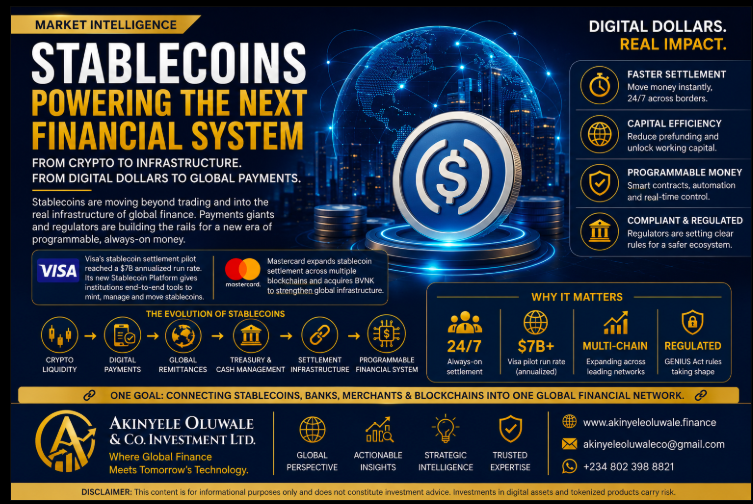
Stablecoins Are Becoming Financial Infrastructure as Visa, Mastercard and Regulators Accelerate the Shift
Stablecoins are moving beyond crypto trading and into the machinery of global payments. Visa is building infrastructure for institutions to mint, manage and move stablecoins, Mastercard is expanding stablecoin settlement, and U.S. regulators are translating the GENIUS Act into operating rules. The next battle is increasingly about who controls the rails through which digital dollars move.
Published: 21 August 2026
Category: Stablecoins & Payments • Digital Finance • Market Intelligence
By: Akinyele Oluwale & Co. Investment Ltd.
Executive Summary
Stablecoins are entering a new phase.
The important story is no longer simply how many USDT or USDC tokens exist. It is how deeply stablecoins are becoming embedded in payments, settlement, treasury operations and banking infrastructure.
Visa's stablecoin settlement pilot reached a $7 billion annualised run rate earlier this year, while its new Visa Stablecoin Platform gives financial institutions infrastructure for accessing, storing, redeeming, minting and burning stablecoins. (Visa Corporate)
Mastercard has simultaneously expanded its settlement capabilities to include regulated stablecoins across multiple blockchain networks and completed its acquisition of stablecoin infrastructure company BVNK in August. (Mastercard)
The message is increasingly clear:
Stablecoins are evolving from crypto instruments into financial infrastructure.
What Happened?
Visa and Mastercard are moving aggressively into stablecoin settlement.
Visa now supports multiple blockchain networks in its settlement infrastructure and is developing enterprise tools that allow banks, fintechs and payment companies to interact with stablecoins without building every component themselves. (Visa Corporate)
Mastercard is taking a similarly broad approach.
Its planned settlement capabilities include USDC, PYUSD, USDG, USDP, RLUSD and SoFiUSD across networks including Ethereum, Solana, Base, Polygon, Arbitrum, XRPL and others. (Mastercard)
Meanwhile, regulation is catching up.
Under the GENIUS Act, U.S. regulators are developing customer-identification, anti-money-laundering, sanctions-compliance and reporting requirements for permitted payment stablecoin issuers. The public-comment period for one important customer-identification proposal closes 21 August 2026. (Federal Reserve)
Background
Stablecoins originally became popular because crypto traders needed a digital representation of dollars that could move between exchanges.
That use case remains important.
But the market is expanding into something much larger:
Trading → Payments → Remittances → Treasury → Settlement → Programmable Money
Traditional international payments can involve correspondent banks, currency conversions, cut-off times and delayed settlement.
Stablecoins introduce the possibility of moving dollar-denominated value across blockchain networks continuously.
That is why payment companies are paying attention.
Why It Matters
The biggest advantage may not simply be speed.
It is capital efficiency.
Businesses operating internationally often keep money across multiple banks and jurisdictions to ensure payments can be completed.
If regulated stablecoin infrastructure reduces the amount of capital trapped in prefunding arrangements, companies could potentially use their working capital more efficiently.
Stablecoins also operate outside traditional banking hours.
Money doesn't need to understand weekends.
That makes digital settlement particularly attractive for global businesses operating continuously.
Winners & Losers / Key Stakeholders
Payment networks may become major winners if they successfully connect traditional money with blockchain settlement.
Banks can participate through issuance, custody, reserve management and tokenized deposits.
Stablecoin issuers gain larger distribution opportunities.
Blockchains compete to become settlement infrastructure.
Merchants and multinational businesses could eventually benefit from faster and more flexible movement of money.
But traditional intermediaries whose economics depend heavily on slow cross-border settlement may face pressure.
Short-Term Impact
The immediate competition will centre on distribution and integration.
Visa and Mastercard aren't trying simply to create another crypto product.
They are positioning themselves as bridges between fiat money, stablecoins, banks, merchants and blockchain networks.
Regulation will determine how quickly that bridge can scale.
The GENIUS Act created the legal foundation; implementing rules now have to make the framework operational. Some regulatory deadlines have already slipped, showing that legislation is only the beginning.
Long-Term Impact
The future financial system may not choose between bank deposits and stablecoins.
Both could coexist.
Imagine:
Bank Deposits + Stablecoins + Tokenized Deposits + CBDCs + Tokenized Assets
all connected through interoperable payment infrastructure.
Mastercard itself describes this emerging environment as a “multi-money world.” (Mastercard Investor Relations)
The winner may therefore not be one currency.
It may be the infrastructure capable of connecting them.
Editorial Perspective
Investors often ask:
“Which stablecoin will win?”
That may be the wrong question.
The bigger opportunity could lie in the rails connecting stablecoins with the existing financial system.
Watch payment networks.
Watch banks.
Watch blockchains.
Watch custodians.
Watch reserve managers.
And most importantly, watch settlement volume.
Stablecoin market capitalisation tells us how much digital money exists.
Settlement activity tells us whether that money is actually becoming useful.
What to Watch Next
Watch the final U.S. GENIUS Act regulations, Visa's search for additional settlement partners, Mastercard's integration of BVNK and the expansion of regulated non-dollar stablecoins.
Also watch accounting treatment.
Clearer accounting standards could make stablecoins easier for corporate treasurers and CFOs to use at scale.
Investing Lesson
Utility matters more than issuance.
A trillion dollars of stablecoins would mean little if those assets simply sat inside wallets.
The real transformation happens when digital dollars begin paying suppliers, settling transactions, moving collateral and managing treasury liquidity.
Follow usage not merely supply.
Key Takeaways
Stablecoins are progressing through a critical transition:
Crypto liquidity → Digital payments → Institutional settlement infrastructure.
Visa and Mastercard's strategies show that established payment networks increasingly view blockchain-based money as something to integrate rather than ignore. (Visa Corporate)
Editorial Bottom Line
The first stablecoin era was about creating digital dollars.
The next is about making those dollars useful everywhere money moves.
The biggest winners may not be those issuing the most tokens.
They may be those connecting stablecoins, banks, blockchains, businesses and traditional payment systems into one functioning financial network.
Stablecoins are no longer waiting outside traditional finance. They are becoming part of its plumbing.
Notes
Primary sources: Visa, Mastercard, Federal Reserve and OCC announcements and regulatory materials covering stablecoin settlement, infrastructure and implementation of the GENIUS Act. (Visa Corporate)
Akinyele Oluwale & Co. Investment Ltd.
Where Global Finance Meets Tomorrow's Technology.