

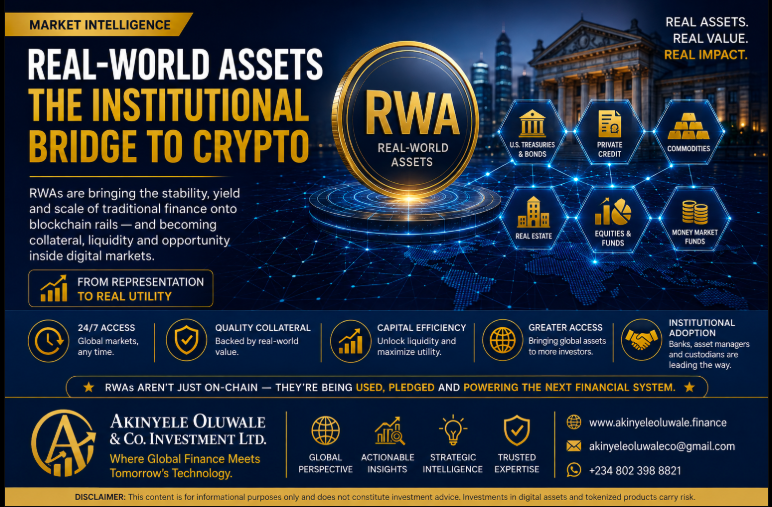
Real-World Assets Are Becoming Crypto’s Institutional Bridge as On-Chain Capital Accelerates
The RWA story is moving beyond simply “putting assets on blockchain.” Tokenized Treasuries, private credit, commodities and investment funds are increasingly being used inside digital markets. The important shift is from representation to utility: real-world assets are beginning to function as collateral, yield instruments and financial building blocks on-chain.
Published: 20 August 2026
Category: Tokenization & RWAs • Institutional Finance • Market Intelligence
By: Akinyele Oluwale & Co. Investment Ltd.
Executive Summary
Real-world assets, or RWAs, are becoming one of the strongest connections between traditional finance and blockchain.
RWA.xyz recently tracked roughly $38 billion in distributed tokenized assets, excluding stablecoins, with tokenized U.S. Treasuries and money market products representing the largest major category. The number of asset holders has also risen sharply. (RWA XYZ)
But market size isn't the most interesting development.
A recent CoinShares/Token Terminal analysis found that tokenized RWA deposits in lending platforms and decentralised exchanges more than tripled year on year from $2.3 billion to $7.4 billion even as overall DeFi deposits declined around 15%. (The Block)
That suggests something important:
RWAs are beginning to move from assets that simply exist on-chain to assets that are actually being used on-chain.
What Happened?
The RWA ecosystem has expanded across several asset classes.
Tokenized Treasury and money market products remain particularly important, while private credit, commodities, equities and other financial assets are developing alongside them. (On-Chain Finance)
Institutional participation is also deepening.
BlackRock recently expanded its tokenized cash management strategy in the United States and launched tokenized access to selected institutional money market funds in Europe. Its European initiative provides tokenized functionality across funds representing a combined $311 billion in assets under management across 15 markets. (BlackRock)
The RWA market is therefore becoming less crypto-native and increasingly connected to established financial products.
Background
An RWA token represents a claim on something that exists outside the blockchain.
That could be:
Treasury bills → Bonds → Private credit → Gold → Funds → Equities → Real estate
The blockchain doesn't magically create the underlying asset.
Instead, it can change how ownership is recorded, transferred, settled and potentially used as collateral.
That distinction is crucial.
A tokenized Treasury remains economically dependent on the Treasury securities behind it. A tokenized property remains dependent on the legal ownership and economics of the property.
The token is infrastructure. The underlying asset remains the source of value.
Why It Matters
The next stage of RWA adoption is utility.
Imagine an investor holding tokenized Treasury exposure.
Instead of that asset sitting passively in an account, blockchain infrastructure could potentially allow it to be transferred, pledged as collateral or integrated into lending and settlement systems.
That creates capital efficiency.
The emergence of RWAs as collateral across lending, margin, reserves and yield strategies is therefore more important than simply watching the total value tokenized. (The Block)
This is where traditional finance and DeFi begin to overlap.
Winners & Losers / Key Stakeholders
Asset managers can gain new distribution channels.
Banks and custodians can provide custody, settlement and compliance infrastructure.
Blockchains benefit when valuable financial assets generate transactions and economic activity on their networks.
DeFi platforms gain access to collateral backed by real-world cash flows rather than relying entirely on volatile crypto assets.
Investors could eventually gain broader access to assets previously restricted by geography, capital requirements or market structure.
But intermediaries built around inefficient settlement and fragmented ownership systems could face pressure.
Short-Term Impact
Tokenized Treasuries will probably remain the industry's strongest entry point.
They combine three things investors understand:
Liquidity + Yield + High-quality collateral.
But investors should resist assuming that tokenization automatically creates liquidity.
Recent academic research found significant differences in actual trading activity between tokenized asset categories, reinforcing that putting an asset on-chain does not guarantee an active secondary market. (arXiv)
Long-Term Impact
The bigger opportunity emerges when RWAs connect with stablecoins and tokenized deposits.
Imagine:
Tokenized assets + Digital cash + Smart contracts + 24/7 settlement.
A bond could generate yield, serve as collateral and settle against digital money within increasingly integrated infrastructure.
At that point, blockchain stops being merely a place where crypto trades.
It becomes part of the infrastructure through which global capital moves.
Editorial Perspective
Investors should avoid reducing the RWA opportunity to:
“Which RWA token will explode?”
That misses the bigger transformation.
Follow where the assets, liquidity, collateral and institutional infrastructure are moving.
The long-term winners may include asset managers, banks, custodians, stablecoin issuers, blockchains, exchanges and specialised infrastructure providers.
The opportunity is an ecosystem not necessarily one token.
What to Watch Next
Watch tokenized Treasury growth, private credit, institutional collateral adoption and the integration of RWAs into lending markets.
Most importantly, watch the relationship between RWAs and stablecoins.
Assets provide value.
Stablecoins provide settlement.
Connecting the two could become one of blockchain finance's most important developments.
Investing Lesson
Never confuse tokenization with value creation.
Putting an asset on blockchain doesn't improve its underlying economics.
A poor loan remains a poor loan.
A weak property remains a weak property.
But a quality asset placed on better infrastructure may become more accessible, transferable and useful.
Key Takeaways
RWAs are progressing from representation → distribution → utility.
The growth of RWA collateral inside lending and trading platforms suggests the market is beginning to discover what tokenized traditional assets can actually do. (The Block)
Editorial Bottom Line
Crypto spent its first era creating entirely new assets.
Its next era may bring trillions of dollars of existing assets onto programmable financial rails.
The real RWA revolution isn't simply putting the world on-chain.
It is making real-world value usable on-chain.
Sources / Notes
Market data and analysis: RWA.xyz, BlackRock, CoinShares/Token Terminal and recent institutional RWA research. (RWA XYZ)
Akinyele Oluwale & Co. Investment Ltd.
Where Global Finance Meets Tomorrow’s Technology.